Student team invents device to cut dialysis risk
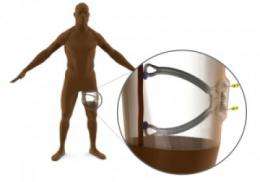
This illustration shows the Hermova Port attached to the femoral vein beneath the skin, where the student inventors say the risk of infection is reduced. Credit: Johns Hopkins University
Johns Hopkins University graduate students have invented a device to reduce the risk of infection, clotting and narrowing of the blood vessels in patients who need blood-cleansing dialysis because of kidney failure.
The device, designed to be implanted under the skin in a patient's leg, would give a technician easy access to the patient's bloodstream and could be easily opened and closed at the beginning and end of a dialysis procedure.
The prototype has not yet been used in human patients, but testing in animals has begun.
The students learned about the need for such a device last year while accompanying physicians on hospital rounds as part of their academic program. They watched as one doctor performed a procedure to open a narrowed blood vessel at a kidney patient's dialysis access site. They learned that this narrowing was a common complication facing kidney patients.
The students discovered that kidney failure each year requires 1.5 million people globally and 350,000 in the United States alone to undergo regular hemodialysis to prevent a fatal buildup of toxins in the bloodstream. The students also learned that the three most common ways to connect the machine to a patient's bloodstream work only for a limited time because of problems with infection, blood clots and narrowing of the blood vessels. Current dialysis access options are "grossly inadequate," contributing to increased healthcare expenses and, in some cases, patient deaths, the students say.
To address these problems, the students developed an access port that can be implanted in the leg beneath the skin, reducing the risk of infection. The Hemova Port's two valves can be opened by a dialysis technician with a syringe from outside the skin. The technician can similarly close the valves when the procedure is over, an approach that helps avoid infection and clotting. The device also includes a simple cleaning system, serving as yet another way to deter infections.
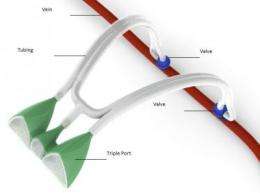
An illustration of a closeup view of the Hemova Port, connected below the skin in the patient's leg to a femoral vein. Credit: Johns Hopkins University
Currently, most dialysis access sites are in the arm or the heart. The Hemova device instead is sutured to the leg's femoral vein, avoiding the unnaturally high blood flows that cause vessel narrowing when dialysis machines are connected to veins and arteries in the arm. The student inventors say the Hemova Port's leg connection should allow the site to remain in use for a significantly longer period of time.The port won a $10,000 first prize for Johns Hopkins graduate students in the 2011 ASME Innovation Showcase. The competition, involving 10 collegiate teams, was conducted in Texas earlier this month at the annual meeting of ASME, founded in 1880 as the American Society of Mechanical Engineers. Judges based their awards on technical ingenuity, quality of business plans, potential for success in the marketplace and other factors.
The five biomedical engineering students on the team were enrolled in a one-year master's degree program in the university's Center for Bioengineering Innovation and Design. Sherri Hall, Peter Li, Shishira Nagesh, Mary O'Grady and Thora Thorgilsdottir all recently graduated, but Li has remained in Baltimore to form a company that will continue to test and develop the project.
With help from the Johns Hopkins Technology Transfer staff, the team has filed for three provisional patents covering their technology. The patents list the five students and three medical faculty advisers as the inventors.
"Winning first-place in the ASME competition is a great honor," Li said. "The award and the recognition will go a long way toward helping to continue further research, and we hope it will bring us closer to the day when our device is available to help dialysis patients."
The Hemova team has applied for a $50,000 grant to conduct more animal testing in the coming months. Clinical trials involving human patients could begin as soon as 2013, the students said.
Provided by
Johns Hopkins University
-
Knowledge unlocks key to healthier options for dialysis patients
Apr 23, 2009 |
not rated yet |
0
-
Canadian researchers discover new way to prevent infections in dialysis patients
Jan 26, 2011 |
not rated yet |
0
-
Study finds new stent improves ability to keep vessels open for dialysis patients
Feb 10, 2010 |
not rated yet |
0
-
Reducing blockage fails to improve access to the bloodstream for kidney dialysis
May 22, 2008 |
not rated yet |
0
-
Clinical Trial Examines Gene Therapy for Dialysis Patients
May 19, 2010 |
not rated yet |
0
-
Motion perception revisited: High Phi effect challenges established motion perception assumptions
Apr 23, 2013 |
3 / 5 (2) |
2
-
Anything you can do I can do better: Neuromolecular foundations of the superiority illusion (Update)
Apr 02, 2013 |
4.5 / 5 (11) |
5
-
The visual system as economist: Neural resource allocation in visual adaptation
Mar 30, 2013 |
5 / 5 (2) |
9
-
Separate lives: Neuronal and organismal lifespans decoupled
Mar 27, 2013 |
4.9 / 5 (8) |
0
-
Sizing things up: The evolutionary neurobiology of scale invariance
Feb 28, 2013 |
4.8 / 5 (10) |
14
-
Classical and Quantum Mechanics via Lie algebras
Apr 15, 2011
- More from Physics Forums - Independent Research
More news stories
ACP issues recommendations for management of high blood glucose in hospitalized patients
High blood glucose is associated with poor outcomes in hospitalized patients, and use of intensive insulin therapy (IIT) to control hyperglycemia is a common practice in hospitals. But the recent evidence does not show a ...
Other
May 24, 2013 |
4 / 5 (1) |
0
Future doctors unaware of their obesity bias
Two out of five medical students have an unconscious bias against obese people, according to a new study by researchers at Wake Forest Baptist Medical Center. The study is published online ahead of print in the Journal of ...
Other
May 23, 2013 |
not rated yet |
0
Plastic realistic: Medical students to use plastinated human bodies for anatomy learning
Nanyang Technological University's (NTU) new medical school will be pioneering the use of plastinated bodies for medical education in Singapore.
Other
May 23, 2013 |
not rated yet |
0
Survey points out deficiencies in addictions training for medical residents
A 2012 survey of internal medicine residents at Massachusetts General Hospital (MGH) – one of the nation's leading teaching hospitals – found that more than half rated the training they had received in addiction and other ...
Other
May 22, 2013 |
5 / 5 (1) |
0
Early use of tracheostomy for mechanically ventilated patients not associated with improved survival
For critically ill patients receiving mechanical ventilation, early tracheostomy (within the first 4 days after admission) was not associated with an improvement in the risk of death within 30 days compared to patients who ...
Other
May 21, 2013 |
not rated yet |
0
First drug to improve heart failure mortality in over a decade
Coenzyme Q10 decreases all cause mortality by half, according to the results of a multicentre randomised double blind trial presented today at Heart Failure 2013 congress. It is the first drug to improve heart failure mortality ...
Seniors more likely to crash when driving with pet, study finds
(HealthDay)—Animals make great companions for senior citizens, but elderly people who always drive with a pet in the car are far more likely to crash than those who never drive with a pet, researchers have ...
Heart failure accelerates male 'menopause'
Heart failure accelerates the aging process and brings on early andropausal syndrome (AS), according to research presented today at the Heart Failure Congress 2013. AS, also referred to as male 'menopause', was four times ...
Death highest in heart failure patients admitted in January, on Friday, and overnight
Mortality and length of stay are highest in heart failure patients admitted in January, on Friday, and overnight, according to research presented today at the Heart Failure Congress 2013. The analysis of nearly 1 million ...
Feds fight morning-after pill age ruling in NY
(AP)—Department of Justice lawyers have again asked a federal appeals court in New York to delay lifting age restrictions and prescription requirements on an emergency contraceptive popularly known as the morning-after ...
New immune system discovered
(Medical Xpress)—A research team, led by Jeremy Barr, a biology post-doctoral fellow, unveils a new immune system that protects humans and animals from infection.
