Developing treatments for Alzheimer's, Parkinson's
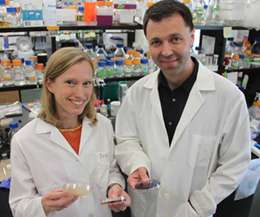
She's a biologist investigating microbial genomics. He studies protein structures using electron microscopy. Put them together and their research opens doors.
A unique collaboration between Marie Elliot and Joaquin Ortega, members of the McMaster Institute for Infectious Disease Research, is providing new insight into the assembly of 'amyloids' - protein aggregates that are associated with neurodegenerative diseases like Alzheimer's and Parkinson's.
Elliot, who studies bacterial development, approached Ortega to help with her biochemical and genetic investigations into amyloids using electron microscopy, a unique structural method to analyze macromolecular assemblies on a very fine scale. Using this combined approach they discovered two separate domains within a 'chaplin' protein (a group of proteins that contribute to the development of Streptomyces bacteria), that contributes to the ability of this protein to form amyloids.
"This finding advances our understanding of amyloid assembly," said Elliot, "and expands the known ways that amyloids can form. This knowledge may ultimately help to increase our chances of treating amyloid-associated disease."
"Amyloids are more typically associated with diseases like Alzheimer's and type II diabetes, and now we have shown that this association is critical for chaplin function," said Elliot. "We are interested in understanding the differences between toxic (disease- causing amyloids), and 'functional amyloids' like the chaplins. To do this, we are probing the underlying genetic and biochemical factors that control the assembly of these functional amyloids." "These findings have a broad impact on better understanding the role of amyloids and contribute to new insight in bacterial development," she said. "Amyloid proteins typically share common biochemical characteristics, but have diverse sequences and cellular functions. What makes the chaplins such a powerful model system is that they have defined biological functions that can be readily assessed and genetically manipulated."
Ortega credits the collaborative nature of the IIDR as one reason for the study's success. The IIDR brings together members from three faculties and eight departments at McMaster. "These kinds of results reflect the things that can be achieved within the IIDR," he said. "It highlights the possibilities of collaborations between groups. Our expertise is different but it complements each other well and allows us to look at problems in a new way. In addition, this work shows the quality, drive and motivation of our trainees at the IIDR. It has been very rewarding to witness how David Capstick and Ahmad Jomaa, first and second author in this publication, took the initial ideas and materialized them into high quality data that provide solid foundation to our findings."
The study, entitled "Dual amyloid domains promote differential functioning of the chaplin proteins during Streptomyces aerial morphogenesis" received funding from the Canadian Institutes of Health Research and is published in the Proceedings of the National Academy of Sciences (PNAS).
More information: Dual amyloid domains promote differential functioning of the chaplin proteins during Streptomyces aerial morphogenesis, PNAS, Published online before print May 31, 2011, doi: 10.1073/pnas.1018715108
Abstract
The chaplin proteins are functional amyloids found in the filamentous Streptomyces bacteria. These secreted proteins are required for the aerial development of Streptomyces coelicolor, and contribute to an intricate rodlet ultrastructure that decorates the surfaces of aerial hyphae and spores. S. coelicolor encodes eight chaplin proteins. Previous studies have revealed that only three of these proteins (ChpC, ChpE, and ChpH) are necessary for promoting aerial development, and of these three, ChpH is the primary developmental determinant. Here, we show that the model chaplin, ChpH, contains two amyloidogenic domains: one in the N terminus and one in the C terminus of the mature protein. These domains have different polymerization properties as determined using fluorescence spectroscopy, secondary structure analyses, and electron microscopy. We coupled these in vitro assays with in vivo genetic studies to probe the connection between ChpH amyloidogenesis and its biological function. Using mutational analyses, we demonstrated that both N- and C-terminal amyloid domains of ChpH were required for promoting aerial hypha formation, while the N-terminal domain was dispensable for assembly of the rodlet ultrastructure. These results suggest that there is a functional differentiation of the dual amyloid domains in the chaplin proteins.


