Sound, vision & hearing loss
June 24, 2011 by Cath Harris in Neuroscience
Sound, vision & hearing loss

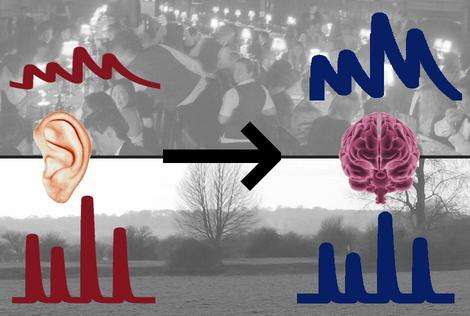
(Medical Xpress) -- The mechanisms used by the brain to distinguish contrasting sounds may be similar to those used to visually pick out a face in the crowd.

Scientists at Oxford University’s Department of Physiology, Anatomy and Genetics are studying the ways in which sound is represented in the and their latest research, published in the journal Neuron, looks at how the brain’s nerve cells respond to sounds heard under different conditions.

The study, carried out by Neil Rabinowitz, Ben Willmore, Jan Schnupp and Andrew King, shows that neurons in the auditory cortex of the ferret's brain adjust their activity to compensate for the contrast between a sound and its background. Examples in human terms could be situations where the underlying environment is silent or very quiet - such as the countryside at night - or very loud, as in a busy pub or high street.

This is known as contrast gain control, a mechanism that our visual systems are thought to use to help focus attention on a particular object. Professor King says: ‘There could be a similar mechanism in the auditory system for picking out sounds of interest against a background of other sounds of different frequencies.’

The research is contributing to the efforts of Professor King’s group to unravel the way the brain processes sound. ‘Auditory scenes around us are changing all the time. We are interested in how our experience of this influences the way information is processed in the brain, and whether that helps to maintain a reliable perception of where and what a sound is under different listening conditions.’

These findings could have significance for our understanding of how the brain compensates for partial loss of hearing and, in time, have implications for the development of cochlear implants and hearing aids.

‘For cochlear implants and hearing aids to work the brain must be able to re-learn how to interpret sounds that have been restored,’ Professor King explains.

Professor King and his team have already shown that the brain can compensate for partial hearing loss. In research published last year, human subjects wore an earplug in one ear and were asked to identify which of several speakers was producing a sound.

‘Our ability to place sound relies on the comparison of signals between our two ears and when tested, when the earplug was first worn, subjects were very poor at locating the . But with practice several times a day for a week they re-learnt how to localise the sounds and once again became very accurate. In other words although the inputs received by the brain had changed, by practising the task, the study showed that we can recover from partial hearing loss.’

Professor King and colleagues are working closely with clinicians and with the hearing charities Deafness Research UK and Action on Hearing Loss (RNID), which aim to help those suffering hearing loss.

‘We hope our work will lead to improvements in the design of devices aimed at restoring hearing. Being aware of the plasticity or adaptability of the brain is important in understanding our ability to respond to .’

More information: http://www.science … 627311004351

Provided by Oxford University search and more info website

4.5 /5 (2 votes)  

Filter


Move the slider to adjust rank threshold, so that you can hide some of the comments.


Display comments: newest first

hush1
Jun 24, 2011

Rank: not rated yet
The research is contributing to the efforts of Professor "Kings group to unravel the way the brain processes sound. Auditory scenes around us are changing all the time. We are interested in how our experience of this influences the way information is processed in the brain, and whether that helps to maintain a reliable perception of where and what a sound is under different listening conditions." - authors

Hint:
What is the first sound you hear?
The auditory is one of the first 'systems' completed during embryonic and fetal development. There is no better way to imprint/prep cells for sound than to listen:
Heartbeat - Your host's and yours. The first in a long line of that which we call:
Sound.

Have a beautiful day, gentlemen.
Rank 4.5 /5 (2 votes)
Relevant PhysicsForums posts
  • A question about drug tolerance
    createdMay 23, 2012
  • Poor nutrition leading to overeating?
    createdMay 23, 2012
  • Math and dyslexia?
    createdMay 21, 2012
  • portable metabolism meter?
    createdMay 21, 2012
  • Rare medical conditions on 20/20 tonight
    createdMay 18, 2012
  • "Good" Cholesterol in Doubt
    createdMay 17, 2012
  • More from Physics Forums - Medical Sciences

More news stories

Of mice and mental models: Neuroscientific implications of risk-optimized behavior in the mouse

(Medical Xpress) -- Regardless of an organism’s biological complexity, every encephalized animal continuously makes under-informed behavioral choices that can have serious consequences. Despite its ubiquity, ...

Neuroscience created 47 minutes ago | popularity not rated yet | comments 0 | with audio podcast feature

Persistent sensory experience is good for aging brain

Despite a long-held scientific belief that much of the wiring of the brain is fixed by the time of adolescence, a new study shows that changes in sensory experience can cause massive rewiring of the brain, even as one ages. ...

Neuroscience created 21 hours ago | popularity not rated yet | comments 0

Boundary stops molecule right where it needs to be

A molecule responsible for the proper formation of a key portion of the nervous system finds its way to the proper place not because it is actively recruited, but instead because it can't go anywhere else.

Neuroscience created 21 hours ago | popularity not rated yet | comments 0 | with audio podcast

Locating ground zero: How the brain's emergency workers find the disaster area

Like emergency workers rushing to a disaster scene, cells called microglia speed to places where the brain has been injured, to contain the damage by 'eating up' any cellular debris and dead or dying neurons. ...

Neuroscience created 21 hours ago | popularity 5 / 5 (2) | comments 0 | with audio podcast

Genetic 'reset switch' enables signaling pathway to induce multiple developmental outcomes for olfactory neurons

Within the nervous system, a handful of signaling pathways modulate development of a cornucopia of different neuronal subtypes. “Even small alterations in neuron differentiation pathways can disrupt subsequent ...

Neuroscience created May 24, 2012 | popularity not rated yet | comments 0


Researchers identify key brain cell in antidepressant action

(Medical Xpress) -- Antidepressant medications such as Prozac have helped improve mood and lessen anxiety in millions of people with major depression. But scientists know surprisingly little about how these drugs work.

Questionable research practices surprisingly common

(Medical Xpress) -- Not all scientific misconduct is flat-out fraud. Much falls into the murkier realm of “questionable research practices.” A new study finds that in one field, psychology, these practices are surprisingly ...

New prostate cancer screening guidelines face a tough sell, study suggests

(Medical Xpress) -- Recent recommendations from the U.S. Preventive Services Task Force (USPSTF) advising elimination of routine prostate-specific antigen (PSA) screening for prostate cancer in healthy men are likely to encounter ...

Energy levels link sleep control mechanisms

Sleep, or lack of it, can determine level of cognitive performance which is linked with accidents as well as increased risk of serious health problems. Links between cell energy levels, gene transcription ...

Routine care for Crohn's disease in children should include measurement of bone age

(Medical Xpress) -- Measuring bone age should be a standard practice of care for pediatric patients with Crohn’s disease, in order to properly interpret growth status and improve treatment, according to a new study from ...

Rockefeller scientists pioneer new method to determine mechanisms of drug action

(Medical Xpress) -- Knowing that a drug works is great. Knowing how it works is a luxury. And until now, determining a drug’s mechanism of action has been a tedious and difficult process for scientists.