The biology behind alcohol-induced blackouts
July 7, 2011 By Jim Dryden in Neuroscience
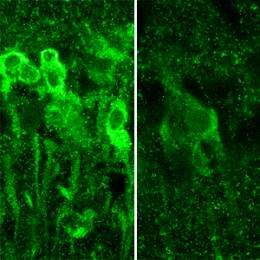
When exposed to large amounts of alcohol, neurons in the hippocampus produce steroids (shown in bright green, at left), which inhibit the formation of memory. Pictured at right, neurons in the same region of the brain that have not been exposed to alcohol. (KAZUHIRO TOKUDA)
(Medical Xpress) -- A person who drinks too much alcohol may be able to perform complicated tasks, such as dancing, carrying on a conversation or even driving a car, but later have no memory of those escapades. These periods of amnesia, commonly known as blackouts, can last from a few minutes to several hours.
Now, at Washington University School of Medicine in St. Louis, neuroscientists have identified the brain cells involved in blackouts and the molecular mechanism that appears to underlie them. They report July 6, 2011, in The Journal of Neuroscience, that exposure to large amounts of alcohol does not necessarily kill brain cells as once was thought. Rather, alcohol interferes with key receptors in the brain, which in turn manufacture steroids that inhibit long-term potentiation (LTP), a process that strengthens the connections between neurons and is crucial to learning and memory.
Better understanding of what occurs when memory formation is inhibited by alcohol exposure could lead to strategies to improve memory.
The mechanism involves NMDA receptors that transmit glutamate, which carries signals between neurons, says Yukitoshi Izumi, MD, PhD, research professor of psychiatry at Washington University School of Medicine in St. Louis. An NMDA receptor is like a double-edged sword because too much activity and too little can be toxic. Weve found that exposure to alcohol inhibits some receptors and later activates others, causing neurons to manufacture steroids that inhibit LTP and memory formation.
Izumi says the various receptors involved in the cascade interfere with synaptic plasticity in the brains hippocampus, which is known to be important in cognitive function. Just as plastic bends and can be molded into different shapes, synaptic plasticity is a term scientists use to describe the changeable properties of synapses, the sites where nerve cells connect and communicate. LTP is the synaptic mechanism that underlies memory formation.
This video is not supported by your browser at this time.
The brain cells affected by alcohol are found in the hippocampus and other brain structures involved in advanced cognitive functions. Izumi and first author Kazuhiro Tokuda, MD, research instructor of psychiatry, studied slices of the hippocampus from the rat brain.
When they treated hippocampal cells with moderate amounts of alcohol, LTP was unaffected, but exposing the cells to large amounts of alcohol inhibited the memory formation mechanism.
It takes a lot of alcohol to block LTP and memory, says senior investigator Charles F. Zorumski, MD, the Samuel B. Guze Professor and head of the Department of Psychiatry. But the mechanism isnt straightforward. The alcohol triggers these receptors to behave in seemingly contradictory ways, and thats what actually blocks the neural signals that create memories. It also may explain why individuals who get highly intoxicated dont remember what they did the night before.
But not all NMDA receptors are blocked by alcohol. Instead, their activity is cut roughly in half.
The exposure to alcohol blocks some NMDA receptors and activates others, which then trigger the neuron to manufacture these steroids, Zorumski says.
The scientists point out that alcohol isnt causing blackouts by killing neurons. Instead, the steroids interfere with synaptic plasticity to impair LTP and memory formation.
Alcohol isnt damaging the cells in any way that we can detect, Zorumski says. As a matter of fact, even at the high levels we used here, we dont see any changes in how the brain cells communicate. You still process information. Youre not anesthetized. You havent passed out. But youre not forming new memories.
Stress on the hippocampal cells also can block memory formation. So can consumption of other drugs. When combined, alcohol and certain other drugs are much more likely to cause blackouts than either substance alone.
The researchers found that if they could block the manufacture of steroids by neurons, they also could preserve LTP in the rat hippocampus. And they did that with drugs called 5-alpha-reductase inhibitors. These include finasteride and dutasteride, which are commonly prescribed to reduce a mans enlarged prostate gland. In the brain, however, those substances seem to preserve memory.
We would expect there may be some differences in the effects of alcohol on patients taking these drugs, Izumi says. Perhaps men taking the drugs would be less likely to experience intoxication blackouts.
The researchers plan to study 5-alpha-reductase inhibitors to see how easily they get into the brain and to determine whether those drugs, or similar substances, might someday play a role in preserving memory.
More information: Tokuda K, Izumi Y, Zorumski CF. Ethanol enhances neurosteroidogenesis in hippocampal pyramidal neurons by paradoxical NMDA receptor activation, The Journal of Neuroscience, vol. 31(27), pp. 9905-9909. July 6, 2011.
Provided by
Washington University School of Medicine in St. Louis
-
Finding the roots of memory impairment from sleep deprivation
Jun 10, 2011 |
not rated yet |
0
-
Roots of memory impairment, resulting from sleep deprivation, identified
May 17, 2011 |
not rated yet |
0
-
Sleep helps brain sift memories, study shows
Dec 01, 2010 |
not rated yet |
0
-
Children with fetal alcohol spectrum disorders have less deep-gray brain matter
May 19, 2011 |
not rated yet |
0
-
FDA-approved drug shows promise as alcoholism treatment
Jan 12, 2011 |
not rated yet |
0
-
Motion perception revisited: High Phi effect challenges established motion perception assumptions
Apr 23, 2013 |
3 / 5 (2) |
2
-
Anything you can do I can do better: Neuromolecular foundations of the superiority illusion (Update)
Apr 02, 2013 |
4.5 / 5 (11) |
5
-
The visual system as economist: Neural resource allocation in visual adaptation
Mar 30, 2013 |
5 / 5 (2) |
9
-
Separate lives: Neuronal and organismal lifespans decoupled
Mar 27, 2013 |
4.9 / 5 (8) |
0
-
Sizing things up: The evolutionary neurobiology of scale invariance
Feb 28, 2013 |
4.8 / 5 (10) |
14
-
How can there be a term called "intestinal metaplasia" of stomach
7 hours ago
-
Pressure-volume curve: Elastic Recoil Pressure don't make sense
May 18, 2013
-
If you became brain-dead, would you want them to pull the plug?
May 17, 2013
-
MRI bill question
May 15, 2013
-
Ratio of Hydrogen of Oxygen in Dessicated Animal Protein
May 13, 2013
-
Alcohol and acetaminophen
May 13, 2013
- More from Physics Forums - Medical Sciences
More news stories
B vitamins could delay dementia
(Medical Xpress)—Despite spending billions of dollars on research and development, drug companies have been unable to come up with effective treatments for dementia and Alzheimer's Disease (AD). Now, A. ...
Neuroscience
36 minutes ago |
4.5 / 5 (2) |
0
|
Waiting for a sign? Researchers find potential brain 'switch' for new behavior
You're standing near an airport luggage carousel and your bag emerges on the conveyor belt, prompting you to spring into action. How does your brain make the shift from passively waiting to taking action when ...
Neuroscience
1 hour ago |
not rated yet |
0
|
If you can remember it, you can remember it wrong
(Medical Xpress)—Native peoples in regions where cameras are uncommon sometimes react with caution when their picture is taken. The fear that something must have been stolen from them to create the photo ...
Neuroscience
2 hours ago |
3.5 / 5 (2) |
0
|
Study shows where scene context happens in our brain
In a remote fishing community in Venezuela, a lone fisherman sits on a cliff overlooking the southern Caribbean Sea. This man –– the lookout –– is responsible for directing his comrades on the water, ...
Neuroscience
4 hours ago |
4 / 5 (1) |
0
|
Clouds in the head
Many brain researchers cannot see the forest for the trees. When they use electrodes to record the activity patterns of individual neurons, the patterns often appear chaotic and difficult to interpret.
Neuroscience
6 hours ago |
not rated yet |
0
Enrichment therapy effective among children with autism, study finds
Children with autism showed significant improvement after six months of simple sensory exercises at home using everyday items such as scents, spoons and sponges, according to UC Irvine neurobiologists.
Poliovirus vaccine trial shows early promise for recurrent glioblastoma
An attack on glioblastoma brain tumor cells that uses a modified poliovirus is showing encouraging results in an early study to establish the proper dose level, researchers at Duke Cancer Institute report.
'Doctor shopping' by obese patients negatively affects health
Overweight and obese patients are significantly more likely than their normal-weight counterparts to repeatedly switch primary care doctors, a practice that disrupts continuity of care and leads to more emergency room visits, ...
Aggressive behavior linked specifically to secondhand smoke exposure in childhood
Children who are exposed to secondhand smoke in early childhood are more likely to grow up to physically aggressive and antisocial, regardless of whether they were exposed during pregnancy or their parents have a history ...
Insight into the dazzling impact of insulin in cells
Australian scientists have charted the path of insulin action in cells in precise detail like never before. This provides a comprehensive blueprint for understanding what goes wrong in diabetes.
Finding a family for a pair of orphan receptors in the brain
Researchers at Emory University have identified a protein that stimulates a pair of "orphan receptors" found in the brain, solving a long-standing biological puzzle and possibly leading to future treatments for neurological ...
Jul 07, 2011
Rank: not rated yet