Scientists identify broad and potent HIV antibodies that mimic CD4 binding
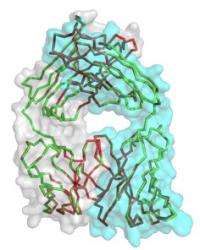
Crystal clear. A group of broadly neutralizing antibodies obtained from four unrelated slow-progressing HIV patients show striking sequence and structural similarities, suggesting that the path for the immune system to achieve this potent activity against the CD4 binding site might be narrow.

In a finding that may be good news for scientists developing HIV vaccines and therapies, a team of researchers at The Rockefeller University and the Howard Hughes Medical Institute have found a way to investigate the broadly neutralizing antibody response against the CD4 binding site of HIV on a monoclonal level. This led to the identification and characterization of several “highly active anti-CD4 binding site antibodies” (HAADs) and their expanded B cell families.

“We are excited to have the ability to isolate not only single potent antibodies but with our new approach investigate the entire families of highly active antibodies against HIV,” says first author Johannes F. Scheid. “What really surprised us was how similar these antibodies were even though they came from different donors, so the path to make them seems to be quite narrow.”

The new research builds on previous findings from the Laboratory of Molecular Immunology, headed by Sherman Fairchild Professor Michel C. Nussenzweig. Scheid and colleagues first characterized in 2009 the overall B cell repertoire against the HIV surface protein in with broadly neutralizing antibodies on a monoclonal level. These patients are a group of individuals that make up roughly 10 percent of HIV patients and their antibodies are able to kill a wide range of diverse HIV strains. Later, Hugo Mouquet and colleagues in Nussenzweig’s lab investigated how polyreactivity might be selected for in the antibody response against HIV. In related research, John Pietzsch and colleagues described the fine epitope of one group of HIV neutralizing antibodies.

For the latest research, Nussenzweig and Scheid, along with David D. Ho of Rockefeller and the Aaron Diamond AIDS Research Center and Rockefeller’s Brian T. Chait, looked at the immune system of four unrelated slow-progressing HIV patients. The patients produced expanded clones of potent broadly neutralizing antibodies that mimic binding to CD4, the receptor that HIV uses to gain entry into host T-cells. The researchers cloned 576 new antibodies, which were derived from a small number of germ-line immunoglobulin genes. In addition, despite undergoing extensive hypermutation, these antibodies show striking sequence and structural similarities suggesting that the path for the immune system to achieve this potent activity against the CD4 binding site might be narrow.

The researchers also found that relatively low concentrations of these broadly neutralizing are required to neutralize the virus.

“This work will help us to understand better how broad neutralization is achieved in some patients and how to possibly phenocopy such a response by a vaccine strategy,” says Scheid.

More information: Sequence and structural convergence of broad and potent HIV antibodies that mimic CD4 binding, Johannes F. Scheid, et al. Science online: July 14, 2011

add to favorites email to friend print save as pdf

Related Stories

Neutralizing HIV

Jul 18, 2011

Each time a virus invades a healthy individual, antibodies created by the body fight to fend off the intruders. For some viruses, like HIV, the antibodies are very specific and are generated too slowly to ...

A natural approach for HIV vaccine

Mar 15, 2009

(PhysOrg.com) -- For 25 years, researchers have tried and failed to develop an HIV vaccine, primarily by focusing on a small number of engineered "super antibodies" to fend off the virus before it takes hold. So far, these ...

Recommended for you

Respect may be the key to stopping patient 'no shows'

20 hours ago

People with HIV are more likely to keep their scheduled medical appointments—and their disease under control—if they feel their physician listens, explains things clearly and knows them as a person, not just a "case," ...

Study details age disparities in HIV continuum of care

Jun 17, 2013

Age disparities exist in the continuum of care for patients with the human immunodeficiency virus (HIV) with people younger than 45 years less likely to be aware of their infection or to have a suppressed viral load, according ...

Cost-effective: Universal HIV testing in India

Jun 10, 2013

In India most people who are HIV positive don't know it, yet testing and treatment are relatively cheap and available. It would therefore meet international standards of cost-effectiveness—and save millions of lives for ...

User comments

More news stories

No danger of cancer through gene therapy virus

In fall 2012, the European Medicines Agency (EMA) approved the modified adeno-associated virus AAV-LPL S447X as the first ever gene therapy for clinical use in the Western world. uniQure, a Dutch biotech company, had developed ...

Antioxidant shows promise in Parkinson's disease

Diapocynin, a synthetic molecule derived from a naturally occurring compound (apocynin), has been found to protect neurobehavioral function in mice with Parkinson's Disease symptoms by preventing deficits in motor coordination.

Paralysed with fear: The story of polio

Thanks to vaccination, polio has been pushed to the brink of extinction – but can we finish the job? This is one of the big questions which a Bristol academic addresses in his new book, published next week.

Laughing gas does not increase heart attacks

(Medical Xpress)—Nitrous oxide—best known as laughing gas—is one of the world's oldest and most widely used anesthetics. Despite its popularity, however, experts have questioned its impact on the risk ...

Model recreates wear and tear of osteoarthritis

(Medical Xpress)—There's a reason osteoarthritis is often called wear-and-tear arthritis: Repeated stress on joints over time results in degeneration of the soft cartilage that normally distributes loads ...