Stem cells grow fully functional new teeth
July 13, 2011
by Deborah Braconnier
in Medical research
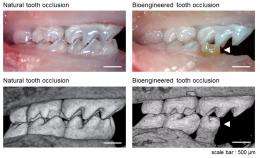
Oral photographs (upper) and micro-CT (lower) images showing occlusion of natural (left) and bioengineered teeth (right). Image credit: PLoS ONE 6(7): e21531. doi:10.1371/journal.pone.0021531
(Medical Xpress) -- Researchers from Japan recently published a paper in PLoS One describing their successful growth and transplantation of new teeth created from the stem cells of mice.
In order to create these teeth, Takashi Tsuji from Tokyo University of Science and his team removed two different stem cells from the molar teeth of mice. They took these stem cells to grow in the laboratory. In order to control how the teeth grew, as far as shape and length, the stem cells were placed in a mold to grow.
Once the cells grew into full tooth units, the researchers then transplanted them into the jaws of one-month-old mice. These transplanted teeth fused with the jaw bones and tissues on an average of about 40 days. The researchers were also able to detect nerve fibers growing in the new teeth.
The mice that received the transplanted teeth were able to eat and chew normally without any complications.
Tsuji hopes that this new development will help further the research being done to allow for the growth of human organs from a patients own stem cells. Currently researchers do not have the ability to culture three-dimensional organs outside of the body. The hope is the growth of these teeth will be the beginning step that is needed.
Tsuji stresses that in order for reparative therapy to be successful, it is important to find the right seed cells. Because the stem cells used for these teeth were taken directly from the molars of the mice, they were able to grow into teeth, complete with enamel and dental bones.
Researchers believe that down the road it may be possible to do this with adult stem cells or cells found in human wisdom teeth and allow for actual teeth to be implanted replacing teeth lost to dental decay or injury.
More information: Oshima M, Mizuno M, Imamura A, Ogawa M, Yasukawa M, et al. (2011) Functional Tooth Regeneration Using a Bioengineered Tooth Unit as a Mature Organ Replacement Regenerative Therapy. PLoS ONE 6(7): e21531. doi:10.1371/journal.pone.0021531
Abstract
Donor organ transplantation is currently an essential therapeutic approach to the replacement of a dysfunctional organ as a result of disease, injury or aging in vivo. Recent progress in the area of regenerative therapy has the potential to lead to bioengineered mature organ replacement in the future. In this proof of concept study, we here report a further development in this regard in which a bioengineered tooth unit comprising mature tooth, periodontal ligament and alveolar bone, was successfully transplanted into a properly-sized bony hole in the alveolar bone through bone integration by recipient bone remodeling in a murine transplantation model system. The bioengineered tooth unit restored enough the alveolar bone in a vertical direction into an extensive bone defect of murine lower jaw. Engrafted bioengineered tooth displayed physiological tooth functions such as mastication, periodontal ligament function for bone remodeling and responsiveness to noxious stimulations. This study thus represents a substantial advance and demonstrates the real potential for bioengineered mature organ replacement as a next generation regenerative therapy.
© 2010 PhysOrg.com
-
Baby teeth might be source of stem cells
Jul 17, 2006 |
not rated yet |
0
-
Researchers use stem cells to regenerate parts of teeth
Dec 20, 2006 |
not rated yet |
0
-
Researchers find stem cells from monkey teeth can stimulate growth and generation of brain cells
Nov 11, 2008 |
not rated yet |
0
-
Broke a tooth? Grow another!
Jan 13, 2010 |
not rated yet |
0
-
Stem cells used to reattach teeth with new technique
Sep 29, 2010 |
not rated yet |
0
-
Motion perception revisited: High Phi effect challenges established motion perception assumptions
Apr 23, 2013 |
3 / 5 (2) |
2
-
Anything you can do I can do better: Neuromolecular foundations of the superiority illusion (Update)
Apr 02, 2013 |
4.5 / 5 (11) |
5
-
The visual system as economist: Neural resource allocation in visual adaptation
Mar 30, 2013 |
5 / 5 (2) |
9
-
Separate lives: Neuronal and organismal lifespans decoupled
Mar 27, 2013 |
4.9 / 5 (8) |
0
-
Sizing things up: The evolutionary neurobiology of scale invariance
Feb 28, 2013 |
4.8 / 5 (10) |
14
-
Pressure-volume curve: Elastic Recoil Pressure don't make sense
May 18, 2013
-
If you became brain-dead, would you want them to pull the plug?
May 17, 2013
-
MRI bill question
May 15, 2013
-
Ratio of Hydrogen of Oxygen in Dessicated Animal Protein
May 13, 2013
-
Alcohol and acetaminophen
May 13, 2013
-
Marie Curie's leukemia
May 13, 2013
- More from Physics Forums - Medical Sciences
More news stories
Study suggests new source of kidneys for transplant
Nearly 20 percent of kidneys that are recovered from deceased donors in the U.S. are refused for transplant due to factors ranging from scarring in small blood vessels of the kidney's filtering units to the organ going too ...
Medical research
4 hours ago |
not rated yet |
0
|
Discovery of circadian clock in mice hair reveals period of time when damage from radiotherapy can be quickly repaired
Discovering that mouse hair has a circadian clock - a 24-hour cycle of growth followed by restorative repair - researchers suspect that hair loss in humans from toxic cancer radiotherapy and chemotherapy ...
Medical research
5 hours ago |
5 / 5 (2) |
1
|
Do salamanders hold the solution to regeneration?
Salamanders' immune systems are key to their remarkable ability to regrow limbs, and could also underpin their ability to regenerate spinal cords, brain tissue and even parts of their hearts, scientists have ...
Medical research
6 hours ago |
5 / 5 (1) |
0
|
New study finds blind people have the potential to use their 'inner bat' to locate objects
New research from the University of Southampton has shown that blind and visually impaired people have the potential to use echolocation, similar to that used by bats and dolphins, to determine the location of an object.
Medical research
8 hours ago |
not rated yet |
1
|
Germ-fighting vaccine system makes great strides in delivery
A novel vaccine study from South Dakota State University (SDSU) will headline the groundbreaking research that will be unveiled at the American Association of Pharmaceutical Scientists' (AAPS) National Biotechnology Conference ...
Medical research
9 hours ago |
not rated yet |
0
The compound in the Mediterranean diet that makes cancer cells 'mortal'
New research suggests that a compound abundant in the Mediterranean diet takes away cancer cells' "superpower" to escape death. By altering a very specific step in gene regulation, this compound essentially re-educates cancer ...
Scientists identify molecular trigger for Alzheimer's disease
Researchers have pinpointed a catalytic trigger for the onset of Alzheimer's disease – when the fundamental structure of a protein molecule changes to cause a chain reaction that leads to the death of neurons ...
Practice makes perfect? Not so much
Turns out, that old "practice makes perfect" adage may be overblown. New research led by Michigan State University's Zach Hambrick finds that a copious amount of practice is not enough to explain why people ...
New immune system discovered
(Medical Xpress)—A research team, led by Jeremy Barr, a biology post-doctoral fellow, unveils a new immune system that protects humans and animals from infection.
Older prostate cancer patients should think twice before undergoing treatment
Older prostate cancer patients with other underlying health conditions should think twice before committing to surgery or radiation therapy for their cancer, according to a multicenter study led by researchers in the UCLA ...
New test better detects elephantiasis worm infection
A new diagnostic test for a worm infection that can lead to severe enlargement and deformities of the legs and genitals is far more sensitive than the currently used test, according to results of a field ...
Jul 13, 2011
Rank: not rated yet
This will primarily benefit those who are missing teeth altogether (If they have the money), and more importantly, it will help spur the research into regrowing other parts of the body.
Jul 13, 2011
Rank: 1.7 / 5 (6)
Jul 13, 2011
Rank: 3 / 5 (2)
And there's the rub .I would imagine that most of those that have missing teeth lack the finances for extensive dental treatment
The older people may not have the regenerative abilities of a one month old mouse.Something for Europe perhaps
Jul 13, 2011
Rank: 5 / 5 (1)
snap! I just realized how ethnocentric my comment was. Good point - in most developed countries, there will likely be the means and methods to put this to use, albeit still for only a small proportion of the population.
Jul 14, 2011
Rank: not rated yet
It's the stem cells that have the regenerative abilities. Age isn't necessarily a factor.
While this is [somewhat] exciting, I'd still like to see them focus more on using stem cells to cure diseases that are currently "incurable".
Jul 14, 2011
Rank: not rated yet
But seriously, the problem with this therapy and with the titanium implants now available is the loss of bone where the teeth have been lost. You can clearly see the loss of bone in the mouse jaw above, so those people who don't get this treatment almost as soon as the wound (from tooth loss) heals can not get it done at all.
Jul 15, 2011
Rank: not rated yet
now the fun part if you get this tooth in your mouth it will wear off within month (missing enamel)so you will have to cap it , it will be super sensitive you might end up with a root canal, decay will love you for the free food.
frustrated you decide to pull it half of your jaw will come out with it.
I think this article had miss translate the research findings.I can taste the extra pepper .
Jul 15, 2011
Rank: 1 / 5 (2)