Strength training curbs hip, spinal bone loss in women with osteoporosis
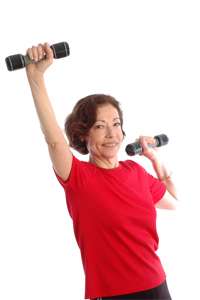
Women with osteoporosis – a skeletal disease that erodes bone density, weakens bone strength and increases the risk of fractures – might think taking it easy is the best way to prevent bone breaks. Yet an updated review of studies confirms that compared to staying sedentary, strength exercises boost bone density in postmenopausal women with osteoporosis.
Prolonged periods of inactivity actually contribute to reduced bone mass, but adding a mechanical load, such as body weight or dumbbells, mitigates the loss, said Tracey Howe, a professor of rehabilitation services at the Glasgow Caledonian University, in Scotland, and the review’s lead author.
“The concept of bone loss is a confusing one for most people. Bone loss is an inevitable part of aging and our review indicates that exercise appears to slow it down. But exercise needs to be done on a regular basis, as stopping exercise means bone loss will continue at the same rate as before,” Howe said.
In their review, Howe and colleagues examined 43 studies that evaluated the effect of exercise programs on the bone health of 4,320 postmenopausal women with osteoporosis. This update of a 2000 review evaluates 27 studies not included in the earlier version.
The review was published by The Cochrane Collaboration, an international organization that evaluates medical research. Systematic reviews like this one draw evidence-based conclusions about medical practice after considering both the content and quality of existing medical trials on a topic.
The main conclusions of the review remain unchanged and, as in the 2000 review, the authors found that exercise has the potential to be a safe and effective way to avert bone loss in postmenopausal women. In general, all types of exercise programs such as aerobics, strength training, walking and tai chi improved bone mineral density and slightly reduced the risk of fracture in postmenopausal women.
Women who exercised regularly lost an average of about 1 percent less bone than non-exercisers, and women who exercised were not more likely to sustain injuries or falls while exercising, the authors wrote. Exercise reduced the chances of having a fracture slightly, from about 11 women of every 100 women to seven of every 100.
What has changed since the previous review, though, is that “the results are more specific to different types of exercise and the effects on the spine and hip (neck of femur),” Howe said in an email interview. The spine and hip are among the most common fractures in women with osteoporosis, a disease that affects an estimated 200 million women worldwide.
Overall, women who did weight training programs that focused on progressively increasing lower body strength had a 1 percent smaller reduction in bone mineral density at the hip, compared to control group participants who did not exercise.
When it came to spinal bone mineral density, the most effective exercise program was a combination of different types of exercise. Performing more than one type of exercise, such as walking, running, dancing or progressive strength training, produced a 3 percent smaller reduction in spinal bone mineral density, compared to non-exercisers, Howe said.
Despite the number of studies added to the review, Howe said that the quality of the reporting of studies was low, and many of the study participants were lost during follow-up.
“The review confirms what most of the studies have suggested all along: Weight-bearing exercise is not only helpful, but essential to prevent and to limit osteoporosis in people as they get older,” said C. David Geier, Jr., M.D., an assistant professor of orthopedic surgery and director of the sports medicine program at the Medical University of South Carolina.
Although the review results are interesting, “you're not going to do a certain type of exercise to prevent a certain type of fracture,” Geier said. “The key with osteoporosis and exercise is to try to prevent it in the first place. Once the hip fracture happens, the cat’s out of the bag. The impact on quality of life and life expectancy is significant.”
Women who lack weight-training experience, yet want to prevent osteoporosis, should get clearance from a doctor to exercise and consult a strength and conditioning specialist to learn how to strength train to avoid injuries, Geier said.
“There's the perception that resistance training is really just for young athletes. That's just not true. There's a role that resistance training plays for everyone,” Geier said.
More information: Howe TE, et al. Exercise for preventing and treating osteoporosis in postmenopausal women. Cochrane Database of Systematic Reviews 2011, Issue 7


