Rare immune cell is asset and liability in fighting infection
August 26, 2011 in Medical research

Rare immune cell is asset and liability in fighting infection

Enlarge

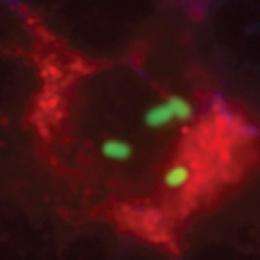
Immune cells in the spleen have brought in stowaways: Listeria bacteria, which appear green in the image. Researchers at Washington University School of Medicine in St. Louis have found that the immune cells the bacteria have exploited can be both helpful and harmful in fighting infection. The cells could be particularly useful in efforts to turn the immune system against cancers using vaccines. Credit: Kenneth Murphy

The same trait that makes a rare immune cell invaluable in fighting some infections also can be exploited by other diseases to cause harm, two new studies show.

In papers published online in Immunity, scientists at Washington University School of Medicine in St. Louis reveal that the cells, known as CD8 alpha+ (CD8a+ DCs), can help the body beat back infection by a common parasite, but the same cells can be hijacked by a to decimate the body's defenses.

The trait that makes the cells both an asset and a liability is the way they alert other , causing them to attack invaders. CD8a+ DCs can sound the alarm in a manner that is particularly helpful for stripping away invaders' disguises. But this process takes time, and Listeria bacteria can take advantage of that delay to wreak havoc inside the spleen.

"As we've discovered how useful these cells can be in fighting different kinds of infections, researchers have wondered why they're so rare," says Kenneth Murphy, MD, PhD, the Eugene L. Opie First Centennial Professor of Pathology and Immunology. "This may be why — overcommitting to any one defensive strategy opens up opportunities for counterstrategies that exploit it."

CD8a+ DCs make up about 10 percent of all dendritic cells in the body. By studying the basic functions of these cells, scientists are laying the groundwork to use them to fight infections. The cells also appear to be essential for some cancer vaccines, which enlist the power of the system to help fight tumors.

Murphy, who is a Howard Hughes Medical Institute Investigator, previously created genetically altered mice where CD8a+ DCs could be selectively eliminated. By comparing these mice with normal mice, Murphy and his collaborators have shown that CD8a+ DCs are essential to priming the body's defenses against viral infections.

Viruses often try to disguise themselves to evade defenders, but CD8a+ DCs can extract characteristic parts of a virus and display them on their surface. Other cells also can make these displays, but CD8a+ DCs do it in a way that helps peel back disguises, causing other immune cells to seek out additional copies of the virus and kill them.

In one of the new studies, doctoral student Mona Mashayekhi showed that CD8a+ DCs are early responders to infection with the Toxoplasma gondii parasite, which causes serious disease in patients with weakened or suppressed immune systems. She found only CD8a+ DCs produce a signal that causes other immune cells to fight the parasite.

In the second paper, Brian Edelson, MD, PhD, assistant professor of and immunology, tested the cells against the bacteria Listeria, which can cause food poisoning. He discovered that CD8a+ DCs could make Listeria infection worse.

"Listeria likes to get into immune cells using a pathway that typically leads to the bacteria's death in garbage disposals inside the cell," Murphy explains. "But that pathway is slowed down in CD8a+ DCs to ensure that they can retain part of the invader to display to other immune cells."

Researchers watched Listeria use this delay to ride inside CD8a+ DCs as they entered the spleen, where immune cells not yet activated for attacking invaders are kept. These cells are easy targets for the bacteria, and infection worsens.

According to Murphy, CD8a+ DCs' specialized ability to initiate immune attacks makes them essential for efforts to create cancer vaccines based on DNA from tumors. He and collaborator William Gillanders, MD, professor of surgery, are working to use these vaccines to make immune cells attack cancers.

"What we're learning from basic studies, for example, has already enabled us to increase the number of CD8a+ DCs in mice until they're about 30 to 40 percent of dendritic cells," Murphy says. "Learning more about how this cell interacts with other immune cells will allow us to create effective cancer vaccines."

Provided by Washington University School of Medicine search and more info website

4.7 /5 (3 votes)  

Rank 4.7 /5 (3 votes)
Relevant PhysicsForums posts

More news stories

Research shows how immune system peacefully co-exists with 'good' bacteria

The human gut is loaded with commensal bacteria – "good" microbes that, among other functions, help the body digest food. The gastrointestinal tract contains literally trillions of such cells, and yet the ...

Medical research created 1 hour ago | popularity not rated yet | comments 0 | with audio podcast

Slowing the aging process—only with antibiotics

Swiss scientists reveal the mechanism responsible for aging hidden deep within mitochondria—and dramatically slow it down in worms by administering antibiotics to the young.

Medical research created 1 hour ago | popularity 4 / 5 (1) | comments 0 | with audio podcast

How healthy are you for your age?

On May 22, JoVE will publish details of a technique to measure the health of human genetic material in relation to a patient's age. The method is demonstrated by the laboratory of Dr. Gil Atzmon at New York's Albert Einste ...

Medical research created 4 hours ago | popularity not rated yet | comments 0

A molecular explanation for age-related fertility decline in women

(Medical Xpress)—Scientists supported by the National Institutes of Health have a new theory as to why a woman's fertility declines after her mid-30s. They also suggest an approach that might help slow ...

Medical research created 5 hours ago | popularity not rated yet | comments 0 | with audio podcast

Medical researchers discover new ways to target, develop and design drugs to prevent and treat viral infection

Researchers at the University of Alberta have discovered a new drug target, developed a new drug and identified a new way to design drugs—all of which could be a winning combination in the battle against viruses.

Medical research created 6 hours ago | popularity 4 / 5 (1) | comments 0 | with audio podcast


Enzyme-activating antibodies revealed as marker for most severe form of rheumatoid arthritis

In a series of lab experiments designed to unravel the workings of a key enzyme widely considered a possible trigger of rheumatoid arthritis, researchers at Johns Hopkins have found that in the most severe ...

Research offers promising new approach to treatment of lung cancer

Researchers have developed a new drug delivery system that allows inhalation of chemotherapeutic drugs to help treat lung cancer, and in laboratory and animal tests it appears to reduce the systemic damage ...

Researchers analyse hunting behaviour of fish larvae in virtual reality

Moving objects attract greater attention – a fact exploited by video screens in public spaces and animated advertising banners on the Internet. For most animal species, moving objects also play a major ...

Overeating learned in infancy, study suggests

In the long run, encouraging a baby to finish the last ounce in their bottle might be doing more harm than good.

Study details genes that control whether tumors adapt or die when faced with p53 activating drugs

When turned on, the gene p53 turns off cancer. However, when existing drugs boost p53, only a few tumors die – the rest resist the challenge. A study published in the journal Cell Reports shows how: tumors that live even i ...

Children of married parents less likely to be obese

Children living in households where the parents are married are less likely to be obese, according to new research from Rice University and the University of Houston.