Lasers light the path of neuron regeneration
September 21, 2011 in Medical research
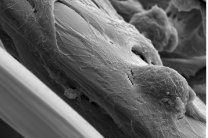
Scaffold with regenerated cells
(Medical Xpress) -- Lasers have been used to fabricate tiny scaffolds to be used as delivery vehicles to drop cells off at damaged locations and help treat diseases such as Alzheimers and Parkinsons.
Owing to the versatility and accuracy of lasers, the structures have shown significant potential for facilitating the growth of cells and could be designed specifically to meet the individual needs of a variety of cells.
In their study published today, Tuesday 20 September, in IOP Publishings journal Biofabrication, researchers used lasers to create intricate scaffolds, with features one thousand times smaller than a millimetre, and demonstrated their ability to effectively harness the growth of neuronal cells.
The repairing of neural tissue for example peripheral nerves, spinal cord and the brain has long been investigated using a technique known as tissue engineering and is now becoming a realistic treatment as technology advances.
A multidisciplinary field in which tissues and organs are formed by growing cells onto materials outside of the body, tissue engineering relies heavily on the creation of scaffolds which determine the efficiency, size, shape and orientation of cell growth.
By fine-tuning the make-up and design of these scaffolds, they could be used as a delivery vehicle to drop cells off at a specific damaged location, help them attach and grow, and then become degraded in the body without any damage to the cells or the host.
In this study, the researchers, from the University of Crete and the University of Sheffield, fabricated a scaffold from a commonly used polymer, polylactic acid (PLA). This synthetic, biocompatible material degrades in the human body to form lactic acid, a naturally occurring chemical that can easily be removed, leaving the regenerated tissue behind in the required size, shape and structure.
An ultra-fast, titanium sapphire laser was tightly focused on the PLA material and moved through three dimensions to create complicated sub-micrometer structures. Within the structures, small struts and holes were fabricated to ensure stability and the efficient delivery of nutrients to the cells; both are essential for tissue generation.
Taking the fabrication one step further, 3D sea-shell structures were created from the polymer to demonstrate the intricacy of the laser technique.
To test the compatibility of the structures, the researchers grew neuronal cells on them and observed, using high powered microscopes, how the cells proliferated and aligned.
The neuronal cells showed good compatibility with the PLA structures with less than 10% of the cells dying after five days.
Study co-author Professor Frederik Claeyssens said, This is the first time we have been able to structure polylactide with such high resolution and the first time that direct laser writing has been applied to tissue engineering.
Compared to other techniques, direct laser writing allows the scaffold to be created in a user-defined manner on the micrometer level and provides the possibility to explore the relationship between structure of, and cell growth on, the scaffold.
An Institute of Physics spokesperson said, The fabrication of appropriate scaffolds is a vital step in the process of tissue engineering and must be fine-tuned if treatments for Alzheimers and Parkinsons are to be realised.
More information: http://iopscience. … 0/3/4/045005
Provided by
Institute of Physics
-
3D printing for new tissues and organs
Jun 18, 2009 |
not rated yet |
0
-
Scientists progress in successful tissue engineering
Mar 23, 2007 |
not rated yet |
0
-
Scientists develop 2-component polymer scaffolds for controlled 3-D cell culture
Apr 06, 2011 |
not rated yet |
0
-
Tissue engineered scaffolding allows reproduction of cartilage tissue
May 09, 2007 |
not rated yet |
0
-
Shaping up: Controlling a stem cell's form can determine its fate
Sep 13, 2011 |
not rated yet |
0
-
Of mice and mental models: Neuroscientific implications of risk-optimized behavior in the mouse
19 hours ago |
not rated yet |
0
-
Limits to growth: Scientists identify key metastasis-enabling enzyme
May 22, 2012 |
5 / 5 (4) |
0
-
Seeing is as seeing does: Spatially-structured retinal input in early development of cortical maps
Apr 26, 2012 |
5 / 5 (4) |
1
-
Dreamless nights: Brain activity during nonrapid eye movement sleep
Apr 09, 2012 |
4.4 / 5 (12) |
0
-
Take your time: Neurobiology sheds light on the superiority of spaced vs. massed learning
Mar 28, 2012 |
4.5 / 5 (21) |
3
-
A question about drug tolerance
May 23, 2012
-
Poor nutrition leading to overeating?
May 23, 2012
-
Math and dyslexia?
May 21, 2012
-
portable metabolism meter?
May 21, 2012
-
Rare medical conditions on 20/20 tonight
May 18, 2012
-
"Good" Cholesterol in Doubt
May 17, 2012
- More from Physics Forums - Medical Sciences
More news stories
Implantable pain disk may help those with cancer
An estimated 3.5 million cancer patients around the globe are in severe pain from their disease, but many get no relief.
Medical research
18 hours ago |
not rated yet |
0
|
Energy levels link sleep control mechanisms
Sleep, or lack of it, can determine level of cognitive performance which is linked with accidents as well as increased risk of serious health problems. Links between cell energy levels, gene transcription ...
Medical research
19 hours ago |
not rated yet |
0
Researchers identify key brain cell in antidepressant action
(Medical Xpress) -- Antidepressant medications such as Prozac have helped improve mood and lessen anxiety in millions of people with major depression. But scientists know surprisingly little about how these drugs work.
Medical research
20 hours ago |
4.5 / 5 (2) |
0
|
Rockefeller scientists pioneer new method to determine mechanisms of drug action
(Medical Xpress) -- Knowing that a drug works is great. Knowing how it works is a luxury. And until now, determining a drugs mechanism of action has been a tedious and difficult process for scientists.
Medical research
20 hours ago |
not rated yet |
0
|
Like curry? New biological role identified for compound used in ancient medicine
Scientists have just identified a new reason why some curry dishes, made with spices humans have used for thousands of years, might be good for you.
Medical research
May 25, 2012 |
4.4 / 5 (10) |
2
|
Of mice and mental models: Neuroscientific implications of risk-optimized behavior in the mouse
(Medical Xpress) -- Regardless of an organism’s biological complexity, every encephalized animal continuously makes under-informed behavioral choices that can have serious consequences. Despite its ubiquity, ...
Tongue analysis software uses ancient Chinese medicine to warn of disease
For 5,000 years, the Chinese have used a system of medicine based on the flow and balance of positive and negative energies in the body. In this system, the appearance of the tongue is one of the measures used to classify ...
Cancer may require simpler genetic mutations than previously thought
Chromosomal deletions in DNA often involve just one of two gene copies inherited from either parent. But scientists haven't known how a deletion in one gene from one parent, called a "hemizygous" deletion, can contribute ...
Inherited DNA change explains overactive leukemia gene
A small inherited change in DNA is largely responsible for overactivating a gene linked to poor treatment response in people with acute leukemia.
Skp2 activates cancer-promoting, glucose-processing Akt
HER2 and its epidermal growth factor receptor cousins mobilize a specialized protein to activate a major player in cancer development and sugar metabolism, scientists report in the May 25 issue of Cell.
Early physical therapist treatment associated with reduced risk of healthcare utilization and reduced overall healthcare
A new study published in Spine shows that early treatment by a physical therapist for low back pain (LBP), as compared to delayed treatment, was associated with reduced risk of subsequent healthcare utilization and lower ...