Have we met before? Direct connections between brain areas responsible for voice, face recognition
September 8, 2011 in Neuroscience
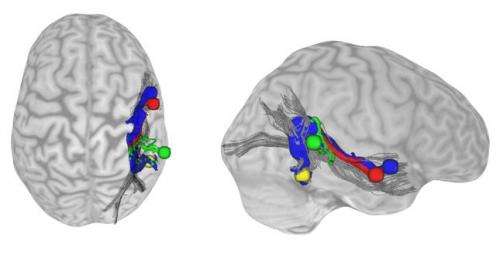
Direct structural connections exist between the two voice recognition areas (blue and red spheres) and the face recognition area (yellow sphere). In comparison, the connection to the area responsible for more general acoustic information (green sphere) is less strong. The connections appear to be part of larger fibre bundles (shown in grey).
(Medical Xpress) -- Face and voice are the two main features by which we recognise other people. Researchers at the Max Planck Institute (MPI) for Human Cognitive and Brain Sciences have now discovered that there is a direct structural connection consisting of fibre pathways between voice- and face-recognition areas in the human brain. The exchange of information, which is assumed to take place between these areas via this connection, could help us to quickly identify familiar people in everyday situations and also under adverse conditions.
Theories differ as to what happens in the brain when we recognise familiar persons. Conventionally, it is assumed that voice and face recognition are separate processes which are only combined on a higher processing level. However, recent findings indicate that voice and face recognition are much more closely related. Katharina von Kriegstein, Leader of the Max Planck Research Group Neural Mechanisms of Human Communication, found in previous research that areas of the brain which are responsible for the identification of faces also become active when we hear a familiar voice. These activations were accompanied by better voice recognition.
We now assume that areas in the brain which are involved in voice and face recognition interact directly and influence each other, says Helen Blank, a member of von Kriegsteins research group. In a new study, Blank could show that a structural connection between voice and face recognition areas exists. She used diffusion-weighted magnetic resonance imaging, a method with which the course of white matter tracts in the brain can be reconstructed when combined with tractography, a mathematical modelling technique. Blank had located the areas responsible for voice and face recognition in her study participants by measuring the reactions of the brain to different voices and faces using magnetic resonance imaging.
Blank discovered a direct connection consisting of fibre pathways between the voice- and the face-recognition area. It is particularly interesting that the face recognition area appears to be more strongly connected with the areas involved in voice identification, despite the fact that these areas are further away than areas which process information from voices on a more general level, says the researcher.
This direct connection in our brains could be used in everyday contexts to simulate the faces of our conversation partners, e.g. when we speak on the telephone to a familiar person. However, the precise nature of the information that is exchanged between the voice- and face-recognition areas remains unclear. A forthcoming study which Blank is currently preparing aims to clarify this issue.
Obtaining a more detailed understanding of how the brain works in relation to the processing of such basic tasks as person recognition could be of benefit in many different areas. The finding is of interest for research on unusual neurological conditions, such as prosopagnosia and phonagnosia, which prevent people from being able to recognise others from their faces or voices, says Blank. The new insights could also stimulate innovations in computer technology and improve person recognition by machines.
More information: Blank H, Anwander A, von Kriegstein K: Direct structural connections between voice- and face-recognition areas. The Journal of Neuroscience, 31(36): 12906-12915.
Provided by
Max-Planck-Gesellschaft
-
How do we combine faces and voices?
Mar 09, 2011 |
not rated yet |
0
-
Voice cells for voice recognition
Aug 24, 2011 |
not rated yet |
0
-
Brain 'hears' voices when reading direct speech
Jul 26, 2011 |
not rated yet |
0
-
Can't place that face? The trouble may be in your neurons
Jul 28, 2010 |
not rated yet |
0
-
Similar structures for face selectivity in human and monkey brains
Apr 28, 2011 |
not rated yet |
0
-
Motion perception revisited: High Phi effect challenges established motion perception assumptions
Apr 23, 2013 |
3 / 5 (2) |
2
-
Anything you can do I can do better: Neuromolecular foundations of the superiority illusion (Update)
Apr 02, 2013 |
4.5 / 5 (11) |
5
-
The visual system as economist: Neural resource allocation in visual adaptation
Mar 30, 2013 |
5 / 5 (2) |
9
-
Separate lives: Neuronal and organismal lifespans decoupled
Mar 27, 2013 |
4.9 / 5 (8) |
0
-
Sizing things up: The evolutionary neurobiology of scale invariance
Feb 28, 2013 |
4.8 / 5 (10) |
14
-
Why is zone 1 in liver more prone to ischemic injury?
May 23, 2013
-
How can there be villous adenoma in colon, if there are no villi there
May 22, 2013
-
How can there be a term called "intestinal metaplasia" of stomach
May 21, 2013
-
Pressure-volume curve: Elastic Recoil Pressure don't make sense
May 18, 2013
-
If you became brain-dead, would you want them to pull the plug?
May 17, 2013
-
MRI bill question
May 15, 2013
- More from Physics Forums - Medical Sciences
More news stories
New neuron formation could increase capacity for new learning, at the expense of old memories
New research presented today shows that formation of new neurons in the hippocampus - a brain region known for its importance in learning and remembering - could cause forgetting of old memories by causing a reorganization ...
Neuroscience
May 24, 2013 |
4 / 5 (4) |
0
Help at hand for people with schizophrenia
How can healthy people who hear voices help schizophrenics? Finding the answer for this is at the centre of research conducted at the University of Bergen.
Neuroscience
May 24, 2013 |
4 / 5 (2) |
2
Japanese research organizations contribute to Human Brain Project
One of the major frontiers of modern science is a comprehensive understanding of the human brain and its functions to guide the development of new technologies in information and communication. In a major announcement for ...
Neuroscience
May 24, 2013 |
3.7 / 5 (3) |
0
Controlling mood through the motions of mitochondria
(Medical Xpress)—Regulating the distribution of power in neurons is done by a system that makes the national electric grid look simple by comparison. Each neuron has several thousand mitochondria confined ...
Neuroscience
May 23, 2013 |
4.9 / 5 (9) |
0
|
Brain uses internal 'average voice' prototype to identify who is talking
(Medical Xpress)—The human brain is able to identify individuals' voices by comparing them against an internal 'average voice' prototype, according to neuroscientists.
Neuroscience
May 23, 2013 |
3.7 / 5 (3) |
3
|
Seniors more likely to crash when driving with pet, study finds
(HealthDay)—Animals make great companions for senior citizens, but elderly people who always drive with a pet in the car are far more likely to crash than those who never drive with a pet, researchers have ...
First drug to improve heart failure mortality in over a decade
Coenzyme Q10 decreases all cause mortality by half, according to the results of a multicentre randomised double blind trial presented today at Heart Failure 2013 congress. It is the first drug to improve heart failure mortality ...
Heart failure accelerates male 'menopause'
Heart failure accelerates the aging process and brings on early andropausal syndrome (AS), according to research presented today at the Heart Failure Congress 2013. AS, also referred to as male 'menopause', was four times ...
Death highest in heart failure patients admitted in January, on Friday, and overnight
Mortality and length of stay are highest in heart failure patients admitted in January, on Friday, and overnight, according to research presented today at the Heart Failure Congress 2013. The analysis of nearly 1 million ...
Feds fight morning-after pill age ruling in NY
(AP)—Department of Justice lawyers have again asked a federal appeals court in New York to delay lifting age restrictions and prescription requirements on an emergency contraceptive popularly known as the morning-after ...
New immune system discovered
(Medical Xpress)—A research team, led by Jeremy Barr, a biology post-doctoral fellow, unveils a new immune system that protects humans and animals from infection.