Protein prompting cells to sprout legs could cause skin cancer to spread
September 15, 2011 in Cancer
Protein prompting cells to sprout legs could cause skin cancer to spread

Enlarge

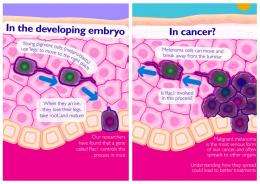
Cancer Research UK scientists have discovered that a protein called Rac1 prompts pigment cells to sprout long ‘legs’ that could propel skin cancer cells, allowing them to spread, according to research published in Developmental Cell today.

The team from Research UK’s Beatson Institute for Cancer Research at the University of Glasgow showed that when Rac1 is switched on in mice it signals healthy , called melanoblasts, to grow legs and ‘travel’ during their early development. When Rac1 was ‘switched off’ the were only able to sprout short buds and had difficulty moving.

Melanoblast cells mature to develop into melanocytes – pigment-producing cells that define skin and hair colour. Melanocytes can form moles, or naevi, and if they contain genetic faults these cells can develop into melanomas – the most dangerous form of .

Immature melanoblasts move through the developing skin layers of an embryo to find the correct place to settle and grow. Once they have matured and anchored in position, they no longer travel.

But cancer cells sometimes mimic the characteristics of immature embryonic cells such as melanoblasts and ‘re-learn’ forgotten skills – such as the ability to move. Studying these immature cells helps scientists understand how cancer develops and spreads.

Lead author, Professor Laura Machesky at Cancer Research UK’s Beatson Institute, said: “We’ve discovered that a called Rac1 triggers the growth of long ‘legs’ which can propel cells during the early stages of skin development.

“But once cells have matured these ‘shape-shifting’ abilities are lost.

“Our study reveals fresh understanding of how melanoma cells could re-learn forgotten skills, such as being able to change shape, and use these abilities to break away from a tumor and move around the body.”

There are around 11,770 new cases of malignant melanoma diagnosed each year in the UK and it is mainly caused by over exposure to UV light. Almost one third of all cases of malignant melanoma occur in people under 55.

Dr. Lesley Walker, Cancer Research UK’s director of cancer information, said: “Our scientists are carrying out pioneering work to understand the biology of skin cancer and to find new and better ways to treat the disease.

“Melanoma can be successfully treated if caught early, but can be deadly if it spreads to new areas.

“It’s critical to understand how this happens so we can develop drugs to block this process.”

More information: Rac1 drives melanoblast organization during mouse development by orchestrating pseudopod-driven motility and cell cycle progression. Li et al. Developmental Cell.

Provided by Cancer Research UK

not rated yet  

Rank not rated yet
Relevant PhysicsForums posts
  • Potential Breakthrough in Seizure Control
    created4 hours ago
  • Popping/Cracked sternum.
    created9 hours ago
  • Which Mental Illness Encompasses This Problem?
    created9 hours ago
  • A question about drug tolerance
    createdMay 23, 2012
  • Poor nutrition leading to overeating?
    createdMay 23, 2012
  • Math and dyslexia?
    createdMay 21, 2012
  • More from Physics Forums - Medical Sciences

More news stories

Skp2 activates cancer-promoting, glucose-processing Akt

HER2 and its epidermal growth factor receptor cousins mobilize a specialized protein to activate a major player in cancer development and sugar metabolism, scientists report in the May 25 issue of Cell.

Cancer created 17 hours ago | popularity not rated yet | comments 0 | with audio podcast

Pancreatectomy OK without downstaging from therapy

(HealthDay) -- Pancreatectomy improves median survival in pancreatic cancer patients even when presurgical neoadjuvant therapy does not lead to radiographic downstaging of tumors, according to a study published ...

Cancer created 18 hours ago | popularity not rated yet | comments 0

Common therapies for basal cell carcinoma offer similar survival

(HealthDay) -- For patients with superficial basal cell carcinoma (sBCC), treatment with imiquimod or photodynamic therapy (PDT) results in similar long-term tumor-free survival, according to a review published ...

Cancer created 19 hours ago | popularity not rated yet | comments 0

Cancer may require simpler genetic mutations than previously thought

Chromosomal deletions in DNA often involve just one of two gene copies inherited from either parent. But scientists haven't known how a deletion in one gene from one parent, called a "hemizygous" deletion, can contribute ...

Cancer created 21 hours ago | popularity not rated yet | comments 0 | with audio podcast

New prostate cancer screening guidelines face a tough sell, study suggests

(Medical Xpress) -- Recent recommendations from the U.S. Preventive Services Task Force (USPSTF) advising elimination of routine prostate-specific antigen (PSA) screening for prostate cancer in healthy men are likely to encounter ...

Cancer created May 25, 2012 | popularity not rated yet | comments 1


Travel to high altitudes tied to Crohn's, colitis flare-ups

(HealthDay) -- People with inflammatory bowel disease, which includes Crohn's disease and colitis, may be at increased risk for flare-ups when they fly or travel to high altitudes for skiing or mountain climbing, ...

Transvaginal mesh op restores pelvic organ prolapse at price

(HealthDay) -- Transvaginal mesh (TVM) procedures are effective for anatomical restoration of pelvic organ prolapse (POP), but patients report a worsening of sexual function following surgery, according to ...

Of mice and mental models: Neuroscientific implications of risk-optimized behavior in the mouse

(Medical Xpress) -- Regardless of an organism’s biological complexity, every encephalized animal continuously makes under-informed behavioral choices that can have serious consequences. Despite its ubiquity, ...

Inherited DNA change explains overactive leukemia gene

A small inherited change in DNA is largely responsible for overactivating a gene linked to poor treatment response in people with acute leukemia.

Tongue analysis software uses ancient Chinese medicine to warn of disease

For 5,000 years, the Chinese have used a system of medicine based on the flow and balance of positive and negative energies in the body. In this system, the appearance of the tongue is one of the measures used to classify ...

Early physical therapist treatment associated with reduced risk of healthcare utilization and reduced overall healthcare

A new study published in Spine shows that early treatment by a physical therapist for low back pain (LBP), as compared to delayed treatment, was associated with reduced risk of subsequent healthcare utilization and lower ...