Brain imaging study: A step toward true 'dream reading'
October 27, 2011 in Neuroscience
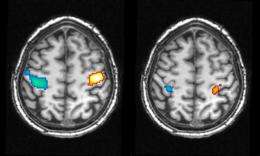
Activity in the motor cortex during the movement of the hands while awake (left) and during a dreamed movement (right). Blue areas indicate the activity during a movement of the right hand, which is clearly demonstrated in the left brain hemisphere, while red regions indicate the corresponding left-hand movements in the opposite brain hemisphere. © MPI of Psychiatry
When people dream that they are performing a particular action, a portion of the brain involved in the planning and execution of movement lights up with activity. The finding, made by scanning the brains of lucid dreamers while they slept, offers a glimpse into the non-waking consciousness and is a first step toward true "dream reading," according to a report published online in the Cell Press journal Current Biology on October 27.
"Dreaming is not just looking at a dream movie," said Martin Dresler of the Max Planck Institute of Psychiatry. "Brain regions representing specific body motions are activated."
Lucid dreamers are aware that they are dreaming and can deliberately control their actions in dreams. The researchers realized that this learned skill presents an opportunity for studying the neural underpinnings of our dreams.
"The main obstacle in studying specific dream content is that spontaneous dream activity cannot be experimentally controlled, as subjects typically cannot perform predecided mental actions during sleep," study coauthor Michael Czisch explained. "Employing the skill of lucid dreaming can help to overcome these obstacles."
The researchers instructed participants to make a series of left and right hand movements separated by a series of eye movements upon entering a lucid dream state while their brains were scanned. Those eye movements served as a signal to the researchers of what was happening in the dream.
Those studies show for the first time that neural activity observed in the brain's sensorimotor cortex can be related to dreamed hand movements.
The discovery suggests that lucid dreaming in combination with neuroimaging and polysomnography (a more common form of sleep monitoring) may allow the transfer of more sophisticated "brain reading" tasks to the dreaming state, the researchers say. In other words, it might eventually be possible to predict dreamed content by analyzing patterns of brain activity.
Dresler says it will also be interesting to investigate brain activity at the moment a dreamer becomes lucid.
"The lucid dreamer gains insight into a very complex state: sleeping, dreaming, but being consciously aware of the dream state," he said. "This may inform us about concepts of consciousness."
Provided by
Cell Press
-
Probing Question: What is a lucid dream?
Aug 26, 2010 |
not rated yet |
0
-
New links between lucid dreaming and psychosis could revive dream therapy in psychiatry
Jul 29, 2009 |
not rated yet |
0
-
Dreams may have an important physiological function
Nov 12, 2009 |
not rated yet |
0
-
Dream reports from both men and women consist of some form of sexual-related activity
Jun 14, 2007 |
not rated yet |
0
-
To learn better, take a nap (and don't forget to dream)
Apr 22, 2010 |
not rated yet |
0
-
Motion perception revisited: High Phi effect challenges established motion perception assumptions
Apr 23, 2013 |
3 / 5 (2) |
2
-
Anything you can do I can do better: Neuromolecular foundations of the superiority illusion (Update)
Apr 02, 2013 |
4.5 / 5 (11) |
5
-
The visual system as economist: Neural resource allocation in visual adaptation
Mar 30, 2013 |
5 / 5 (2) |
9
-
Separate lives: Neuronal and organismal lifespans decoupled
Mar 27, 2013 |
4.9 / 5 (8) |
0
-
Sizing things up: The evolutionary neurobiology of scale invariance
Feb 28, 2013 |
4.8 / 5 (10) |
14
-
Why is zone 1 in liver more prone to ischemic injury?
20 hours ago
-
How can there be villous adenoma in colon, if there are no villi there
May 22, 2013
-
How can there be a term called "intestinal metaplasia" of stomach
May 21, 2013
-
Pressure-volume curve: Elastic Recoil Pressure don't make sense
May 18, 2013
-
If you became brain-dead, would you want them to pull the plug?
May 17, 2013
-
MRI bill question
May 15, 2013
- More from Physics Forums - Medical Sciences
More news stories
Controlling mood through the motions of mitochondria
(Medical Xpress)—Regulating the distribution of power in neurons is done by a system that makes the national electric grid look simple by comparison. Each neuron has several thousand mitochondria confined ...
Neuroscience
7 hours ago |
4.8 / 5 (5) |
0
|
Brain uses internal 'average voice' prototype to identify who is talking
(Medical Xpress)—The human brain is able to identify individuals' voices by comparing them against an internal 'average voice' prototype, according to neuroscientists.
Neuroscience
11 hours ago |
1 / 5 (1) |
0
|
Depression common among children with temporal lobe epilepsy
A new study determined that children and adolescents with seizures involving the temporal lobe are likely to have clinically significant behavioral problems and psychiatric illness, especially depression. Findings published ...
Neuroscience
11 hours ago |
not rated yet |
0
The secret lives, and deaths, of neurons
As the human body fine-tunes its neurological wiring, nerve cells often must fix a faulty connection by amputating an axon—the "business end" of the neuron that sends electrical impulses to tissues or other ...
Neuroscience
13 hours ago |
5 / 5 (2) |
0
|
Regenerating spinal cord fibers may be treatment for stroke-related disabilities
A study by researchers at Henry Ford Hospital found "substantial evidence" that a regenerative process involving damaged nerve fibers in the spinal cord could hold the key to better functional recovery by most stroke victims.
Neuroscience
13 hours ago |
not rated yet |
0
|
ACP issues recommendations for management of high blood glucose in hospitalized patients
High blood glucose is associated with poor outcomes in hospitalized patients, and use of intensive insulin therapy (IIT) to control hyperglycemia is a common practice in hospitals. But the recent evidence does not show a ...
Motion quotient: IQ predicted by ability to filter motion (w/ video)
A brief visual task can predict IQ, according to a new study. This surprisingly simple exercise measures the brain's unconscious ability to filter out visual movement. The study shows that individuals whose ...
Multiple research teams unable to confirm high-profile Alzheimer's study
Teams of highly respected Alzheimer's researchers failed to replicate what appeared to be breakthrough results for the treatment of this brain disease when they were published last year in the journal Science.
Scientists discover molecule triggers sensation of itch
Scientists at the National Institutes of Health report they have discovered in mouse studies that a small molecule released in the spinal cord triggers a process that is later experienced in the brain as ...
Researchers find common childhood asthma unconnected to allergens or inflammation
Little is known about why asthma develops, how it constricts the airway or why response to treatments varies between patients. Now, a team of researchers at Weill Cornell Medical College, Columbia University Medical Center ...
Type 2 diabetes progresses faster in kids, study finds
(HealthDay)—Type 2 diabetes is more aggressive in children than adults, with signs of serious complications seen just a few years after diagnosis, new research finds.
Oct 28, 2011
Rank: not rated yet
Oct 28, 2011
Rank: 2 / 5 (4)
Is it the experience of Nature you replace?
Who takes Nature for granted? Why?
Oct 28, 2011
Rank: 1 / 5 (1)
I wonder if the researchers explored the difference in brain activity between all the possible cases: performing the action, trying to perform the action but being physically restrained not to be able to, consciously imagining to perform the action without performing it, and dreaming of any of these as well. This article doesn't make much clear.
Oct 28, 2011
Rank: 1 / 5 (1)
Oct 31, 2011
Rank: not rated yet
BTW, what do mean by
Oct 31, 2011
Rank: 1 / 5 (1)
The quote explained:
When you replace the physical, the replacement will be inferior to the 'real' reality you replaced.
Please, no lecture. Naive realism does not exist. Those words are meaningless. Experience is not what you have been taught the word means.
.1)What is inside your head are neurons. If you can not agree to that, the discourse ends here.
.2)What else is inside your head besides neurons? Electrical activity, from the neurons.
.3)What else is inside your head besides electrical activity from neurons? Nothing. Why? Because that is all your need - no matter what exists 'outside' the electrical activity of neurons.
When you were in the womb, you performed literally the functions you will exhibited at birth:
Did you breath? Yes you did. (Amniotic fluid)
Did you hear? Yes you did. (Mothers' and your heartbeat)
Did you see? Yes you did. (Darkness)
cont...
Oct 31, 2011
Rank: 1 / 5 (1)
Did you smile. Yes, you did. (Research recordings)
Did you blink? Yes, you did. (More research)
This list does not stop. You did literally everything in the womb that you will repeat at birth. At birth you will cry.
Let's talk about the word 'experience'.
What did you 'experience' in the womb?
If you 'experienced' nothing in the womb, were you dead?
If you 'experienced' something in the womb, what was that 'experience'? Describe that experience.
I suggest when talking about the human state (of mind) you dump three words from you vocabulary:
1.)Experience
2.)Naive realism
3.)Truth
Let me know when you do. Then we can discourse further about what really happens to your neurons and all that exists beyond the membranes of your neurons.
Then there is no aspect about you that I will fail not to adequately explain. And rest assured. The words, naive realism, experience and truth will not be among the words of explanation.
Nov 06, 2011
Rank: 1 / 5 (1)
Understand Sleep
From
http://universe-life.com/2011/07/16/sleep-researchers-are-still-researching/" title="http://http://universe-life.com/2011/07/16/sleep-researchers-are-still-researching/" rel="nofollow" target="_blank">http://universe-l...arching/
Why Life Eats And Why Life Sleeps:
-Life ( and other, inanimate, mass spin arrays ) eats because the universe expands.
-Life sleeps because RNAs genesised-evolved long before metabolism evolved. They were active ONLY during sunlight hours. Thus sleep is inherent for RNAs, even though, being ORGANISMS, they now adapt to when/extent sleep time are feasible
Dov Henis
(comments from 22nd century)
http://universe-life.com
Nov 09, 2011
Rank: not rated yet
I don't need you to "adequately explain" my experience to me.
If you choose to espouse some particular form of extreme reductionism, that is your choice. I no longer fight about such things; life is too short to be expended assailing apparently immovable objects so I just go around them. I am satisfied that human experience is intrinsically paradoxical and that there is no escape from the paradox.
If you want to test your mettle though try Steven Lehar,
http:// cns-alumni .bu .edu/~slehar/webstuff/bubw3/bubw3 .html#compmech
NB: remove the spaces and the link should work. Enjoy!