Our brains are made of the same stuff, despite DNA differences
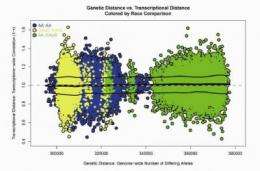
Our brains are all made of the same stuff. Despite individual and ethnic genetic diversity, our prefrontal cortex shows a consistent molecular architecture. For example, overall differences in the genetic code (“genetic distance”) between African -Americans (AA) and caucasians (cauc) showed no effect on their overall difference in expressed transcripts (“transcriptional distance”). The vertical span of color-coded areas is about the same, indicating that our brains all share the same tissue at a molecular level, despite distinct DNA differences on the horizontal axis. Each dot represents a comparison between two individuals. The AA::AA comparisons (blue) generally show more genetic diversity than cauc::cauc comparisons (yellow), because caucasians are descended from a relatively small subset of ancestors who migrated from Africa, while African Americans are descended from a more diverse gene pool among the much larger population that remained in Africa. AA::cauc comparisons (green) differed most across their genomes as a whole, but this had no effect on their transcriptomes as a whole. Credit: Joel Kleinman, M.D., Ph.D., NIMH Clinical Brain Disorders Branch
Despite vast differences in the genetic code across individuals and ethnicities, the human brain shows a "consistent molecular architecture," say researchers supported by the National Institutes of Health. The finding is from a pair of studies that have created databases revealing when and where genes turn on and off in multiple brain regions through development.
"Our study shows how 650,000 common genetic variations that make each of us a unique person may influence the ebb and flow of 24,000 genes in the most distinctly human part of our brain as we grow and age," explained Joel Kleinman, M.D., Ph.D., of the National Institute of Mental Health (NIMH) Clinical Brain Disorders Branch.
Kleinman and NIMH grantee Nenad Sestan, M.D., Ph.D. of Yale University, New Haven, Conn., led the sister studies in the Oct. 27, 2011 issue of the journal Nature.
"Having at our fingertips detailed information about when and where specific gene products are expressed in the brain brings new hope for understanding how this process can go awry in schizophrenia, autism and other brain disorders," said NIMH Director Thomas R. Insel, M.D.
Both studies measured messenger RNAs or transcripts. These intermediate products carry the message from DNA, the genetic blueprint, to create proteins and differentiated brain tissue. Each gene can make several transcripts, which are expressed in patterns influenced by a subset of the approximately 1.5 million DNA variations unique to each of us. This unique set of transcripts is called our transcriptome a molecular signature that is unique to every individual. The transcriptome is a measure of the diverse functional potential that exists in the brain.
Both studies found that rapid gene expression during fetal development abruptly switches to much slower rates after birth that gradually decline and eventually level off in middle age. These rates surge again as the brain ages in the last decades, mirroring rates seen in childhood and adolescence, according to one of the studies. The databases hold secrets to how the brain's ever-changing messenger chemical systems, cells and development processes are related to gene expression patterns through development.
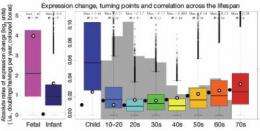
Overall gene expression plummets 5-fold in infancy and 90-fold in childhood from its prenatal peak. The decline levels-off during the middle years, but expression surges again in the last decades of life, as the brain ages. Note: The fetal/infant graph at left is based on a different scale than the lifespan graph at right, so the two are not visually comparable. Credit: Joel Kleinman, M.D., Ph.D., NIMH Clinical Brain Disorders Branch
For example, if a particular version of a gene is implicated in a disorder, the new resources might reveal how that variation affects the gene's expression over time and by brain region. By identifying even distant genes that may be turning on and off in-sync, the databases may help researchers discover whole modules of genes involved in the illness. They can also reveal how variation in one gene influences another's expression.Prefrontal cortex
Kleinman's team focused on how genetic variations are linked to the expression of transcripts in the brain's prefrontal cortex, the area that controls insight, planning and judgment, across the lifespan. They studied 269 postmortem, healthy human brains, ranging in age from two weeks after conception to 80 years old, using 49,000 genetic probes. The database on prefrontal cortex gene expression alone totals more than 1 trillion pieces of information, according to Kleinman.
Among key findings in the prefrontal cortex:
- Individual genetic variations are profoundly linked to expression patterns. The most similarity across individuals is detected early in development and again as we approach the end of life.
- Different types of related genes are expressed during prenatal development, infancy, and childhood, so that each of these stages shows a relatively distinct transcriptional identity. Three-fourths of genes reverse their direction of expression after birth, with most switching from on to off.
- Expression of genes involved in cell division declines prenatally and in infancy, while expression of genes important for making synapses, or connections between brain cells, increases. In contrast, genes required for neuronal projections decline after birth likely as unused connections are pruned.
- By the time we reach our 50s, overall gene expression begins to increase, mirroring the sharp reversal of fetal expression changes that occur in infancy.
- Genetic variation in the genome as a whole showed no effect on variation in the transcriptome as a whole, despite how genetically distant individuals might be. Hence, human cortexes have a consistent molecular architecture, despite our diversity.
Multiple brain regions
Sestan and colleagues characterized gene expression in 16 brain regions, including 11 areas of the neocortex, from both hemispheres of 57 human brains that spanned from 40 days post-conception to 82 years analyzing the transcriptomes of 1,340 samples. Using 1.4 million probes, the researchers measured the expression of exons, which combine to form a gene's protein product. This allowed them to pinpoint changes in these combinations that make up a protein, as well as to chart the gene's overall expression.
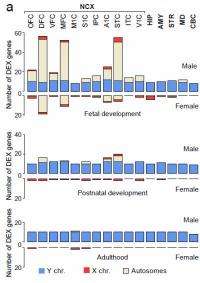
Males show more sex-biased gene expression. More genes differentially expressed (DEX) between the sexes were found in males than females, especially prenatally. Some genes found to have such sex-biased expression had previously been associated with disorders that affect males more than females, such as schizophrenia, Williams syndrome, and autism. Eleven of the brain areas shown are in the neocortex (NCX), or outer mantle. Credit: Nenad Sestan, M.D., Ph.D., Yale University Department of Neurobiology and Kavli Institute for Neuroscience
Among key findings:-- Over 90 percent of the genes expressed in the brain are differentially regulated across brain regions and/or over developmental time periods. There are also widespread differences across region and time periods in the combination of a gene's exons that are expressed.
-- Timing and location are far more influential in regulating gene expression than gender, ethnicity or individual variation.
-- Among 29 modules of co-expressed genes identified, each had distinct expression patterns and represented different biological processes. Genetic variation in some of the most well-connected genes in these modules, called hub genes, has previously been linked to mental disorders, including schizophrenia and depression.
-- Telltale similarities in expression profiles with genes previously implicated in schizophrenia and autism are providing leads to discovery of other genes potentially involved in those disorders.
-- Sex differences in the risk for certain mental disorders may be traceable to transcriptional mechanisms. More than three-fourths of 159 genes expressed differentially between the sexes were male-biased, most prenatally. Some genes found to have such sex-biased expression had previously been associated with disorders that affect males more than females, such as schizophrenia, Williams syndrome, and autism.
More information: The Kleinman study data on genetic variability are accessible to qualified researchers at www.ncbi.nlm.nih.g… 000417.v1.p1 , while the gene expression data can be found at www.ncbi.nlm.nih.g… acc5GSE30272 . In addition, BrainCloud, a web browser application developed by NIMH to interrogate the Kleinman study data, can be downloaded at www.libd.org/braincloud .
Provided by National Institutes of Health
-
Autism blurs distinctions between brain regions
Jun 03, 2011 |
not rated yet |
0
-
Gene activity in the brain depends on genetic background
Oct 19, 2010 |
not rated yet |
0
-
Scientists identify age-associated defects in schizophrenia
Mar 01, 2010 |
not rated yet |
0
-
Common gene version optimizes thinking -- but with a possible downside
Feb 08, 2007 |
not rated yet |
0
-
Researchers find a partially shared genetic profile between schizophrenia and bipolar disorder
Jul 17, 2008 |
not rated yet |
0
-
Motion perception revisited: High Phi effect challenges established motion perception assumptions
Apr 23, 2013 |
3 / 5 (2) |
2
-
Anything you can do I can do better: Neuromolecular foundations of the superiority illusion (Update)
Apr 02, 2013 |
4.5 / 5 (11) |
5
-
The visual system as economist: Neural resource allocation in visual adaptation
Mar 30, 2013 |
5 / 5 (2) |
9
-
Separate lives: Neuronal and organismal lifespans decoupled
Mar 27, 2013 |
4.9 / 5 (8) |
0
-
Sizing things up: The evolutionary neurobiology of scale invariance
Feb 28, 2013 |
4.8 / 5 (10) |
14
-
Classical and Quantum Mechanics via Lie algebras
Apr 15, 2011
- More from Physics Forums - Independent Research
More news stories
Researchers complete largest genetic sequencing study of human disease
Researchers from Queen Mary, University of London have led the largest sequencing study of human disease to date, investigating the genetic basis of six autoimmune diseases.
Genetics
9 hours ago |
4 / 5 (1) |
0
|
Researchers develop model for better testing, targeting of malignant peripheral nerve sheath tumors
University of Minnesota Medical School researchers from the Masonic Cancer Center, University of Minnesota, in partnership with the University's Brain Tumor Program, have developed a new mouse model of malignant peripheral ...
Genetics
May 20, 2013 |
5 / 5 (1) |
0
|
Researchers identify new circadian clock component
Northwestern University scientists have shown a gene involved in neurodegenerative disease also plays a critical role in the proper function of the circadian clock.
Genetics
May 16, 2013 |
3 / 5 (1) |
1
|
Returning genetic incidental findings without patient consent violates basic rights, experts say
Informed consent is the backbone of patient care. Genetic testing has long required patient consent and patients have had a "right not to know" the results. However, as 21st century medicine now begins to use the tools of ...
Genetics
May 16, 2013 |
5 / 5 (1) |
3
|
Ethicists provide framework supporting new recommendations on reporting incidental findings in gene sequencing
In a paper published in Science Express, a group of experts led by bioethicists in the Center for Medical Ethics and Health Policy at Baylor College of Medicine provide a framework for the new American College of Medical Geneti ...
Genetics
May 16, 2013 |
not rated yet |
0
Slowing the aging process—only with antibiotics
Swiss scientists reveal the mechanism responsible for aging hidden deep within mitochondria—and dramatically slow it down in worms by administering antibiotics to the young.
Brain can be trained in compassion, study shows
Until now, little was scientifically known about the human potential to cultivate compassion—the emotional state of caring for people who are suffering in a way that motivates altruistic behavior.
Having both migraines, depression may mean smaller brain
(HealthDay)—Migraines and depression can each cause a great deal of suffering, but new research indicates the combination of the two may be linked to something else entirely—a smaller brain.
Novel approach for influenza vaccination shows promise in early animal testing
A new approach for immunizing against influenza elicited a more potent immune response and broader protection than the currently licensed seasonal influenza vaccines when tested in mice and ferrets. The vaccine ...
Enzyme-activating antibodies revealed as marker for most severe form of rheumatoid arthritis
In a series of lab experiments designed to unravel the workings of a key enzyme widely considered a possible trigger of rheumatoid arthritis, researchers at Johns Hopkins have found that in the most severe ...
Research offers promising new approach to treatment of lung cancer
Researchers have developed a new drug delivery system that allows inhalation of chemotherapeutic drugs to help treat lung cancer, and in laboratory and animal tests it appears to reduce the systemic damage ...


Oct 26, 2011
Rank: not rated yet
Oct 26, 2011
Rank: 1 / 5 (3)
I corrected the title typo for you.
Your welcome.
Oct 26, 2011
Rank: 1 / 5 (1)
Then I will ask myself what I can do to help you comment instead of just rating.
Oct 26, 2011
Rank: 1 / 5 (3)
Oct 26, 2011
Rank: not rated yet
Unless the brain loses 'rewiring' ability or capacity, I am all for a 'we-have-a-say-in-what-we-rewire' and 'we-have-no-say-in-how-the-rewiring-will-occur'.
The wording:
The already available associations in our brain and the combo of constant external new associations to those already available associations we are aware of in our brain is probability - what is probability of the right combo you custom tailor to advance your insight and/or understanding.
In the above wording, 'flashes of brilliance' happen more or less all the time. Faced with choice, it is a matter of chance that 'flashes of brilliance' and choice coincide.
The coincidence of both at the same time are labeled "right choices" - appearing to an onlooker as "genius".
cont...
Oct 27, 2011
Rank: 5 / 5 (1)
No one likes to be told of their thoughts falling short. So you simply explain your thought processes that led to your achievement. "Genius", true "genius" is putting to words your thought processes with words or language everyone understands.
You are a genius when everyone understands you. You did nothing except bring together associations and choice no one else had. You were lucky enough to have unique associations.
Which earns you both: Praise and scorn.
Only one flash of brilliance and you are no different than Einstein or Hawking. Only the number of right choices keeps you in their shadows.
Oct 27, 2011
Rank: not rated yet
To those who rated my comments a one, I know what your IQ is, was, and ever will be. YOUR choices won't make YOU any smarter. What I didn't say and should be obvious is that it works both ways, your choices can also make you no smarter or even less smart. So don't believe me, the world needs people to change my tires and take my garbage while I enjoy the fruits of the choices I made that made me smart enough to not have to work anymore.
Oct 27, 2011
Rank: not rated yet
Oct 30, 2011
Rank: not rated yet