Mushroom compound appears to improve effectiveness of cancer drugs
October 11, 2011 in Cancer
Mushroom compound appears to improve effectiveness of cancer drugs

Enlarge

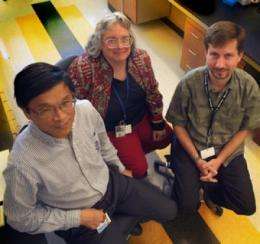
A compound isolated from a wild, poisonous mushroom growing in a Southwest China forest appears to help a cancer killing drug fulfill its promise, researchers report. Pictured (L to R) are GHSU researchers, Dr. Kebin Liu, Dr. Wendy Bollag and Dr. Keith Robertson. Credit: Phil Jones, GHSU campus photographer

A compound isolated from a wild, poisonous mushroom growing in a Southwest China forest appears to help a cancer killing drug fulfill its promise, researchers report.

The compound, verticillin A, sensitizes to TRAIL, a drug which induces cancer cells to self destruct, said Dr. Kebin Liu, cancer immunologist at the Georgia Health Sciences University Cancer Center and corresponding author of the study in the journal Cancer Research.

The compound appears to keep cancer cells from developing resistance to TRAIL, short for tumor necrosis factor-related apoptosis inducing ligand. , intrinsic or acquired, is a major problem for , accounting for greater than 90 percent of treatment failures in patients with metastatic disease.

"If we can make drugs work again, more people will survive," Liu said.

Patient experience has shown cancer's skill at desensitizing itself to the TRAIL. "It looks as though most cancer cells have found a way to become resistant and evade its action," said Dr. Wendy Bollag, cell physiologist at GHSU and a study co-author. Tenacious cancer cells also are naturally resistant to , which is how TRAIL works.

In mice, they found verticillin A alone was adequate to kill cancer cells, but the required dose made the mice sick, a common problem with many cancer therapies. However, when a lower dose was paired with TRAIL, it became a powerful, more tolerable recipe that killed previously .

They also found that the compound improved the efficacy of commonly used etoposide and cisplatin, which also work by promoting cancer cell death but are less targeted than TRAIL. "We believe this could be a good companion drug for a lot of cancer therapies," Liu said.

One way verticillin A appears to work is by upregulating BN1P3, a gene that promotes cell death, the researchers said. Cancer cells work to silence BN1P3 through a process called DNA methylation; verticillin A appears to modify the same process to turn the gene on.

All cells use but cancer cells use it differently, said Dr. Keith Robertson, cancer epigeneticist and Georgia Cancer Coalition Scholar. "Verticillin A may be working by altering methylation in a way that makes the cancer cells sensitive to TRAIL," Robertson said.

Their studies were of metastatic human colon cancer cells, which are highly resistant to treatment, including TRAIL, both in culture as well as transplanted into mice. They did similar studies on sarcoma, lung adenocarcinoma and breast cancer.

Additional toxicity studies are needed before moving forward with clinical trials, Bollag said. The researchers also want to pursue the compound's potential in melanoma and pancreatic cancer.

Verticillin A was isolated from mushrooms in Dr. Ping Wu's laboratory at the Research Centre of Siyuan Natural Pharmacy and Biotoxicology at China's Zhejiang University and brought to GHSU by former postdoctoral fellow, Dr. Feiyan Liu, the study's first author, who studied with Kebin Liu in Augusta for two years. The Chinese university is involved in extensive studies to isolate active compounds from plants to explore their therapeutic potential and both Dr. Lius liked verticillin A's aggressive response against cancer.

Provided by Georgia Health Sciences University

5 /5 (2 votes)  

Rank 5 /5 (2 votes)
Relevant PhysicsForums posts
  • Potential Breakthrough in Seizure Control
    created7 hours ago
  • Popping/Cracked sternum.
    created12 hours ago
  • Which Mental Illness Encompasses This Problem?
    created12 hours ago
  • A question about drug tolerance
    createdMay 23, 2012
  • Poor nutrition leading to overeating?
    createdMay 23, 2012
  • Math and dyslexia?
    createdMay 21, 2012
  • More from Physics Forums - Medical Sciences

More news stories

Skp2 activates cancer-promoting, glucose-processing Akt

HER2 and its epidermal growth factor receptor cousins mobilize a specialized protein to activate a major player in cancer development and sugar metabolism, scientists report in the May 25 issue of Cell.

Cancer created 20 hours ago | popularity not rated yet | comments 0 | with audio podcast

Pancreatectomy OK without downstaging from therapy

(HealthDay) -- Pancreatectomy improves median survival in pancreatic cancer patients even when presurgical neoadjuvant therapy does not lead to radiographic downstaging of tumors, according to a study published ...

Cancer created 21 hours ago | popularity not rated yet | comments 0

Common therapies for basal cell carcinoma offer similar survival

(HealthDay) -- For patients with superficial basal cell carcinoma (sBCC), treatment with imiquimod or photodynamic therapy (PDT) results in similar long-term tumor-free survival, according to a review published ...

Cancer created 22 hours ago | popularity not rated yet | comments 0

Cancer may require simpler genetic mutations than previously thought

Chromosomal deletions in DNA often involve just one of two gene copies inherited from either parent. But scientists haven't known how a deletion in one gene from one parent, called a "hemizygous" deletion, can contribute ...

Cancer created May 25, 2012 | popularity not rated yet | comments 0 | with audio podcast

New prostate cancer screening guidelines face a tough sell, study suggests

(Medical Xpress) -- Recent recommendations from the U.S. Preventive Services Task Force (USPSTF) advising elimination of routine prostate-specific antigen (PSA) screening for prostate cancer in healthy men are likely to encounter ...

Cancer created May 25, 2012 | popularity not rated yet | comments 1


Travel to high altitudes tied to Crohn's, colitis flare-ups

(HealthDay) -- People with inflammatory bowel disease, which includes Crohn's disease and colitis, may be at increased risk for flare-ups when they fly or travel to high altitudes for skiing or mountain climbing, ...

Family history of Alzheimer's affects functional connectivity

(HealthDay) -- Cognitively normal individuals with a family history of late-onset Alzheimer's disease (AD) may display lower resting state functional connectivity in the default mode network (DMN) of the brain, ...

Transvaginal mesh op restores pelvic organ prolapse at price

(HealthDay) -- Transvaginal mesh (TVM) procedures are effective for anatomical restoration of pelvic organ prolapse (POP), but patients report a worsening of sexual function following surgery, according to ...

Tongue analysis software uses ancient Chinese medicine to warn of disease

For 5,000 years, the Chinese have used a system of medicine based on the flow and balance of positive and negative energies in the body. In this system, the appearance of the tongue is one of the measures used to classify ...

Early physical therapist treatment associated with reduced risk of healthcare utilization and reduced overall healthcare

A new study published in Spine shows that early treatment by a physical therapist for low back pain (LBP), as compared to delayed treatment, was associated with reduced risk of subsequent healthcare utilization and lower ...

New device allows pacemaker patients to safely undergo MRIs

For many, it's a medical conundrum: The very pacemaker keeping their heart in rhythm prevents them from undergoing an MRI to diagnose other ailments, because interaction between the two devices could prove deadly.