Long road from farm to fork worsens food outbreaks
October 2, 2011 BY MARY CLARE JALONICK , Associated Press in Health

Long road from farm to fork worsens food outbreaks (AP)

Enlarge

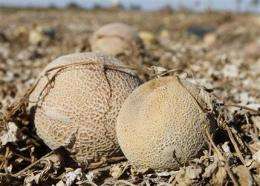
Cantaloupes rot in the afternoon heat on a field on the Jensen Farms near Holly, Colo., on Wednesday, Sept. 28, 2011. The Food and Drug Administration has recalled 300,000 cases of cantaloupe grown on the Jensen Farms after connecting it with a listeria outbreak. Officials said Wednesday more illnesses and possibly more deaths may be linked to the outbreak of listeria in coming weeks. (AP Photo/Ed Andrieski)

(AP) -- The recent listeria outbreak from cantaloupe shows that large-scale occurrences of serious illnesses linked to tainted food have grown more common over the years, partly because much of what we eat takes a long and winding road from farm to fork.

A cantaloupe grown on a Colorado field may make four or five stops before it reaches the dinner table. There's the packing house where it is cleaned and packaged, then the distributor who contracts with retailers to sell the in large quantities. A processor may cut or bag the fruit. The retail distribution center is where the melons are sent out to various stores. Finally it's stacked on display at the .

Imported , which make up almost two-thirds of the produce consumed in the United States, have an even longer journey.

"Increasingly with agribusiness you have limited producers of any given , so a breakdown in a facility or plant or in a large field crop operation exposes thousands because of the way the food is distributed," says Dr. Brian Currie, an infectious disease specialist at Montefiore Medical Center in New York.

The Colorado cantaloupe crop that's linked to 84 illnesses and as many as 17 deaths in 19 states has traveled so far and wide that producer Jensen Farms doesn't even know exactly where their fruit ended up.

The company said last week that it can't provide a list of retailers that sold the tainted fruit because the melons were sold and resold. It named the 28 states where the fruit was shipped, but people in other states have reported getting sick.

A Kansas-based processor that purchased cantaloupes from Jensen, Carol's Cuts, didn't provide a notice to its customers that it had sold the farm's cantaloupes until nine days after the original recall.

"The is very complex," says Sherri McGarry, a senior adviser in the Food and Drug Administration's Office of Foods. "There are many steps, and the more steps there are the harder it can be to link up each step to identify what the common source" of an outbreak is.

Fewer and larger farms and companies dominate food production in the country. That has driven some consumers to seek out farmers markets and locally grown produce. Supermarkets now highlight food grown nearby, while farmers markets have soared in popularity.

But many in the produce industry have come together to try and improve the ability to quickly trace food from field to plate.

This is good business. Large recalls, such as spinach in 2006, peanuts in 2009 and eggs in 2010, tend to depress sales for an entire product industry, even if only one company or grower was responsible for the outbreak.

Recent outbreaks of salmonella in peanuts and eggs, which are ingredients in thousands of foods, have been more widespread and sickened more people than have the tainted cantaloupe.

"There has been a laser focus on improving traceability so any recall can identify the affected product immediately and not have an effect on the rest of the entire category," says Ray Gilmer of United Fresh Produce Association, which represents the country's largest growers.

Gilmer says that larger food companies have no choice but to take very seriously.

"The stakes for a large company to have a food safety incident are huge," he said. "It could destroy their company."

Listeria, a bacteria found in soil and water, often turns up in processed meats because it can contaminate a processing facility and stay there for a long period of time. It's also common in unpasteurized cheeses and unpasteurized milk, though less so produce such as cantaloupe.

The disease can cause fever, muscle aches, gastrointestinal symptoms and even death. One in five people who have listeria can die.

A food safety law passed by Congress last year gives the FDA new power to improve tracing food through the system. Food safety advocates say the law will help make the food network safer by focusing on making every step in the chain safer and making it easier to find the source of outbreaks.

For the first time, larger farms are required to submit plans detailing how they are keeping their produce safe.

Erik Olson, director of food and consumer safety programs for the Pew Health Group, says it is critical that those improvements are made to prevent more, larger outbreaks as the system grows more complex.

"Clearly the food industry has just changed enormously in the last several decades," Olson said. "It would be virtually impossible to sit down and eat a meal and eat food that hasn't come from all over the world."

More information: Centers for Disease Control and Prevention: http://www.cdc.gov/listeria/index.html

©2011 The Associated Press. All rights reserved. This material may not be published, broadcast, rewritten or redistributed.

5 /5 (1 vote)  

Filter


Move the slider to adjust rank threshold, so that you can hide some of the comments.


Display comments: newest first

Vendicar_Decarian
Oct 02, 2011

Rank: 3 / 5 (2)
Odd isn't it that America can't seem to keep dung out of it's meat, urine out of it's milk, or Lysteria out of it's water.

It is another failure of American Capitalism.
ryggesogn2
Oct 02, 2011

Rank: 3 / 5 (2)
I bet every carton of contaminated musk melon has "USDA Inspected" stamped on it.

"The stakes for a large company to have a food safety incident are huge," he said. "It could destroy their company."

The stakes for a smaller company are not so huge.

"Listeria is killed by pasteurization and cooking; however, in certain ready-to-eat foods such as hot dogs and deli meats, contamination may occur after cooking but before packaging."
But the govt says we all need to eat more FRESH fruit and veggies?

"low-dose ionizing radiation treatment could be an effective
method for eliminating L. monocytogenes on fresh and fresh-cut produce."
http://ddr.nal.us...8227.pdf
Vendicar_Decarian
Oct 03, 2011

Rank: 1 / 5 (1)
"I bet every carton of contaminated musk melon has "USDA Inspected" stamped on it." - RyggTard

Put up or shut up. Liar.

We all know how the U.S. food inspection system is bought and owned by the food production industry which even supplies it's own biased food inspectors.

Another failure of American Capitalism.
Rank 5 /5 (1 vote)
Related Stories
Relevant PhysicsForums posts

More news stories

Youth who have their first drink during puberty have higher levels of later drinking

Research shows that the earlier the age at which youth take their first alcoholic drink, the greater the risk of developing alcohol problems. Thus, age at first drink (AFD) is generally considered a powerful predictor of ...

Health created 13 hours ago | popularity not rated yet | comments 0

British MPs concerned about parliamentary boozing

One quarter of British lawmakers believe there is an "unhealthy" drinking culture in the Houses of Parliament, according to a survey published on Friday.

Health created 18 hours ago | popularity not rated yet | comments 0

Patient openness to research can depend on race and sex of study personnel

Researchers at the University of Cincinnati (UC) have found that the race and sex of study personnel can influence a patient's decision on whether or not to participate in clinical research.

Health created 19 hours ago | popularity not rated yet | comments 0

Clinical support for patient self-management is rhetoric rather than reality

The processes to allow people to self-manage their own illness are not being used appropriately by health professionals to the benefit of their patients, new research suggests.

Health created 19 hours ago | popularity not rated yet | comments 0

Control of heart disease risk factors varies among outpatient practices

Control of heart disease risk factors varies widely among outpatient practices, according to a study presented at the American Heart Association's Quality of Care and Outcomes Research Scientific Sessions 2013.

Health created 20 hours ago | popularity not rated yet | comments 0


AIDS science at 30: 'Cure' now part of lexicon

Big names in medicine are set to give an upbeat assessment of the war on AIDS on Tuesday, 30 years after French researchers identified the virus that causes the disease.

For combat veterans suffering from post-traumatic stress disorder, 'fear circuitry' in the brain never rests

Chronic trauma can inflict lasting damage to brain regions associated with fear and anxiety. Previous imaging studies of people with post-traumatic stress disorder, or PTSD, have shown that these brain regions can over-or ...

Melon focus headband turns to Kickstarter for rollout plans

(Medical Xpress)—What if the quality of your work depends more on your focus on the piano keys or canvas or laptop than your musical or painting or computing skills? If target users can be convinced, they ...

Temporal processing in the olfactory system

The neural machinery underlying our olfactory sense continues to be an enigma for neuroscience. A recent review in Neuron seeks to expand traditional ideas about how neurons in the olfactory bulb might encode information about ...

Now we know why old scizophrenia medicine works on antibiotics-resistant bacteria

In 2008 researchers from the University of Southern Denmark showed that the drug thioridazine, which has previously been used to treat schizophrenia, is also a powerful weapon against antibiotic-resistant bacteria such as ...

Individuals who drink heavily and smoke may show 'early aging' of the brain

Treatment for alcohol use disorders works best if the patient actively understands and incorporates the interventions provided in the clinic. Multiple factors can influence both the type and degree of neurocognitive abnormalities ...