Congress pushes back on healthier school lunches
November 15, 2011 By MARY CLARE JALONICK , Associated Press in Health

Congress pushes back on healthier school lunches (AP)

Enlarge

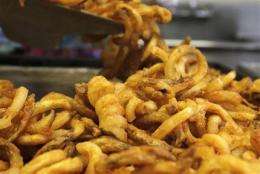
FILE - In this Sept. 14, 2011 file photo, fresh fries are scooped into containers during lunch at Gardiner High School in Gardiner, Maine. Congress wants to keep pizza and french fries on school lunch lines, fighting back against an Obama administration proposal to make school lunches healthier. The final version of a spending bill released late Monday would unravel school lunch standards the Agriculture Department proposed earlier this year, which included limiting the use of potatoes on the lunch line and delaying limits on sodium and delaying a requirement to boost whole grains. (AP Photo/Pat Wellenbach)

(AP) -- Who needs leafy greens and carrots when pizza and french fries will do?

In an effort many 9-year-olds will cheer, Congress wants pizza and french fries to stay on school lunch lines and is fighting the Obama administration's efforts to take out of schools.

The final version of a spending bill released late Monday would unravel school lunch standards the Agriculture Department proposed earlier this year. These include limiting the use of potatoes on the lunch line, putting new restrictions on sodium and boosting the use of whole grains. The legislation would block or delay all of those efforts.

The bill also would allow tomato paste on pizzas to be counted as a vegetable, as it is now. USDA had wanted to only count a half-cup of tomato paste or more as a vegetable, and a serving of pizza has less than that.

Nutritionists say the whole effort is reminiscent of the Reagan administration's much-ridiculed attempt 30 years ago to classify ketchup as a vegetable to cut costs. This time around, food companies that produce frozen pizzas for schools, the salt industry and potato growers requested the changes and lobbied Congress.

that are subsidized by the federal government must include a certain amount of vegetables, and USDA's proposal could have pushed pizza-makers and potato growers out of the school lunch business.

Piling on to the companies' opposition, some conservatives argue that the federal government shouldn't tell children what to eat. In a summary of the bill, Republicans on the House Appropriations Committee said the changes would "prevent overly burdensome and costly regulations and ...provide greater flexibility for local school districts to improve the of meals."

School districts have said some of the USDA proposals go too far and cost too much when budgets are extremely tight. Schools have long taken broad instructions from the government on what they can serve in the federally subsidized meals that are given free or at reduced price to low-income children. But some schools have balked at government attempts to tell them exactly what foods they can't serve.

Reacting to that criticism, House Republicans had urged USDA to rewrite the standards in a bill passed in June. The Senate last month voted to block the potato limits in its version, with opposition to the restrictions led by potato-growing states. Neither version of the bill included the latest provisions on tomato paste, sodium or whole grains; House and Senate negotiators added those in the last two weeks as they put finishing touches on the legislation.

The school lunch proposal is based on 2009 recommendations by the Institute of Medicine, the health arm of the National Academy of Sciences. Agriculture Secretary Tom Vilsack said they are necessary to reduce childhood obesity and future health care costs.

USDA spokeswoman Courtney Rowe said Tuesday that the department will continue its efforts to make lunches healthier.

"While it's unfortunate that some members of Congress continue to put special interests ahead of the health of America's children, USDA remains committed to practical, science-based standards for school meals," she said in a statement.

Nutrition advocate Margo Wootan of the Center for Science in the Public Interest said Congress's proposed changes will keep schools from serving a wider array of vegetables. Children already get enough pizza and potatoes, she says. It also would slow efforts to make pizzas - a longtime standby on school lunch lines - healthier, with whole grain crusts and lower sodium levels.

"They are making sure that two of the biggest problems in the school lunch program, pizza and french fries, are untouched," she said.

A group of retired generals advocating for healthier school lunches also criticized the spending bill. The group, called Mission: Readiness, has called poor nutrition in school lunches a national security issue because obesity is the leading medical disqualifier for military service.

"We are outraged that Congress is seriously considering language that would effectively categorize pizza as a vegetable in the school lunch program," Amy Dawson Taggart, the director of the group, said in a letter to lawmakers before the final bill was released. "It doesn't take an advanced degree in nutrition to call this a national disgrace."

Specifically, the bill would:

- Block the from limiting starchy vegetables, including corn and peas, to two servings a week. The rule was intended to cut down on , which many schools serve daily.

- Allow USDA to count two tablespoons of tomato paste as a vegetable, as it does now. The department had attempted to require that only a half-cup of tomato paste could be considered a vegetable. Federally subsidized lunches must have a certain number of vegetables to be served.

- Require further study on long-term sodium reduction requirements set forth by the USDA guidelines.

- Require USDA to define "whole grains" before they regulate them. The USDA rules require schools to use more .

who have fought the USDA standards say they were too strict and neglected the nutrients that potatoes, other starchy vegetables and tomato paste do offer.

"This agreement ensures that nutrient-rich vegetables such as potatoes, corn and peas will remain part of a balanced, healthy diet in federally funded school meals and recognizes the significant amounts of potassium, fiber and vitamins A and C provided by tomato paste, ensuring that students may continue to enjoy healthy meals such as pizza and pasta," said Kraig Naasz, president of the American Frozen Food Institute.

The provisions are part of a final House-Senate compromise on a $182 billion measure that would fund the day-to-day operations of the departments of Agriculture, Commerce, Justice, Transportation and Housing and Urban Development. Both the House and the Senate are expected to vote on the bill this week and send it to President Barack Obama.

©2011 The Associated Press. All rights reserved. This material may not be published, broadcast, rewritten or redistributed.

5 /5 (1 vote)  

Filter


Move the slider to adjust rank threshold, so that you can hide some of the comments.


Display comments: newest first

Shootist
Nov 15, 2011

Rank: not rated yet
No. Congress hasn't "pushed back" on healthier scrool lunches. Congress correctly noted that it isn't Washington's place to dictate to the rest of the Nation how to feed their children. That is why we have 50 states. That is why those 50 states are divided into Counties and Parishes. Most decisions, all internal decisions, are better made as close to the People as possible.

Damn, but I hate those who support Washington Dictates. Are you all idiots, or just corrupt? Move to NK or Cuba if you love your centralized gob'mint so much.
Nerdyguy
Nov 15, 2011

Rank: not rated yet
No. Congress hasn't "pushed back" on healthier scrool lunches. Congress correctly noted that it isn't Washington's place to dictate to the rest of the Nation how to feed their children. That is why we have 50 states. That is why those 50 states are divided into Counties and Parishes. Most decisions, all internal decisions, are better made as close to the People as possible...


Agreed. Do we really need the federal government telling every state and local government in the U.S. how to feed their kids? Remember, we already have government agencies, programs, and plans in place in EVERY locality to handle this.

For people not from the U.S., education is under the purview of the States, with a few exceptions, like some of the laws passed in recent decades (e.g., No Child Left Behind).

I'd rather see the federal government working towards balancing the budget, fixing the national economy, etc. vs. duplicating the efforts of every State decision.

that_guy
Nov 16, 2011

Rank: not rated yet
Actually the federal government and FDA has had quite a bit of say in school lunches since the Federal government pushed to have compulsory public education in the first place. The federal govenment funds a large portion of school budgets and lunches.

We wouldn't have any public education or school lunches in many states if the fed govt had not stepped in. (mississippi anyone?)

And I do believe there should be some minimum standard set so that kids get food that meets their nutritional needs and doesn't kill them.

That said, I do agree with you guys that the minutae of this situation is ridiculous, and really, making school lunches healthier than they already are wouldn't make a lot of difference. The worst food that children get is not from schools.
Rank 5 /5 (1 vote)
Relevant PhysicsForums posts

More news stories

New research identifies risks, interventions for children's GI health

An increasing number of U.S. children are experiencing gastrointestinal issues that require interventions to resolve, according to research presented at Digestive Disease Week (DDW).

Health created 6 hours ago | popularity not rated yet | comments 0 | with audio podcast

Youth who have their first drink during puberty have higher levels of later drinking

Research shows that the earlier the age at which youth take their first alcoholic drink, the greater the risk of developing alcohol problems. Thus, age at first drink (AFD) is generally considered a powerful predictor of ...

Health created May 17, 2013 | popularity not rated yet | comments 0

British MPs concerned about parliamentary boozing

One quarter of British lawmakers believe there is an "unhealthy" drinking culture in the Houses of Parliament, according to a survey published on Friday.

Health created May 17, 2013 | popularity not rated yet | comments 0

Patient openness to research can depend on race and sex of study personnel

Researchers at the University of Cincinnati (UC) have found that the race and sex of study personnel can influence a patient's decision on whether or not to participate in clinical research.

Health created May 17, 2013 | popularity not rated yet | comments 0

Clinical support for patient self-management is rhetoric rather than reality

The processes to allow people to self-manage their own illness are not being used appropriately by health professionals to the benefit of their patients, new research suggests.

Health created May 17, 2013 | popularity not rated yet | comments 0


AIDS science at 30: 'Cure' now part of lexicon

Big names in medicine are set to give an upbeat assessment of the war on AIDS on Tuesday, 30 years after French researchers identified the virus that causes the disease.

For combat veterans suffering from post-traumatic stress disorder, 'fear circuitry' in the brain never rests

Chronic trauma can inflict lasting damage to brain regions associated with fear and anxiety. Previous imaging studies of people with post-traumatic stress disorder, or PTSD, have shown that these brain regions can over-or ...

US psychiatry gets makeover in new manual

The latest makeover to a massive psychiatric tome honored by some, reviled by others and even called the "Bible" of mental disorders is being released Saturday with a host of new changes.

New case of SARS-like virus in Saudi: ministry

A new case of the deadly coronavirus has been detected in Saudi Arabia where 15 people have already died after contracting it, the health ministry announced on Saturday on its Internet website.

New colonoscope provides ground-breaking view of colon

A ground-breaking advance in colonoscopy technology signals the future of colorectal care, according to research presented today at Digestive Disease Week(DDW). Additional research focuses on optimizing the minimal withdrawal ...

Flesh-eating disease victim gets prosthetic hands

(AP)—A woman who lost both hands, her left leg and right foot after contracting a flesh-eating disease has been fitted with prosthetic hands.