Mystery of resistance to malaria solved in new study
November 11, 2011 by Lin Edwards in Medical research report

Plasmodium falciparum

Enlarge

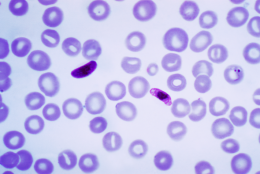
This photomicrograph of a blood smear contains a macro- and microgametocyte of the Plasmodium falciparum parasite. Image: Wikipedia.

(Medical Xpress) -- Malaria is a disease caused by parasites passed to humans via the bites of infected mosquitoes. Globally, the disease causes over a million deaths every year, and is especially rife in parts of Africa and Asia. The parasites infect red blood corpuscles (the hemoglobin-containing cells that carry oxygen around the body) and hijack the support structure within the cells. Some people are known to be naturally resistant to the serious effects of malaria, and scientists have wondered for decades exactly how their resistance functions. Now new research gone a long way to solving the mystery.

It has been known for decades that some people in Africa and elsewhere who have a mutated gene that causes sickle cell anemia also have to malaria because their red blood corpuscles contain an unusual form of hemoglobin―hemoglobin S, which results in the hemoglobin aggregating within the cell. Possessing only one copy of the mutated hemoglobin S makes the person a largely asymptomatic carrier, while two copies produces symptomatic sickle-cell anemia. In both cases the mutation gives some protection against malaria. Another mutation, hemoglobin C, causes hemolytic when two copies of the mutation are present, and this form also protects against malaria.

In a paper published in Science, researcher Marek Cyrklaff, of Heidelberg University in Germany, and colleagues in Germany and Burkina Faso, report that the unusual forms of hemoglobin in the red prevent the malaria parasite, Plasmodium falciparum, from hijacking the actin filaments that provide the skeleton scaffolding within the cell. They compared healthy and infected red corpuscles containing 'normal' hemoglobin with healthy and infected cells containing hemoglobin S or hemoglobin C. Using powerful cryoelectron tomography, the scientists discovered that in normal healthy cells the filaments of actin protein are short and located beneath the outer cell membrane , where they provide a support structure for the cell and makes it strong but pliable enough to pass through the tiniest blood vessels.
Protection from severe malaria explained
Enlarge

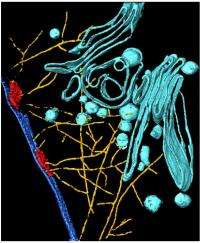
In red blood cells with normal hemoglobin, the malaria parasite Plasmodium falciparum establishes a trafficking system (yellow). The parasite’s proteins - encased in transport envelopes - (turquoise) use this system to directly access the cell surface of the red blood cell. Photo: courtesy of Science/AAAS.

In infected cells with normal hemoglobin they found the actin protein was in long filaments, which the parasite used to build a cytoskeleton, or intracellular bridge, within the cell to transport its own manufactured protein, adhesin, to the surface of the cell. The effect of adhesin, as its name suggests, is to make adjoining cells stick together and to stick the cells to the blood vessel walls, causing the inflammation responses characteristic of malaria. In the hemoglobin S and C cells, the bridge could not be completed and the adhesin could not be effectively transported to the cell surface, thus reducing cell stickiness.

The scientists also found, after further experiments, that hemoglobin C and S are more easily oxidized than the unmutated form, and when actin filaments were placed with the hemoglobin, the C and S forms resulted in shorter actin filaments than normal hemoglobin, as did oxidized .

Malaria is most often treated with quinine, but clinical trials of a vaccine are now being carried out in Africa by GlaxoSmithKline, and the results look promising, with a 65% effectiveness rate. The new research suggests that further drugs could eventually be developed that interfere with the parasite's ability to use the actin filaments for its own purposes.

More information: Hemoglobins S and C Interfere with Actin Remodeling in Plasmodium falciparum–Infected Erythrocytes, Science, DOI: 10.1126/science.1213775

ABSTRACT
The hemoglobins S and C protect carriers from severe Plasmodium falciparum malaria. Here, we found that these hemoglobinopathies affected the trafficking system that directs parasite-encoded proteins to the surface of infected erythrocytes. Cryoelectron tomography revealed that the parasite generated a host-derived actin cytoskeleton within the cytoplasm of wild-type red cells that connected the Maurer's clefts with the host cell membrane and to which transport vesicles were attached. The actin cytoskeleton and the Maurer's clefts were aberrant in erythrocytes containing hemoglobin S or C. Hemoglobin oxidation products, enriched in hemoglobin S and C erythrocytes, inhibited actin polymerization in vitro and may account for the protective role in malaria.

Journal reference: Science search and more info website

(c) 2011 Medical Xpress

4.8 /5 (16 votes)  

Filter


Move the slider to adjust rank threshold, so that you can hide some of the comments.


Display comments: newest first

Vendicar_Decarian
Nov 12, 2011

Rank: 1 / 5 (1)
Why are government scientists wasting their time with this nonsense.

Curing Malaria is just not profitable and hence is not in the best interest of the taxpayer.

AtomThick
Nov 12, 2011

Rank: not rated yet
...Curing Malaria is just not profitable and hence is not in the best interest of the taxpayer.


Are you a taxpayer in germany?
Rank 4.8 /5 (16 votes)
Relevant PhysicsForums posts

More news stories

Computational tool translates complex data into simplified 2-dimensional images

In their quest to learn more about the variability of cells between and within tissues, biomedical scientists have devised tools capable of simultaneously measuring dozens of characteristics of individual ...

Medical research created 40 minutes ago | popularity not rated yet | comments 0 | with audio podcast

Now we know why old scizophrenia medicine works on antibiotics-resistant bacteria

In 2008 researchers from the University of Southern Denmark showed that the drug thioridazine, which has previously been used to treat schizophrenia, is also a powerful weapon against antibiotic-resistant bacteria such as ...

Medical research created May 17, 2013 | popularity 3.7 / 5 (3) | comments 0 | with audio podcast

SUMO wrestling cells reveal new protective mechanism target for stroke

Scientists investigating the interaction of a group of proteins in the brain responsible for protecting nerve cells from damage have identified a new target that could increase cell survival.

Medical research created May 17, 2013 | popularity 5 / 5 (1) | comments 0

How serotonin receptors can shape drug effects, from LSD to migraine medication

New findings by researchers carrying out experiments at the U.S. Department of Energy Office of Science's Advanced Photon Source (APS) help explain why some drugs that interact with two kinds of human serotonin ...

Medical research created May 17, 2013 | popularity 4 / 5 (1) | comments 0 | with audio podcast

Preventing blood poisoning

Peptide molecules derived from the body's natural immune system can help boost the body's defence against life-threatening blood poisoning, joint University research has uncovered.

Medical research created May 17, 2013 | popularity 4 / 5 (1) | comments 0 | with audio podcast


New theory on genesis of osteoarthritis comes with successful therapy in mice

Scientists at Johns Hopkins have turned their view of osteoarthritis (OA) inside out. Literally. Instead of seeing the painful degenerative disease as a problem primarily of the cartilage that cushions joints, ...

'Gap' for HIV vaccine efforts after latest setback

The hunt for an HIV vaccine has gobbled up $8 billion in the past decade, and the failure of the most recent efficacy trial has delivered yet another setback to 26 years of efforts.

Alzheimer's leaves bilingual victims stranded in Canada

The devastating effect of Alzheimer's disease on bilingual people has been thrown into focus in Canada, where the sudden loss of a second language can leave sufferers feeling like strangers in their own country.

Consuming coffee linked to lower risk of detrimental liver disease, study finds

Regular consumption of coffee is associated with a reduced risk of primary sclerosing cholangitis (PSC), an autoimmune liver disease, Mayo Clinic research shows. The findings were being presented at the Digestive Disease ...

Ketamine shows significant therapeutic benefit in people with treatment-resistant depression

Patients with treatment-resistant major depression saw dramatic improvement in their illness after treatment with ketamine, an anesthetic, according to the largest ketamine clinical trial to-date led by researchers from the ...

Research examines new methods for managing digestive health

Research presented at Digestive Disease Week (DDW) explores new methods for managing digestive health through diet and lifestyle.