Researchers work with platelet-rich plasma to heal chronic wounds in veterans
November 10, 2011 By Sathya Achia Abraham in Medical research
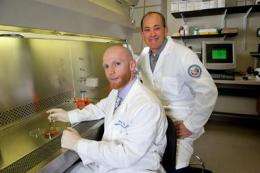
Scott A. Sell, Ph.D., and his mentor Jeffery J. Ericksen, M.D.
(Medical Xpress) -- During the conflicts in Iraq and Afghanistan, blast injuries resulting from improvised explosive devices, or IEDs, and roadsides bombs took countless lives and left thousands of soldiers who managed to survive with devastating injuries.
Many of these troops experienced polytrauma injuries including spinal cord injuries and traumatic brain injuries, loss of limbs, damage to various organs, internal injuries, orthopedic injuries and a whole gamut of dermal injuries.
Immobile patients particularly those with spinal cord injuries are at risk of developing chronic pressure ulcers. These non-healing wounds are a cause of distress for patients and their caregivers, and costly to treat.
Working to stimulate healing and promote tissue repair of chronic pressure ulcers are Scott A. Sell, Ph.D., a polytrauma research fellow at the Hunter Holmes McGuire VA Medical Center with an affiliate appointment in the VCU School of Engineerings Department of Biomedical Engineering, and his mentor Jeffery J. Ericksen, M.D., associate professor in the VCU Department of Physical Medicine and Rehabilitation, who is also affiliated with the Hunter Holmes McGuire VA Medical Center.
Sells work centers on tissue engineering a field that combines cells and scaffold to aid in the restoration or replacement of tissue/organ function.
We noticed that many of these vets with polytrauma brain injuries and spinal cord injuries had large tissue defects - some have large muscle mass and/or tissue missing, many are paralyzed to varying degrees, and these injuries lead to pressure ulcers, said Sell.
These wounds are chronically inflamed and never heal. So we were trying to come up with bedside tissue regeneration approaches to stimulate these wounds to close up and heal and build some sort of tissue there, he said.
Sell first became interested in tissue engineering while doing research in the lab of Gary L. Bowlin, Ph.D., professor of biomedical engineering in the VCU School of Engineering and director of the Tissue Engineering Laboratory at VCU. From there, Sell took his knowledge of ligament regeneration and began looking at regenerative and tissue engineering approaches to treat polytrauma and work with a multidisciplinary team at the Richmond VA.
Once I got to the VA and could see first-hand the clinical applications of tissue engineering, it was really eye opening. Just to see a lot of the large tissue defects the vets have to deal with and pain they endure I knew I had to branch off into tissue and dermal engineering, he said.
Advancing PRP to treat chronic pressure ulcers
Sell and Ericksen have been able to use a method known as platelet-rich plasma therapy, or PRP, at the patients bedside where they draw a patients blood and spin in a centrifuge to make a platelet-rich plasma and then inject it back into the wound site to accelerate the healing in pressure ulcers that are not responding to conventional treatment.
While the method has been used in the clinic for example, the PRP injections Hines Ward had before the Super Bowl in 2009 for his ligament sprain Sell and Ericksen have taken the work one step further to develop a sustained release method for delivering PRP growth factors and cytokines.
According to Sell, they used a liquid PRP for immediate stimulation, and alginate beads containing PRP as a delivery vehicle for the sustained release of PRP-derived growth factors into pressure ulcers that no longer respond to conventional treatment. Alginate is a biomaterial derived from seaweed or algae that is known to be biocompatible. It is commonly used as a wound dressing in the treatment of pressure ulcers.
In a small case study published this year in The Journal of Spinal Cord Medicine, the VCU team reported that the sustained release of growth factors from PRP therapy positively stimulated healing in chronic pressure ulcers in three veterans with spinal cord injuries.
The team has plans to soon conduct a large-scale clinical trial to further understand the role of PRP therapy to treat chronic pressure ulcers in patients with spinal cord injuries.
While our preliminary work has been very promising in treating these chronic wounds, we hope to start a large-scale trial in the near future to really demonstrate the healing potential of the PRP, said Sell.
Going forward, it is possible that PRP, particularly with a sustained release component, will not only be effective in treating chronic pressure ulcers, but could also be beneficial in jump-starting the healing process in the wide array of physical injuries that are typically seen in our veteran patients, he said.
Provided by
Virginia Commonwealth University
-
Enhanced plasma shortens time off for injured athletes
Nov 12, 2009 |
not rated yet |
0
-
Clinical trial seeks to determine whether platelet-rich plasma can ease the pain of osteoarthritis
Mar 22, 2011 |
not rated yet |
0
-
Research offers hope in new treatment for spinal cord injuries
May 03, 2011 |
not rated yet |
0
-
Researchers control growth rate of replacement blood vessels, tissues
Mar 06, 2008 |
not rated yet |
0
-
Gene Therapy Hastens Healing Process in Chronic Leg Ulcers
Dec 03, 2009 |
not rated yet |
0
-
Motion perception revisited: High Phi effect challenges established motion perception assumptions
Apr 23, 2013 |
3 / 5 (2) |
2
-
Anything you can do I can do better: Neuromolecular foundations of the superiority illusion (Update)
Apr 02, 2013 |
4.5 / 5 (11) |
5
-
The visual system as economist: Neural resource allocation in visual adaptation
Mar 30, 2013 |
5 / 5 (2) |
9
-
Separate lives: Neuronal and organismal lifespans decoupled
Mar 27, 2013 |
4.9 / 5 (8) |
0
-
Sizing things up: The evolutionary neurobiology of scale invariance
Feb 28, 2013 |
4.8 / 5 (10) |
14
-
Why is zone 1 in liver more prone to ischemic injury?
6 hours ago
-
How can there be villous adenoma in colon, if there are no villi there
May 22, 2013
-
How can there be a term called "intestinal metaplasia" of stomach
May 21, 2013
-
Pressure-volume curve: Elastic Recoil Pressure don't make sense
May 18, 2013
-
If you became brain-dead, would you want them to pull the plug?
May 17, 2013
-
MRI bill question
May 15, 2013
- More from Physics Forums - Medical Sciences
More news stories
New discovery in fight against deadly meningococcal disease
Professor Michael Jennings, Deputy Director of the Institute for Glycomics at Griffith University, was part of an international team that discovered the previously unknown pathway of how the bacterium colonizes people.
Medical research
44 minutes ago |
5 / 5 (1) |
0
|
Study reveals active site of enzyme linked to stuttering
(Medical Xpress)—Scientists from the Joint Center for Structural Genomics (JCSG) at SLAC National Accelerator Laboratory have determined the 3-D structure of the chemically active part of an enzyme involved ...
Medical research
1 hour ago |
not rated yet |
0
|
Researchers develop sperm-sorting design that may aid couples undergoing in vitro fertilization
(Medical Xpress)—According to the World Health Organization, approximately 70 million couples experience infertility worldwide. Current data suggests that nearly one third of infertility disorders are due ...
Medical research
2 hours ago |
5 / 5 (1) |
0
Baby's life saved with groundbreaking 3-D printed device that restored his breathing
Every day, their baby stopped breathing, his collapsed bronchus blocking the crucial flow of air to his lungs. April and Bryan Gionfriddo watched helplessly, just praying that somehow the dire predictions ...
Medical research
17 hours ago |
5 / 5 (3) |
0
Research shows how immune system peacefully co-exists with 'good' bacteria
The human gut is loaded with commensal bacteria – "good" microbes that, among other functions, help the body digest food. The gastrointestinal tract contains literally trillions of such cells, and yet the ...
Medical research
21 hours ago |
5 / 5 (3) |
0
|
Are kids who take music lessons different from other kids?
(Medical Xpress)—Research by U of T Mississauga psychology professor Glenn Schellenberg reveals that two key personality traits – openness-to-experience and conscientiousness—predict better than IQ ...
Pay attention: How we focus and concentrate
Scientists at Newcastle University have shed new light on how the brain tunes in to relevant information.
New imaging techniques used to help patients suffering from epilepsy
New techniques in imaging of brain activity developed by Jean Gotman, from McGill University's Montreal Neurological Institute, and his colleagues lead to improved treatment of patients suffering from epilepsy. The combination ...
Researchers identify networks of neurons in the brain that are disrupted in psychiatric disease
Studying the networks of connections in the brains of people affected by schizophrenia, bipolar disease or depression has allowed Dr. Peter Williamson, from Western University, to gain a better understanding of the biological ...
Cold plasma successful against brain cancer cells
For the first time, physicists from the Max Planck Institute for Extraterrestrial Physics (MPE), biologists and physicians demonstrated the synergistic effect of cold atmospheric plasma - a partly ionized ...
Can you put a price on health?
As health services strive to improve quality and reduce costs, researchers study the benefits – and the pitfalls – of 'pay for performance' in hospitals.