Probiotic protects intestine from radiation injury
November 16, 2011 in Medical research
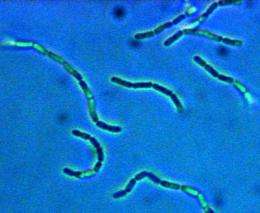
The probiotic Lactobacillus rhamnosus GG may protect the lining of the small intestine from radiation injury. Credit: Mathew A. Ciorba, MD
Scientists at Washington University School of Medicine in St. Louis have shown that taking a probiotic before radiation therapy can protect the intestine from damage at least in mice.
The new study suggests that taking a probiotic also may help cancer patients avoid intestinal injury, a common problem in those receiving radiation therapy for abdominal cancers. The research is published online in the journal Gut.
Radiation therapy often is used to treat prostate, cervical, bladder, endometrial and other abdominal cancers. But the therapy can kill both cancer cells and healthy ones, leading to severe bouts of diarrhea if the lining of the intestine gets damaged.
This video is not supported by your browser at this time.
Antibiotics can kill life-threatening bacterial infections, but in recent years, we've heard more about the potential health benefits of so-called probiotics. And now Washington University researchers have found that one probiotic appears to protect the small intestine from radiation damage. Intestinal damage can be a problem for patients receiving radiation therapy for abdominal cancers. Credit: Washington University BioMed Radio
"For many patients, this means radiation therapy must be discontinued, or the radiation dose reduced, while the intestine heals," says senior investigator William F. Stenson, MD, the Dr. Nicholas V. Costrini Professor in Gastroenterology & Inflammatory Bowel Disease at Washington University. "Probiotics may provide a way to protect the lining of the small intestine from some of that damage."Stenson has been searching for ways to repair and protect healthy tissue from radiation. This study showed that the probiotic bacteria Lactobacillus rhamnosus GG (LGG), among other Lactobacillus probiotic strains, protected the lining of the small intestine in mice receiving radiation.
"The lining of the intestine is only one cell-layer thick," Stenson says. "This layer of epithelial cells separates the rest of the body from what's inside the intestine. If the epithelium breaks down as the result of radiation, the bacteria that normally reside in the intestine can be released, travel through the body and cause serious problems such as sepsis."
The researchers found that the probiotic was effective only if given to mice before radiation exposure. If the mice received the probiotic after damage to the intestinal lining had occurred, the LGG treatment could not repair it in this model.
Because the probiotic protected intestinal cells in mice exposed, the investigators believe it may be time to study probiotic use in patients receiving radiation therapy for abdominal cancers.
"In earlier human studies, patients usually took a probiotic after diarrhea developed when the cells in the intestine already were injured," says first author Matthew A. Ciorba, MD, assistant professor of medicine in the Division of Gastroenterology. "Our study suggests we should give the probiotic prior to the onset of symptoms, or even before the initiation of radiation because, at least in this scenario, the key function of the probiotic seems to be preventing damage, rather than facilitating repair."
The investigators sought to evaluate LGG's protective effects in a way that would leave little doubt about whether it was preventing injury, and if so, how it was protecting the cells that line the intestine.
"Some human studies have looked at the possibility that probiotics might reduce diarrhea, but most of those studies have not been quite as rigorous as we would like, and the mechanism by which the probiotics might work has not been addressed," Stenson says.
Previously, Stenson and his colleagues demonstrated that a molecular pathway involving prostaglandins and cyclooxygenase-2 (COX-2), key components in inflammation, could protect cells in the small intestine by preventing the programmed cell death, or apoptosis, that occurs in response to radiation.
They gave measured doses of LGG to mice, directly delivering the live bacteria to the stomach. They found it protected only mice that could make COX-2. In mutant mice unable to manufacture COX-2, the radiation destroyed epithelial cells in the intestine, just as it did in mice that didn't receive the probiotic.
"In the large intestine, or colon, cells that make COX-2 migrate to sites of injury and assist in repair," Ciorba says. "In this study, we evaluated that response in the small intestine, and we found that COX-2-expressing cells could migrate from the lining to the area of the intestine, called the crypt, where new epithelial cells are made, and we believe this mechanism is key to the protective effect we observed."
If human studies are launched, Ciorba says one bit of encouraging news is that the doses of probiotic given to mice were not exceptionally large, and their intestines were protected. So people wouldn't need mega-doses of the probiotic to get protection.
"The bacteria we use is similar to what's found in yogurt or in commercially available probiotics," he says. "So theoretically, there shouldn't be risk associated with this preventative treatment strategy any more than there would be in a patient with abdominal cancer eating yogurt."
In addition, he notes, future research is focused on isolating the particular radio-protective factor produced by the probiotic. When that is identified, a therapeutic could be developed to harness the probiotic benefit without using the live bacteria.
More information: Ciorba MA, Riehl TE, Rao SM, Moon C, Ee X, Nava GM, Walker MS, Marinshaw JM, Stappenbeck TS, Stenson WF. Lactobacillus probiotic protects intestinal epithelium from radiation injury in a TLR2/cyclo-osygenase-2-dependent manner. Gut, available online at gut.bmj.com/conten… -300367.long
Provided by
Washington University School of Medicine
-
New probiotic combats inflammatory bowel disease
Jan 31, 2011 |
not rated yet |
0
-
Could a probiotic be used to treat inflammatory bowel disease?
Oct 20, 2011 |
not rated yet |
0
-
New polymer research could boost probiotics industry
Sep 06, 2011 |
not rated yet |
0
-
Comfort food: Probiotic-derived product protects in model of intestinal inflammation
May 23, 2011 |
not rated yet |
0
-
Beneficial bacteria help repair intestinal injury by inducing reactive oxygen species
May 10, 2011 |
not rated yet |
0
-
Motion perception revisited: High Phi effect challenges established motion perception assumptions
Apr 23, 2013 |
3 / 5 (2) |
2
-
Anything you can do I can do better: Neuromolecular foundations of the superiority illusion (Update)
Apr 02, 2013 |
4.5 / 5 (11) |
5
-
The visual system as economist: Neural resource allocation in visual adaptation
Mar 30, 2013 |
5 / 5 (2) |
9
-
Separate lives: Neuronal and organismal lifespans decoupled
Mar 27, 2013 |
4.9 / 5 (8) |
0
-
Sizing things up: The evolutionary neurobiology of scale invariance
Feb 28, 2013 |
4.8 / 5 (10) |
14
-
Why is zone 1 in liver more prone to ischemic injury?
May 23, 2013
-
How can there be villous adenoma in colon, if there are no villi there
May 22, 2013
-
How can there be a term called "intestinal metaplasia" of stomach
May 21, 2013
-
Pressure-volume curve: Elastic Recoil Pressure don't make sense
May 18, 2013
-
If you became brain-dead, would you want them to pull the plug?
May 17, 2013
-
MRI bill question
May 15, 2013
- More from Physics Forums - Medical Sciences
More news stories
Study reveals new mechanism for estrogen suppression of liver lipid synthesis
By discovering the new mechanism by which estrogen suppresses lipid synthesis in the liver, UC Irvine endocrinologists have revealed a potential new approach toward treating certain liver diseases.
Medical research
May 23, 2013 |
not rated yet |
0
|
MRI-based measurement helps predict vascular disease in the brain
Aortic arch pulse wave velocity, a measure of arterial stiffness, is a strong independent predictor of disease of the vessels that supply blood to the brain, according to a new study published in the June issue the journal ...
Medical research
May 23, 2013 |
not rated yet |
0
Antibiotics: A new understanding of sulfonamide nervous system side effects
Since the discovery of Prontosil in 1932, sulfonamide antibiotics have been used to combat a wide spectrum of bacterial infections, from acne to chlamydia and pneumonia. However, their side effects can include serious neurological ...
Medical research
May 23, 2013 |
not rated yet |
0
|
Scientists discover molecule triggers sensation of itch
Scientists at the National Institutes of Health report they have discovered in mouse studies that a small molecule released in the spinal cord triggers a process that is later experienced in the brain as ...
Medical research
May 23, 2013 |
5 / 5 (3) |
0
|
Discarded immune cells induce the relocation of stem cells
Spanish researchers have discovered that the daily clearance of neutrophils from the body stimulates the release of hematopoietic stem cells from the bone marrow into the bloodstream, according to a report published today ...
Medical research
May 23, 2013 |
5 / 5 (2) |
0
Researchers identify first drug targets in childhood genetic tumor disorder
Two mutations central to the development of infantile myofibromatosis (IM)—a disorder characterized by multiple tumors involving the skin, bone, and soft tissue—may provide new therapeutic targets, according to researchers ...
Engineered cytomegalovirus protects monkeys from HIV equivalent
(Medical Xpress)—A new study by researchers in the US has shown that an ancient virus can be modified to help in the fight against the simian immunodeficiency virus SIV, which is the equivalent in monkeys ...
Driving and hands-free talking lead to spike in errors, study shows
Talking on a hands-free device while behind the wheel can lead to a sharp increase in errors that could imperil other drivers on the road, according to new research from the University of Alberta.
Hormone levels may provide key to understanding psychological disorders in women
Women at a particular stage in their monthly menstrual cycle may be more vulnerable to some of the psychological side-effects associated with stressful experiences, according to a study from UCL.
Going live: Immune cell activation in multiple sclerosis
Biological processes are generally based on events at the molecular and cellular level. To understand what happens in the course of infections, diseases or normal bodily functions, scientists would need to ...
Pollen count apps for smartphones are nothing to sneeze at
Kate O'Reilly's spring allergy survival kit includes the usual stuff - nasal sprays, allergy pills and a box of tissues. This season, she's added a new weapon to her line of defense: an app on her smartphone.