Scarring a necessary evil to prevent further damage after heart attack
November 15, 2011 in Cardiology
Scarring a necessary evil to prevent further damage after heart attack

Enlarge

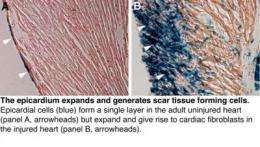
This is a comparison of uninjured and injured tissue in the outer layer of the heart showing the expansion and generation of cells that form scarring. Credit: Arjun Deb, M.D.

After a heart attack, the portions of the heart damaged by a lack of oxygen become scar tissue. Researchers have long sought ways to avoid this scarring, which can harden the walls of the heart, lessen its ability to pump blood throughout the body and eventually lead to heart failure. But new research from the University of North Carolina at Chapel Hill School of Medicine shows that interrupting this process can weaken heart function even further.

In a study appearing online November 15, 2011, in the , the investigators observed that cells in the outer layer of the generated . But when they blocked these cells from doing so, they essentially demonstrated that when fixing a broken heart, timing may be everything.

"We now know that scarring is a good thing, because it prevents a precipitous decline in heart function immediately after heart injury," said Arjun Deb, MD, senior study author and assistant professor of medicine and cell and at the UNC School of Medicine. "The question is not whether, but when it makes the most sense to manipulate the cells of the heart to decrease scarring and enhance regeneration." Deb is also a member of UNC's McAllister Heart Institute and the Lineberger Comprehensive Cancer Center.

Regeneration happens naturally in lower organisms like zebrafish – the striped, thumb-sized inhabitants of household aquariums – but for some reason not in higher organisms like humans. Years ago researchers noticed that a thin outer layer of cells on the surface of the heart muscle – known as the epicardium – was playing an important role in regenerating the zebrafish heart after injury. But what role the epicardium might have in an injured mammalian heart was an open question.

By studying a mouse model of cardiac injury, Deb and his colleagues found that the epicardium of the mammalian heart was also activated after a . But unlike in zebrafish where the epicardium contributed to generation of heart muscle cells, in the mouse the epicardium generated fibroblasts, the fibrous cells that underlie scar tissue.

The researchers then found that a protein called Wnt1, which they had formerly shown to enhance function of human vascular stem cells, was driving stem cells within the epicardium to become fibroblasts. They wondered if interrupting this molecular pathway could ameliorate scarring and improve . Surprisingly, when they interrupted Wnt1 signaling in genetically engineered mice, the mutants developed within 2 weeks after cardiac injury.

"There are clearly evolutionary parallels between the zebrafish and the mouse, but there must be some sort of a selection pressure in mammals to respond to heart injury by scarring, because if we interrupt this process then the heart quickly fails following injury," said Deb. "In organisms where there is a high pressure of blood flow, these cells may need to turn into scar tissue to maintain the tensile strength of the heart wall and prevent catastrophic rupture," speculates Deb.

Now Deb and his colleagues are genetically manipulating the residing in the epicardium at later time points to see if they can coax them to stop turning into fibroblasts and start forming heart-regenerating myocytes. If so, the approach could prove to be an invaluable way to help patients recover from a heart attack.

Provided by University of North Carolina School of Medicine search and more info website

not rated yet  

Rank not rated yet
Relevant PhysicsForums posts
  • Force in a magnetic coupling
    created8 hours ago
  • Sign of scalar product in electric potential integral?
    created15 hours ago
  • Heat engines: how can we yield work?
    created16 hours ago
  • Work done by us on the spring
    createdMay 25, 2012
  • Surface current density
    createdMay 25, 2012
  • Work done on body moving in a circle
    createdMay 25, 2012
  • More from Physics Forums - Classical Physics

More news stories

One-fifth of healthy middle-aged men have low-grade murmur

(HealthDay) -- More than one-fifth of healthy middle-aged men have a low-grade systolic heart murmur that confers a nearly five-fold higher risk of future aortic valve replacement (AVR), according to a study ...

Cardiology created May 25, 2012 | popularity not rated yet | comments 0

New device allows pacemaker patients to safely undergo MRIs

For many, it's a medical conundrum: The very pacemaker keeping their heart in rhythm prevents them from undergoing an MRI to diagnose other ailments, because interaction between the two devices could prove deadly.

Cardiology created May 25, 2012 | popularity not rated yet | comments 0 | with audio podcast

New study should end debate over magnesium treatment for preventing poor outcome after haemorrhagic stroke

An international randomised trial and meta-analysis published Online First in The Lancet should put an end to the debate about the use of intravenous magnesium sulphate to prevent poor outcomes after haemorrhagic stroke. The in ...

Cardiology created May 25, 2012 | popularity not rated yet | comments 0

Low vitamin D in diet increases stroke risk in Japanese-Americans

Japanese-American men who did not eat foods rich in vitamin D had a higher risk of stroke later in life, according to results of a 34-year study reported in Stroke, an American Heart Association journal.

Cardiology created May 24, 2012 | popularity not rated yet | comments 0

Clot buster seems to help up to 6 hours after stroke

(HealthDay) -- The largest study of its kind finds that stroke patients benefit from a clot-busting drug even six hours after a stroke, suggesting that the current recommended 4.5-hour limit could be expanded.

Cardiology created May 24, 2012 | popularity not rated yet | comments 0


Travel to high altitudes tied to Crohn's, colitis flare-ups

(HealthDay) -- People with inflammatory bowel disease, which includes Crohn's disease and colitis, may be at increased risk for flare-ups when they fly or travel to high altitudes for skiing or mountain climbing, ...

Family history of Alzheimer's affects functional connectivity

(HealthDay) -- Cognitively normal individuals with a family history of late-onset Alzheimer's disease (AD) may display lower resting state functional connectivity in the default mode network (DMN) of the brain, ...

Transvaginal mesh op restores pelvic organ prolapse at price

(HealthDay) -- Transvaginal mesh (TVM) procedures are effective for anatomical restoration of pelvic organ prolapse (POP), but patients report a worsening of sexual function following surgery, according to ...

Tongue analysis software uses ancient Chinese medicine to warn of disease

For 5,000 years, the Chinese have used a system of medicine based on the flow and balance of positive and negative energies in the body. In this system, the appearance of the tongue is one of the measures used to classify ...

Of mice and mental models: Neuroscientific implications of risk-optimized behavior in the mouse

(Medical Xpress) -- Regardless of an organism’s biological complexity, every encephalized animal continuously makes under-informed behavioral choices that can have serious consequences. Despite its ubiquity, ...

Weight struggles? Blame new neurons in your hypothalamus

New nerve cells formed in a select part of the brain could hold considerable sway over how much you eat and consequently weigh, new animal research by Johns Hopkins scientists suggests in a study published in the May issue ...