Tuning out: How brains benefit from meditation
November 21, 2011 in Psychology & Psychiatry

Tuning out: How brains benefit from meditation

Enlarge

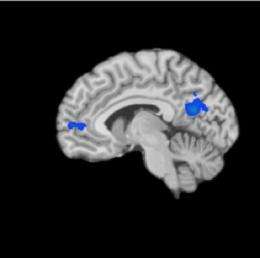
Experienced meditators seem to switch off areas of the brain associated with wandering thoughts, anxiety and some psychiatric disorders such as schizophrenia. Researchers used fMRI scans to determine how the brains of meditators differed from subjects who were not meditating. The areas shaded in blue highlight areas of decreased activity in the brains of meditators. Credit: courtesy of yale

Experienced meditators seem to be able switch off areas of the brain associated with daydreaming as well as psychiatric disorders such as autism and schizophrenia, according to a new brain imaging study by Yale researchers.

Meditation's ability to help people stay focused on the moment has been associated with increased , said Judson A. Brewer, assistant professor of psychiatry and lead author of the study published the week of Nov. 21 in the . Understanding how meditation works will aid investigation into a host of diseases, he said.

"Meditation has been shown to help in variety of health problems, such as helping people quit smoking, cope with cancer, and even prevent psoriasis," Brewer said.

The Yale team conducted scans on both experienced and novice meditators as they practiced three different meditation techniques.

They found that experienced meditators had decreased activity in areas of the brain called the default mode network, which has been implicated in lapses of attention and disorders such as anxiety, , and even the buildup of beta in Alzheimer's disease. The decrease in activity in this network, consisting of the medial prefrontal and , was seen in experienced meditators regardless of the type of meditation they were doing.

The scans also showed that when the default mode network was active, associated with self-monitoring and cognitive control were co-activated in experienced meditators but not novices. This may indicate that meditators are constantly monitoring and suppressing the emergence of "me" thoughts, or mind-wandering. In pathological forms, these states are associated with diseases such as autism and schizophrenia.

The meditators did this both during meditation, and also when just resting — not being told to do anything in particular. This may indicate that meditators have developed a "new" default mode in which there is more present-centered awareness, and less "self"-centered, say the researchers.

"Meditation's ability to help people stay in the moment has been part of philosophical and contemplative practices for thousands of years," Brewer said. "Conversely, the hallmarks of many forms of mental illness is a preoccupation with one's own thoughts, a condition meditation seems to affect. This gives us some nice cues as to the neural mechanisms of how it might be working clinically."

Provided by Yale University search and more info website

4.7 /5 (47 votes)  

Filter


Move the slider to adjust rank threshold, so that you can hide some of the comments.


Display comments: newest first

Isaacsname
Nov 21, 2011

Rank: 1 / 5 (1)
No surprise, life is a temporary optical illusion viewed from the inside the " self ".
dogbert
Nov 21, 2011

Rank: 3 / 5 (3)
Interesting article. The study is clearly presented and the conclusions are both reasonable and are presented as hypotheses rather than findings.

It is refreshing to see a scientific article presented in a scientific manner. Five stars.

I must seriously consider meditating. The benefits appear to be substantial.
Cynical1
Nov 22, 2011

Rank: not rated yet
My own meditation method is to let all those daydream thoughts bubble up and examine them all, filing some and discarding others, then focusing on the one or 2 that are left...
Wait - Does this mean I am mentally ill?
hyongx
Nov 22, 2011

Rank: 3 / 5 (2)
I must seriously consider meditating. The benefits appear to be substantial.


Only trouble with meditating - it's boring.
haha...
MaxwellsDemon
Nov 22, 2011

Rank: 4.9 / 5 (8)
Only trouble with meditating - it's boring.
haha...

@hyongx

Actually most people don't make it through the first week or two of a daily meditation regime because the howling cacophany of the "ordinary" thought process can be so deeply unsettling. You don't really realize all of the crazy random thoughts that fill your head every day until you stop and take a long hard look at what's going on in your mind.

But once the shock wears off, your thoughts start to become less insane, and you become keenly and gleefully conscious of your body's functions and the world around you: it's a very wakeful state, contrary to common misconceptions.

Very tough to maintain that frame of mind in a world that's totally psychotic and ruthless though.
ericb4
Nov 24, 2011

Rank: not rated yet
Does anybody know the meditation techniques used in the study? Or if you know of other good resources for that it would be much appreciated!
Cynical1
Nov 24, 2011

Rank: not rated yet
Dang good question, Ericb...
MediocreSmoke
Nov 24, 2011

Rank: not rated yet
@ericb4 I read a similar article somewhere else and I believe they used several different techniques. Also if you wanted to start meditating it isn't really something you can just turn on for 30 minutes a day like stretching, you have to really understand what you're trying to do and why. I've found that the Dalai Lama articulates things well, you might try some of his literature. Ethics for the New Millennium might be a good place to start, good luck with your endeavors!
MaxwellsDemon
Nov 25, 2011

Rank: 5 / 5 (2)
Or if you know of other good resources for that it would be much appreciated!

@ericb4

This is going to sound disappointing, but the essence of meditation can be summed up very simply: "shut up, sit still, and pay attention." The point is to observe yourself as objectively/dispassionately as possible, like a scientist studying a subject in the lab. All the other stuff; breathing techniques, chanting phrases or words, body positioning disciplines, etc., are just meaningless clutter, imo. Meditation is about directly seeing and understanding the unfettered process of mind.

Before getting into the process I like to read the short essays of a great English-speaking meditator who died in 1986 named Jiddu Krishnamurti (not to be confused with the Krishna religion, or any other religion for that matter). He was a truly brilliant student of the mind, deeply insightful.
David6502
Nov 25, 2011

Rank: not rated yet
@MaxwellsDemon

I couldn't agree more. Krishnamurti also gives a concise description of how to meditate free of all the clutter you describe. Interestingly his approach to meditation is very similar to that of Shikantaza Zen meditation, which consists more of an opening up and witnessing of mental processes rather than a narrowing of focus and concentration common to most popular forms of meditation.
Cynical1
Nov 25, 2011

Rank: not rated yet
Meditation is about directly seeing and understanding the unfettered process of mind.

okay, then... so I'm NOT doing it wrong...
MaxwellsDemon
Nov 25, 2011

Rank: not rated yet
an opening up and witnessing of mental processes rather than a narrowing of focus and concentration common to most popular forms of meditation.

@David6502

You make a crucial point, David6502 - meditation is exactly the opposite of concentration and focus (which are the domain of the thought process). Meditation is about being a non-participant, a witness. It's very simple in theory, but arduous in practice. We're all so deeply conditioned to compulsively use every instant toward accomplishing something, that it's nearly impossible to surrender our ambitions even for a single hour a day.
MaxwellsDemon
Nov 25, 2011

Rank: not rated yet
My own meditation method is to let all those daydream thoughts bubble up and examine them all, filing some and discarding others, then focusing on the one or 2 that are left...

@Cynical1

You've just described "thinking," or perhaps "deep thinking," which is a different matter altogether. The key to
meditation is to simply witness the thoughts as they arise, recognize that they appear but without following
them, filing them away, or focusing on them at all...just let them arise and pass on by without luring you into
thinking about them further. Buddha suggested that you just acknowledge that the thought has appeared by
thinking "thought, thought" and letting the silence return until the next thought arises. Don't get invested at all
in any of the thoughts that come up (this is the hard part, btw). Instead, wait for the intervals of silence between
the thoughts.

Those intervals will grow, and become a doorway to the ineffable.
Cynical1
Nov 26, 2011

Rank: not rated yet
Max, I think I may have described the process backwards, now that I actually think about it. And at the end of all those thoughts bubbling, I seem to fall asleep, if even for just a short time.
Anyway, there doesn't seem to be any quiet times between thoughts anf that's okay with me - it's a (metaphorical? Fractal?)reflection of the universe.
MaxwellsDemon
Nov 26, 2011

Rank: not rated yet
@Cynical1
It's true, in the beginning the interval between thoughts is too small to see. They are there though, just as there

are pauses between each word in a sentence...but we overlook them because we're focused on the words and

not the spaces.

It takes about 2-3 weeks to get the hang of passively "disowning" your thoughts during meditation; seeing them

with no more significance than a passing cloud. As they lose their grip on you, they slow down a lot, and

become less urgent and wild. Then the gap between one thought and the next will sometimes become surprisingly long. That surprise registers as a subtle jolt of fear at first, which conjures a thought. But as the lingering silences become more and more hum-drum to you, soon many consecutive seconds will pass before another thought arises.

That's when you begin to see that you still exist even when your mind is totally silent.
MaxwellsDemon
Nov 26, 2011

Rank: not rated yet
Sorry about the formatting issues, Notepad inserted its own paragraph breaks for some reason.
rwinners
Nov 27, 2011

Rank: not rated yet
Experienced meditators seem to be able switch off areas of the brain associated with daydreaming as well as psychiatric disorders such as autism and schizophrenia, "

Are functions of psych disorders and daydreaming centered in the same location of the brain?
Manhar
Dec 15, 2011

Rank: 1 / 5 (1)
I am experienced in meditation. Description given by MaxwellsDemon is correct. Meditation is not concentration at all. Initially you need to create a supervisor within you to watch your thought process and try to turn off for a few second at a time. What is supervisory process? We have three to four active channels in our mind, like driving car watching road and listening music. Same way a supervisory channel can be opened. Meditation is a time consuming process and may take couple of years to shut your mind for hour or so. You can increase the time but it is strenuous on the body system. The collection of lectures of an Indian lady VIMALA THAKKAR published in Australia and Holland describe the functions of the organs of human body in meditation process.
I have heard that very deep meditation requires at least 12 to 15 years of practice. Deep meditation means that your coconsciousness leaves your body and you will not feel any thing at all even your body is destroyed.
rwinners
Dec 15, 2011

Rank: not rated yet
I find a good nap works every bit as well as meditation.
Avdhutaya
Dec 23, 2011

Rank: not rated yet
In my experience,'Meditation'means'attaining and maintaining a point in the middle'. It occurs spontaneously when the autonomous nervous system is able to function unhindered by the demands we place upon it by our emotions, thoughts, and subsequent behaviour, and only to people who desire peace and who realise that it is not something that can be achieved, but something that has to be allowed to happen, through one's own free-will. In that state one is 'thoughtlessly aware' (Nirvichara Samadhi), wherein all cognitive faculties increase alongside an awareness of increased perception of inner calmness, a sense of contentment, compassion for one's self and others, effortless forgiveness and generosity as it brings enjoyment, and an ability to discriminate between what is conducive to the state and what is antagonistic to it, while remaining essentially benign in ones own outlook and behaviour.
Rank 4.7 /5 (47 votes)
Related Stories
Relevant PhysicsForums posts

More news stories

Are there atheists in foxholes? Study says they're the minority

Ernie Pyle – an iconic war correspondent in World War II – reportedly said "There are no atheists in foxholes." A new joint study between two brothers at Cornell and Virginia Wesleyan found that only ...

Psychology & Psychiatry created 2 hours ago | popularity 2.5 / 5 (2) | comments 0

Breathing exercises help veterans find peace after war, scholar says

(Medical Xpress)—Research by Stanford scholar Emma Seppala at the Center for Compassion and Altruism Research and Education found that post-traumatic stress disorder decreased in veterans who participated ...

Psychology & Psychiatry created 2 hours ago | popularity not rated yet | comments 0

Depression raises diabetics' risk of severe low blood sugar episodes

(Medical Xpress)—Patients with diabetes who are depressed are much more likely to develop episodes of dangerously low blood sugars, or hypoglycemia, than are those who are not depressed, a new study has ...

Psychology & Psychiatry created 3 hours ago | popularity not rated yet | comments 0 | with audio podcast

Motion quotient: IQ predicted by ability to filter motion (w/ video)

A brief visual task can predict IQ, according to a new study. This surprisingly simple exercise measures the brain's unconscious ability to filter out visual movement. The study shows that individuals whose ...

Psychology & Psychiatry created 23 hours ago | popularity 4.5 / 5 (11) | comments 2 | with audio podcast

Anxious men fare worse during job interviews, study finds

Nervous about that upcoming job interview? You might want to take steps to reduce your jitters, especially if you are a man.

Psychology & Psychiatry created May 23, 2013 | popularity 5 / 5 (1) | comments 0


Going live: Immune cell activation in multiple sclerosis

Biological processes are generally based on events at the molecular and cellular level. To understand what happens in the course of infections, diseases or normal bodily functions, scientists would need to ...

Young children who miss well-child visits are more likely to be hospitalized

Young children who missed more than half of recommended well-child visits had up to twice the risk of hospitalization compared to children who attended most of their visits, according to a study published today in the American Jo ...

Engineered cytomegalovirus protects monkeys from HIV equivalent

(Medical Xpress)—A new study by researchers in the US has shown that an ancient virus can be modified to help in the fight against the simian immunodeficiency virus SIV, which is the equivalent in monkeys ...

Controlling mood through the motions of mitochondria

(Medical Xpress)—Regulating the distribution of power in neurons is done by a system that makes the national electric grid look simple by comparison. Each neuron has several thousand mitochondria confined ...

New neuron formation could increase capacity for new learning, at the expense of old memories

New research presented today shows that formation of new neurons in the hippocampus - a brain region known for its importance in learning and remembering - could cause forgetting of old memories by causing a reorganization ...

Help at hand for people with schizophrenia

How can healthy people who hear voices help schizophrenics? Finding the answer for this is at the centre of research conducted at the University of Bergen.