Uncovering a key player in metastasis
November 15, 2011 by Anne Trafton in Cancer
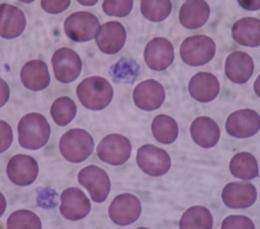
Giant platelets are shown here on a blood smear. Image: wikipedia/Bobjgalindo
About 90 percent of cancer deaths are caused by secondary tumors, known as metastases, which spread from the original tumor site.
To become mobile and break free from the original tumor, cancer cells need help from other cells in their environment. Many cells have been implicated in this process, including immune system cells and cells that form connective tissue. Another collaborator in metastasis is platelets, the blood cells whose normal function is to promote blood clotting.
The exact role played by platelets has been unclear, but a new paper from Richard Hynes, the Daniel K. Ludwig Professor for Cancer Research, and colleagues shows that platelets give off chemical signals that induce tumor cells to become more invasive and plant themselves in new locations. The findings, published Nov. 14 in Cancer Cell, may help researchers develop drugs that could prevent cancers from spreading, if they are diagnosed before metastasis occurs.
For many years, cancer biologists believed that platelets helped to promote metastasis by helping the cells to form big clumps, allowing them to get stuck in new locations more easily. However, some suspected they might have a more active role, because they contain many growth factors and cytokines, many of which can stimulate cancerous growth.
Before cancer cells can metastasize, they typically undergo a shift known as the epithelial-mesenchymal transition (EMT). During this shift, cells lose their ability to adhere to each other and begin to migrate away from their original locations.
Myriam Labelle, a postdoc in Hynes lab and lead author of the Cancer Cell paper, found that cancer cells would undergo this transition if grown in contact with platelets in a lab dish. She then analyzed which genes were being turned on in the metastatic cells and found that genes activated by transforming growth factor beta (TGF-beta, or TGF-b) were very active. TGF-beta was already known to promote EMT. Labelle then went on to show that depletion of TGF-beta from platelets in vivo blocked metastasis.
This work shows that platelets are not just a shield for circulating cancer cells, but also a traveling kit of pro-invasive stimuli, says Joan Massagué, chair of the cancer biology and genetics program at the Sloan-Kettering Institute, who was not part of this study. For nearly three decades platelets have been known to be the richest source of TGF-b in the body, yet it is only now that someone realized what an important role platelets play as a TGF-b source in tumor dissemination.
A complex interaction
In further experiments, Labelle found that the cancer cells would not become metastatic if exposed only to TGF-beta, suggesting that they need an additional signal from the platelets.
Platelets release many chemicals other than TGF-beta they are little bags of stickiness and growth factors, designed to promote wound healing, says Hynes, who is a member of the David H. Koch Institute for Integrative Cancer Research at MIT. However, none of those chemicals on its own was enough to promote metastasis. Labelle found that direct physical contact between platelets and tumor cells was necessary for the cells to become metastatic.
Specifically, when platelets come into contact with tumor cells, they somehow activate the NF-kappa-b pathway, which is involved in regulating the immune response to infection. Both of the signals, NF-kappa-b activation and TGF-beta, are necessary for the switch to occur.
While tumor cells receive the initial stimulus to become mobile while still in their original location, Hynes and Labelle suspect that the additional boost they get from platelets once they enter the bloodstream makes it easier for the cells to penetrate the walls of blood vessels into a new tumor site.
White blood cells are also suspected in promoting metastasis, and Labelle is now doing experiments to figure out what their role may be, and how they may work together with platelets. She is also examining how platelets activate the NF-kappa-b pathway in tumor cells.
Better understanding of the signals that tumor cells need to metastasize may help researchers develop drugs that can prevent such metastases from developing. Its important to understand exactly what platelets are doing, and eventually this could be an opportunity for drugs that would treat metastasis, Labelle says.
Such an approach would be useful for stopping primary tumors or metastases from spreading, but would likely not have much effect on secondary tumors that had already formed.
This story is republished courtesy of MIT News (web.mit.edu/newsoffice/), a popular site that covers news about MIT research, innovation and teaching.
Provided by
Massachusetts Institute of Technology
-
Researchers unravel biochemical factor important in tumor metastasis
Nov 09, 2011 |
not rated yet |
0
-
Researchers learn how signaling molecule orchestrates breast cancer's spread
Apr 03, 2008 |
not rated yet |
0
-
Fugitive cancer cells can be blocked by stopping blood cells that aid them
Mar 07, 2008 |
not rated yet |
0
-
Method for manufacturing patient-specific human platelets
Nov 22, 2010 |
not rated yet |
0
-
Genes set scene for metastasis
Apr 11, 2007 |
not rated yet |
0
-
Motion perception revisited: High Phi effect challenges established motion perception assumptions
Apr 23, 2013 |
3 / 5 (2) |
2
-
Anything you can do I can do better: Neuromolecular foundations of the superiority illusion (Update)
Apr 02, 2013 |
4.5 / 5 (11) |
5
-
The visual system as economist: Neural resource allocation in visual adaptation
Mar 30, 2013 |
5 / 5 (2) |
9
-
Separate lives: Neuronal and organismal lifespans decoupled
Mar 27, 2013 |
4.9 / 5 (8) |
0
-
Sizing things up: The evolutionary neurobiology of scale invariance
Feb 28, 2013 |
4.8 / 5 (10) |
14
-
Why is zone 1 in liver more prone to ischemic injury?
May 23, 2013
-
How can there be villous adenoma in colon, if there are no villi there
May 22, 2013
-
How can there be a term called "intestinal metaplasia" of stomach
May 21, 2013
-
Pressure-volume curve: Elastic Recoil Pressure don't make sense
May 18, 2013
-
If you became brain-dead, would you want them to pull the plug?
May 17, 2013
-
MRI bill question
May 15, 2013
- More from Physics Forums - Medical Sciences
More news stories
New fluorescent tools for cancer diagnosis
In recent years, microRNAs (miRNAs) and other non-coding RNAs are small molecules that help control the expression of specific proteins. In recent years they have emerged as disease biomarkers. miRNA profiles have been used ...
Cancer
6 hours ago |
not rated yet |
0
Modulating the immune system to combat metastatic cancer
Cancer cells spread and grow by avoiding detection and destruction by the immune system. Stimulation of the immune system can help to eliminate cancer cells; however, there are many factors that cause the immune system to ...
Cancer
6 hours ago |
not rated yet |
0
Scientists put bowel cancer under the microscope
Researchers from London's Kingston University have begun a two-year study which could help prolong the lives of people with colorectal tumours.
Cancer
9 hours ago |
5 / 5 (1) |
0
Researcher identifies breast cancer fighting hormone
Transformative research from Western University has identified new hormones in the body which may suppress breast cancer and stimulate the regression of breast tumors.
Cancer
10 hours ago |
5 / 5 (1) |
0
Ground breaking cancer research finds immune system link
(Medical Xpress)—Curtin University researchers have found evidence that targeting specific cells in the body can reverse the effects of cancer on the immune system.
Cancer
10 hours ago |
5 / 5 (3) |
0
Researchers identify first drug targets in childhood genetic tumor disorder
Two mutations central to the development of infantile myofibromatosis (IM)—a disorder characterized by multiple tumors involving the skin, bone, and soft tissue—may provide new therapeutic targets, according to researchers ...
Engineered cytomegalovirus protects monkeys from HIV equivalent
(Medical Xpress)—A new study by researchers in the US has shown that an ancient virus can be modified to help in the fight against the simian immunodeficiency virus SIV, which is the equivalent in monkeys ...
Driving and hands-free talking lead to spike in errors, study shows
Talking on a hands-free device while behind the wheel can lead to a sharp increase in errors that could imperil other drivers on the road, according to new research from the University of Alberta.
Hormone levels may provide key to understanding psychological disorders in women
Women at a particular stage in their monthly menstrual cycle may be more vulnerable to some of the psychological side-effects associated with stressful experiences, according to a study from UCL.
Going live: Immune cell activation in multiple sclerosis
Biological processes are generally based on events at the molecular and cellular level. To understand what happens in the course of infections, diseases or normal bodily functions, scientists would need to ...
Pollen count apps for smartphones are nothing to sneeze at
Kate O'Reilly's spring allergy survival kit includes the usual stuff - nasal sprays, allergy pills and a box of tissues. This season, she's added a new weapon to her line of defense: an app on her smartphone.
Nov 15, 2011
Rank: 1 / 5 (2)
Medicine is a violation of God's will, just like education.
Do not eat of the fruit of the tree of knowledge as it is the path chosen for you by Lucifer.