Brain's connective cells are much more than glue; they also regulate learning and memory
December 29, 2011 in Medical research
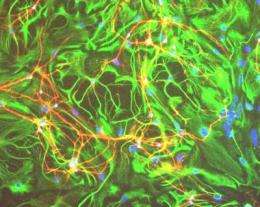
This is a network of neurons (in red) and glia cells (in green) grown in a petri dish. Blue dots are the cells' nuclei. Credit: Pablo Blinder/American Friends of Tel Aviv University (AFTAU)
Glia cells, named for the Greek word for "glue," hold the brain's neurons together and protect the cells that determine our thoughts and behaviors, but scientists have long puzzled over their prominence in the activities of the brain dedicated to learning and memory. Now Tel Aviv University researchers say that glia cells are central to the brain's plasticity how the brain adapts, learns, and stores information.
According to Ph.D. student Maurizio De Pittà of TAU's Schools of Physics and Astronomy and Electrical Engineering, glia cells do much more than hold the brain together. A mechanism within the glia cells also sorts information for learning purposes, De Pittà says. "Glia cells are like the brain's supervisors. By regulating the synapses, they control the transfer of information between neurons, affecting how the brain processes information and learns."
De Pittà's research, led by his TAU supervisor Prof. Eshel Ben-Jacob, along with Vladislav Volman of The Salk Institute and the University of California at San Diego and Hugues Berry of the Université de Lyon in France, has developed the first computer model that incorporates the influence of glia cells on synaptic information transfer. Detailed in the journal PLoS Computational Biology, the model can also be implemented in technologies based on brain networks such as microchips and computer software, Prof. Ben-Jacob says, and aid in research on brain disorders such as Alzheimer's disease and epilepsy.
Regulating the brain's "social network"
The brain is constituted of two main types of cells: neurons and glia. Neurons fire off signals that dictate how we think and behave, using synapses to pass along the message from one neuron to another, explains De Pittà. Scientists theorize that memory and learning are dictated by synaptic activity because they are "plastic," with the ability to adapt to different stimuli.
But Ben-Jacob and colleagues suspected that glia cells were even more central to how the brain works. Glia cells are abundant in the brain's hippocampus and the cortex, the two parts of the brain that have the most control over the brain's ability to process information, learn and memorize. In fact, for every neuron cell, there are two to five glia cells. Taking into account previous experimental data, the researchers were able to build a model that could resolve the puzzle.
The brain is like a social network, says Prof. Ben-Jacob. Messages may originate with the neurons, which use the synapses as their delivery system, but the glia serve as an overall moderator, regulating which messages are sent on and when. These cells can either prompt the transfer of information, or slow activity if the synapses are becoming overactive. This makes the glia cells the guardians of our learning and memory processes, he notes, orchestrating the transmission of information for optimal brain function.
New brain-inspired technologies and therapies
The team's findings could have important implications for a number of brain disorders. Almost all neurodegenerative diseases are glia-related pathologies, Prof. Ben-Jacob notes. In epileptic seizures, for example, the neurons' activity at one brain location propagates and overtakes the normal activity at other locations. This can happen when the glia cells fail to properly regulate synaptic transmission. Alternatively, when brain activity is low, glia cells boost transmissions of information, keeping the connections between neurons "alive."
The model provides a "new view" of how the brain functions. While the study was in press, two experimental works appeared that supported the model's predictions. "A growing number of scientists are starting to recognize the fact that you need the glia to perform tasks that neurons alone can't accomplish in an efficient way," says De Pittà. The model will provide a new tool to begin revising the theories of computational neuroscience and lead to more realistic brain-inspired algorithms and microchips, which are designed to mimic neuronal networks.
Journal reference:
PLoS Computational Biology
Provided by
Tel Aviv University
-
Milestone in the regeneration of brain cells
Aug 20, 2007 |
not rated yet |
0
-
Identification of dopamine 'mother cells' could lead to future Parkinson's treatments
Apr 07, 2008 |
not rated yet |
0
-
Protein keeps sleep-deprived flies ready to learn
May 05, 2011 |
not rated yet |
0
-
Potential pathway for drug intervention
Mar 13, 2009 |
not rated yet |
0
-
Rising star of brain found to regulate circadian rhythms
Apr 14, 2011 |
not rated yet |
0
-
Of mice and mental models: Neuroscientific implications of risk-optimized behavior in the mouse
May 25, 2012 |
not rated yet |
0
-
Limits to growth: Scientists identify key metastasis-enabling enzyme
May 22, 2012 |
5 / 5 (4) |
0
-
Seeing is as seeing does: Spatially-structured retinal input in early development of cortical maps
Apr 26, 2012 |
5 / 5 (4) |
1
-
Dreamless nights: Brain activity during nonrapid eye movement sleep
Apr 09, 2012 |
4.4 / 5 (12) |
0
-
Take your time: Neurobiology sheds light on the superiority of spaced vs. massed learning
Mar 28, 2012 |
4.5 / 5 (21) |
3
-
Potential Breakthrough in Seizure Control
13 hours ago
-
Popping/Cracked sternum.
18 hours ago
-
Which Mental Illness Encompasses This Problem?
18 hours ago
-
A question about drug tolerance
May 23, 2012
-
Poor nutrition leading to overeating?
May 23, 2012
-
Math and dyslexia?
May 21, 2012
- More from Physics Forums - Medical Sciences
More news stories
Implantable pain disk may help those with cancer
An estimated 3.5 million cancer patients around the globe are in severe pain from their disease, but many get no relief.
Medical research
May 25, 2012 |
not rated yet |
0
|
Energy levels link sleep control mechanisms
Sleep, or lack of it, can determine level of cognitive performance which is linked with accidents as well as increased risk of serious health problems. Links between cell energy levels, gene transcription ...
Medical research
May 25, 2012 |
not rated yet |
0
Researchers identify key brain cell in antidepressant action
(Medical Xpress) -- Antidepressant medications such as Prozac have helped improve mood and lessen anxiety in millions of people with major depression. But scientists know surprisingly little about how these drugs work.
Medical research
May 25, 2012 |
4.7 / 5 (3) |
0
|
Rockefeller scientists pioneer new method to determine mechanisms of drug action
(Medical Xpress) -- Knowing that a drug works is great. Knowing how it works is a luxury. And until now, determining a drugs mechanism of action has been a tedious and difficult process for scientists.
Medical research
May 25, 2012 |
not rated yet |
0
|
Like curry? New biological role identified for compound used in ancient medicine
Scientists have just identified a new reason why some curry dishes, made with spices humans have used for thousands of years, might be good for you.
Medical research
May 25, 2012 |
4.5 / 5 (12) |
2
|
Travel to high altitudes tied to Crohn's, colitis flare-ups
(HealthDay) -- People with inflammatory bowel disease, which includes Crohn's disease and colitis, may be at increased risk for flare-ups when they fly or travel to high altitudes for skiing or mountain climbing, ...
Family history of Alzheimer's affects functional connectivity
(HealthDay) -- Cognitively normal individuals with a family history of late-onset Alzheimer's disease (AD) may display lower resting state functional connectivity in the default mode network (DMN) of the brain, ...
Transvaginal mesh op restores pelvic organ prolapse at price
(HealthDay) -- Transvaginal mesh (TVM) procedures are effective for anatomical restoration of pelvic organ prolapse (POP), but patients report a worsening of sexual function following surgery, according to ...
Of mice and mental models: Neuroscientific implications of risk-optimized behavior in the mouse
(Medical Xpress) -- Regardless of an organism’s biological complexity, every encephalized animal continuously makes under-informed behavioral choices that can have serious consequences. Despite its ubiquity, ...
Weight struggles? Blame new neurons in your hypothalamus
New nerve cells formed in a select part of the brain could hold considerable sway over how much you eat and consequently weigh, new animal research by Johns Hopkins scientists suggests in a study published in the May issue ...
Thioridazine kills cancer stem cells in human while avoiding toxic side-effects of conventional cancer treatments
A team of scientists at McMaster University has discovered a drug, thioridazine, successfully kills cancer stem cells in the human while avoiding the toxic side-effects of conventional cancer treatments.
Dec 29, 2011
Rank: 1 / 5 (1)
I wonder how that happens ? Myelin is a dielectric, does this mean that it no longer functions as an insulator ? Or is there a threshold that's exceeded during a seizure ?
Dec 29, 2011
Rank: 5 / 5 (2)
It is interesting to think about. While I am definitely no expert, I would assume that the over-excitation of the neurons in seizures probably has less to do with myelin and more to do with the Vmax and turnover number of the enzymes responsible for potassium sequestration and the conversion of glutamate to glutamine. The neuron has its own braking mechanisms, such as phosphorylation of K channels and intrinsic K leak channels. If glutamate concentrations in the cleft get too high, astrocytes' affect on the driving force of K diminishes once Vmax is reached. Of course, glia also have a Ca2 mediated release of glutamate (like neurons), but that may only be relevant to the other side of the coin.
Dec 29, 2011
Rank: 5 / 5 (1)
Dec 29, 2011
Rank: 5 / 5 (1)
Dec 29, 2011
Rank: not rated yet
Rofl, thanks for the excellent answer !! Took me about 5 minutes to look up the big words though :P
It is very technical, but worth reading up on, even for a layman.
So myelin is basically responsible for preventing signals leaking to nearby cells ?
Dec 30, 2011
Rank: 1 / 5 (6)
Jan 02, 2012
Rank: 5 / 5 (3)
Jan 02, 2012
Rank: not rated yet