Studies: Avastin may fight early breast cancers
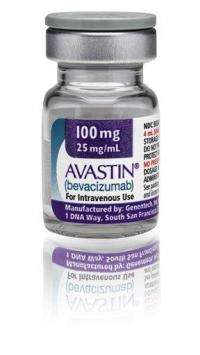
Surprising results from two new studies may reopen debate about the value of Avastin for breast cancer. The drug helped make tumors disappear in certain women with early-stage disease, researchers found.
Avastin recently lost approval for treating advanced breast cancer, but the new studies suggest it might help women whose disease has not spread so widely. These were the first big tests of the drug for early breast cancer, and doctors were cautiously excited that it showed potential to help.
In one study, just over one third of women given Avastin plus chemotherapy for a few months before surgery had no sign of cancer in their breasts when doctors went to operate, versus 28 percent of women given chemo alone. In the other study, more than 18 percent on Avastin plus chemo had no cancer in their breasts or lymph nodes at surgery versus 15 percent of those on chemo alone.
A big caveat, though: The true test is whether Avastin improves survival, and it's too soon to know that - both studies are still tracking the women's health. The drug also has serious side effects.
"I don't think it's clear yet whether this is going to be a winner," Dr. Harry Bear of Virginia Commonwealth University said of Avastin. But he added, "I don't think we're done with it."
Bear led one study, in the United States. Dr. Gunter von Minckwitz of the University of Frankfurt led the other in Germany. Results are in Thursday's New England Journal of Medicine.
Avastin (uh-VAS'-tihn) is still on the market for some colon, lung, kidney and brain tumors. In 2008, it won conditional U.S. approval for advanced breast cancer because it seemed to slow the disease. Further research showed it didn't meaningfully extend life and could cause heart problems, bleeding and other problems. The government revoked its approval for breast cancer in November.
Now doctors can prescribe Avastin for breast cancer but insurers may not pay. Treatment can cost $10,000 a month. The drug is made by California-based Genentech, part of the Swiss company Roche. It is still approved for treating advanced breast cancer in Europe and Japan.
The new studies tested it in a relatively novel way - before surgery. This is sometimes done to shrink tumors that seem inoperable, or to enable women to have just a lump removed instead of the whole breast.
The women in the studies had tumors that were large enough to warrant treatment besides surgery. Their cancers were not the type that can be treated by Herceptin, another widely used drug.
In the U.S. study, 1,200 women were given chemo or chemo plus infusions of Avastin. By the time of their surgery, no cancer could be found in the breasts of more than 34 percent of those given Avastin versus 28 percent of the others. (Surgeons still have to operate because they don't know the tumor is gone until they check tissue samples.)
The German study involved 1,900 women including some with larger tumors. It used a stricter definition of cancer-free at surgery: no sign of disease in the breast or lymph nodes rather than just the breast. No cancer was seen in 18 percent of women on Avastin versus 15 percent of those given only chemo. Different chemo drugs were used - a factor that might change Avastin's effectiveness.
The U.S. study was paid for by the National Cancer Institute with some support from drug companies. The German study was sponsored by drug companies. Some researchers consult for Genentech or other makers of cancer drugs.
If even one of these studies shows a survival advantage for Avastin "that would be a game changer" although side effects remain a concern, said Dr. Gary Lyman. He is a Duke University researcher who was on the federal advisory panel that recommended revoking Avastin's approval.
However, von Minckwitz said side effects are more justifiable in early breast cancer patients because "the intention is cure" rather than in late-stage disease where cure isn't usually possible.
Of the more than 200,000 women in the U.S. diagnosed each year with breast cancer, about 30,000 are like those in the new studies, Lyman estimated.
But the studies' impact could be far greater: The participants' tissue samples are being analyzed for genes and biomarkers to predict which women are most likely to respond to Avastin. That could lead to a relook of using the drug for certain women with advanced disease, too.
Three other studies are under way testing Avastin in early breast cancer; one is expected to have results by the end of this year, said Dr. Sandra Horning, global development chief of cancer drugs for Roche and Genentech. The company does not plan to seek any change in Avastin's use until more results are available, she said.
More information:
Studies: www.nejm.org
Avastin: www.avastin.com
©2012 The Associated Press. All rights reserved. This material may not be published, broadcast, rewritten or redistributed.


