New study confirms that mom's love good for child's brain
January 30, 2012 in Psychology & Psychiatry
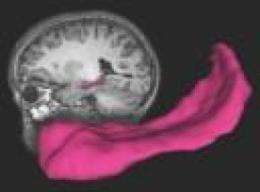
The hippocampus (highlighted in fuchsia) is a key brain structure important to learning, memory and stress response. New research shows that children who were nurtured by their mothers early in life have a larger hippocampus than children who were not nurtured as much. Credit: Washington University School of Medicine
School-age children whose mothers nurtured them early in life have brains with a larger hippocampus, a key structure important to learning, memory and response to stress.
The new research, by child psychiatrists and neuroscientists at Washington University School of Medicine in St. Louis, is the first to show that changes in this critical region of children's brain anatomy are linked to a mother's nurturing.
Their research is published online in the Proceedings of the National Academy of Sciences Early Edition.
"This study validates something that seems to be intuitive, which is just how important nurturing parents are to creating adaptive human beings," says first author Joan L. Luby, MD. "I think the public health implications suggest that we should pay more attention to parents' nurturing, and we should do what we can as a society to foster these skills because clearly nurturing has a very, very big impact on later development."
The brain-imaging study involved children ages 7 to 10 who had participated in an earlier study of preschool depression that Luby and her colleagues began about a decade ago. That study involved children, ages 3 to 6, who had symptoms of depression, other psychiatric disorders or were mentally healthy with no known psychiatric problems.
This video is not supported by your browser at this time.
Researchers at Washington University School of Medicine in St. Louis have found that when young children get plenty of nurturing from their mothers, those children end up with a bigger hippocampus in the brain by the time they reach school age. the hippocampus is an important structure related to learning, memory and stress response. Jim Dryden has more… Credit: Washington University BioMed Radio
As part of the initial study, the children were closely observed and videotaped interacting with a parent, almost always a mother, as the parent was completing a required task, and the child was asked to wait to open an attractive gift. How much or how little the parent was able to support and nurture the child in this stressful circumstance which was designed to approximate the stresses of daily parenting was evaluated by raters who knew nothing about the child's health or the parent's temperament."It's very objective," says Luby, professor of child psychiatry. "Whether a parent was considered a nurturer was not based on that parent's own self-assessment. Rather, it was based on their behavior and the extent to which they nurtured their child under these challenging conditions."
The study didn't observe parents and children in their homes or repeat stressful exercises, but other studies of child development have used similar methods as valid measurements of whether parents tend to be nurturers when they interact with their children.
For the current study, the researchers conducted brain scans on 92 of the children who had had symptoms of depression or were mentally healthy when they were studied as preschoolers. The imaging revealed that children without depression who had been nurtured had a hippocampus almost 10 percent larger that children whose mothers were not as nurturing.
"For years studies have underscored the importance of an early, nurturing environment for good, healthy outcomes for children," Luby says. "But most of those studies have looked at psychosocial factors or school performance. This study, to my knowledge, is the first that actually shows an anatomical change in the brain, which really provides validation for the very large body of early childhood development literature that had been highlighting the importance of early parenting and nurturing. Having a hippocampus that's almost 10 percent larger just provides concrete evidence of nurturing's powerful effect."
Luby says the smaller volumes in depressed children might be expected because studies in adults have shown the same results. What did surprise her was that nurturing made such a big difference in mentally healthy children.
"We found a very strong relationship between maternal nurturing and the size of the hippocampus in the healthy children," she says.
Although 95 percent of the parents whose nurturing skills were evaluated during the earlier study were biological mothers, the researchers say that the effects of nurturing on the brain are likely to be the same, for any primary caregiver whether they are fathers, grandparents or adoptive parents.
The fact that the researchers found a larger hippocampus in the healthy children who were nurtured is striking, Luby says, because the hippocampus is such an important brain structure.
When the body faces stresses, the brain activates the autonomic nervous system, an involuntary system of nerves that controls the release of stress hormones. Those hormones help us cope with stress by increasing the heart rate and helping the body adapt. The hippocampus is the main brain structure involved in that response. It's also key in learning and memory, and larger volumes would suggest a link to improved performance in school, among other things.
Past animal studies have indicated that a nurturing mother can influence brain development, and many studies in human children have identified improvements in school performance and healthier development in children raised in a nurturing environment. But until now, there has not been solid evidence linking a nurturing parent to changes in brain anatomy in children.
"Studies in rats have shown that maternal nurturance, specifically in the form of licking, produces changes in genes that then produce changes in receptors that increase the size of the hippocampus," Luby says. "That phenomenon has been replicated in primates, but it hasn't really been clear whether the same thing happens in humans. Our study suggests a clear link between nurturing and the size of the hippocampus."
She says educators who work with families who have young children may improve school performance and child development by not only teaching parents to work on particular tasks with their children but by showing parents how to work with their children.
"Parents should be taught how to nurture and support their children. Those are very important elements in healthy development," Luby says.
More information: Luby JL, Barch DM, Belden A, Gaffrey MS, Tillman R, Babb C, Nishino T, Suzuki H, Botteron KN. Maternal support in early childhood predicts larger hippocampal volumes at school age. Proceedings of the National Academy of Sciences Early Edition, Jan. 30, 2012. www.pnas.org/cgi/d… s.1118003109
Journal reference:
Proceedings of the National Academy of Sciences
Provided by
Washington University School of Medicine
-
Orphaned children exhibit genetic changes that require nurturing parents
Dec 05, 2011 |
not rated yet |
0
-
Preschool depression: The importance of early detection of depression in young children
May 19, 2010 |
not rated yet |
0
-
Parent-child play therapy relieves depression in preschoolers
Jan 21, 2011 |
not rated yet |
0
-
High sensitivity to stress isn't always bad for children
Feb 05, 2010 |
not rated yet |
0
-
Depression: Not just for adults
Jun 02, 2011 |
not rated yet |
0
-
Motion perception revisited: High Phi effect challenges established motion perception assumptions
Apr 23, 2013 |
3 / 5 (2) |
2
-
Anything you can do I can do better: Neuromolecular foundations of the superiority illusion (Update)
Apr 02, 2013 |
4.5 / 5 (11) |
5
-
The visual system as economist: Neural resource allocation in visual adaptation
Mar 30, 2013 |
5 / 5 (2) |
9
-
Separate lives: Neuronal and organismal lifespans decoupled
Mar 27, 2013 |
4.9 / 5 (8) |
0
-
Sizing things up: The evolutionary neurobiology of scale invariance
Feb 28, 2013 |
4.8 / 5 (10) |
14
-
Pressure-volume curve: Elastic Recoil Pressure don't make sense
23 hours ago
-
If you became brain-dead, would you want them to pull the plug?
May 17, 2013
-
MRI bill question
May 15, 2013
-
Ratio of Hydrogen of Oxygen in Dessicated Animal Protein
May 13, 2013
-
Alcohol and acetaminophen
May 13, 2013
-
Marie Curie's leukemia
May 13, 2013
- More from Physics Forums - Medical Sciences
More news stories
Ketamine shows significant therapeutic benefit in people with treatment-resistant depression
Patients with treatment-resistant major depression saw dramatic improvement in their illness after treatment with ketamine, an anesthetic, according to the largest ketamine clinical trial to-date led by researchers from the ...
Psychology & Psychiatry
1 hour ago |
4.5 / 5 (2) |
0
|
US psychiatry gets makeover in new manual
The latest makeover to a massive psychiatric tome honored by some, reviled by others and even called the "Bible" of mental disorders is being released Saturday with a host of new changes.
Psychology & Psychiatry
13 hours ago |
not rated yet |
0
Study reviews readmissions in inpatient psychiatric facilities
(HealthDay)—Most Medicare beneficiaries treated in inpatient psychiatric facilities (IPFs) exhibit characteristics associated with hospital readmission, according to a report prepared for the National Association ...
Psychology & Psychiatry
May 17, 2013 |
not rated yet |
0
Skydiving is never plane sailing
Skydivers show the same level of physical stress before every jump whether a first-timer or experienced jumper, say Northumbria researchers.
Psychology & Psychiatry
May 17, 2013 |
not rated yet |
0
|
Kids, especially boys, perceive sadness of depressed parents
Children of depressed parents pick up on their parents' sadness—whether mom or dad realizes their mood or not.
Psychology & Psychiatry
May 17, 2013 |
4.5 / 5 (2) |
1
|
Consuming coffee linked to lower risk of detrimental liver disease, study finds
Regular consumption of coffee is associated with a reduced risk of primary sclerosing cholangitis (PSC), an autoimmune liver disease, Mayo Clinic research shows. The findings were being presented at the Digestive Disease ...
Research examines new methods for managing digestive health
Research presented at Digestive Disease Week (DDW) explores new methods for managing digestive health through diet and lifestyle.
New smartphone application improves colonoscopy preparation
The use of a smartphone application significantly improves patients' preparation for a colonoscopy, according to new research presented today at Digestive Disease Week (DDW). The preparation process, which begins days in ...
New research identifies practice changes to improve value and quality of GI procedures
There are significant cost and risk factors associated with two procedures commonly used to diagnose or treat gastrointestinal problems, according to research presented at Digestive Disease Week (DDW).
New research identifies risks, interventions for children's GI health
An increasing number of U.S. children are experiencing gastrointestinal issues that require interventions to resolve, according to research presented at Digestive Disease Week (DDW).
New case of SARS-like virus in Saudi: ministry
A new case of the deadly coronavirus has been detected in Saudi Arabia where 15 people have already died after contracting it, the health ministry announced on Saturday on its Internet website.
Jan 30, 2012
Rank: 5 / 5 (1)
This is very disturbing to me, how children are born to parents that are cut off from their instincts to demonstrate love and need to be taught. I think this is a widespread issue that is the root of an enormous amount of social problems.
Jan 31, 2012
Rank: 5 / 5 (1)
People increasingly eat till they die, neglect (often unknowingly, too) their frieds, kin and children. And themselves. No wonder the children's brains don't develop like they should.
I agree with Telekinetic, this really is a widespread issue, and it is the ultimate cause of a lot of social problems. This brings about mental pollution and psychological climate change much worse than what environmentalists ever could imagine.
I am so thankful that at least some scientists are beginning to see the writing on the wall!
Feb 02, 2012
Rank: not rated yet