Scientists identify gene crucial to normal development of lungs and brain
January 12, 2012 in Medical research
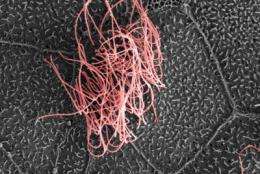
The Salk researchers discovered the master gene that tells cells to develop multiple hair-like cilia, such as those seen in pink in this false-colored electron microscope image of the surface of a frog embryo. Credit: Courtesy of the Salk Institute for Biological Studies; Chris Kintner, Molecular Neurobiology Laboratory, and Matthew Joens and James Fitzpatrick, Waitt Advanced Biophotonics Center
Scientists at the Salk Institute for Biological Studies have identified a gene that tells cells to develop multiple cilia, tiny hair-like structures that move fluids through the lungs and brain. The finding may help scientists generate new therapies that use stem cells to replace damaged tissues in the lung and other organs.
"Cells with multiple cilia play a number of important roles, including moving fluids through the respiratory tract, brain and spinal cord," says Christopher R. Kintner, a professor in Salk's Molecular Neurobiology Laboratory, who led the research. "Knowing the gene that instructs cells to develop multiple cilia helps us understand how we might coax stem cells into developing into this type of cell, which we could then use to repair damaged tissue."
The findings of the research, which was supported by the National Institutes of Health and Salk's Innovation Grants Program, were published in the January 8 online issue of Nature Cell Biology.
Kintner and his collaborator, Jennifer Stubbs, a scientist now at Pathway Genomics, a San Diego biotech company, along with Eszter Vladar, a postdoctoral fellow in the laboratory of Jeffery Axelrod, at the Stanford University School of Medicine, made their discovery by initially studying the embryos of African clawed frogs (Xenopus laevis).
Multiciliate cells form on the outside of the embryos, making them easy to study, and the genetic mechanisms that direct the frog cells to develop multiple cilia are likely similar to those of humans.
Humans and other organisms inherited cilia from our single-celled primordial ancestors that used these beating structures as a form of propulsion. Most cells in our body project a single, non-moving cilium used as a tiny antenna for detecting chemical and physical stimuli. But certain specialized tissues require cells with 100 to 200 moving cilia that beat in concert to move fluids through the body.
These cells aid in pushing cerebrospinal fluid through the brain and spinal cord, helping to circulate and replenish this fluid. In the respiratory system, the cilia push mucus that traps dust, pathogens and other foreign matter from the lung up into the trachea, helping prevent infections.
In a previous study, published in Nature Genetics, Kintner and Stubbs identified a protein, FoxJ1, that promoted the formation of a single moving cilium. What remained unclear is how certain cells activate FoxJ1 in a way that leads to the formation of hundreds of motile cilia per cell.
In their new study, Kintner and his collaborators identified a gene that produces a second protein, which they dubbed "multicilin," that tells cells to develop multiple cilia. When cells are exposed to multicilin, their genetic mechanisms for developing multiple cilia are activated. In a developing embryo, the protein instructs certain stem cells that will line the lungs, kidney and skin to develop into multiciliate cells.
When the researchers inhibited multicilin's action, the frogs' skin and kidney failed to form multiciliate cells. The scientists also found that multicilin is both necessary and sufficient to instruct the development of multiple cilia in cells that line the airways of mice.
"This means that multicilin directs the development of these cells in a number of different organs," Kintner says. "How multiciliate cells develop had been a mystery, but this fills in a big piece of the puzzle."
Kintner notes that patients with respiratory diseases such as chronic asthma, emphysema and cystic fibrosis often suffer from lung infections, which may result from damage to the ciliated cells that move protective mucus out of the airways. In the future, stem cell therapies might replace those damage cells with new ciliated cells, but first scientists need to know how to guide stem cells along a pathway into multiciliate cells.
"Our findings suggest that multicilin could be central to differentiating stem cells into replacement cells," Kintner says. "It's a necessary step in developing such therapies."
Provided by
Salk Institute
-
Scientists study cilia -- microscopic hair
May 05, 2006 |
not rated yet |
0
-
Unexpected function of dyslexia gene
Jun 20, 2011 |
not rated yet |
0
-
How cells' sensing hairs are made
Jun 08, 2011 |
not rated yet |
0
-
Primary cilium as cellular 'GPS system' crucial to wound repair
Dec 17, 2008 |
not rated yet |
0
-
Researchers describe genetic basis of rare human diseases
Jul 08, 2011 |
not rated yet |
0
-
Motion perception revisited: High Phi effect challenges established motion perception assumptions
Apr 23, 2013 |
3 / 5 (2) |
2
-
Anything you can do I can do better: Neuromolecular foundations of the superiority illusion (Update)
Apr 02, 2013 |
4.5 / 5 (11) |
5
-
The visual system as economist: Neural resource allocation in visual adaptation
Mar 30, 2013 |
5 / 5 (2) |
9
-
Separate lives: Neuronal and organismal lifespans decoupled
Mar 27, 2013 |
4.9 / 5 (8) |
0
-
Sizing things up: The evolutionary neurobiology of scale invariance
Feb 28, 2013 |
4.8 / 5 (10) |
14
-
Why is zone 1 in liver more prone to ischemic injury?
May 23, 2013
-
How can there be villous adenoma in colon, if there are no villi there
May 22, 2013
-
How can there be a term called "intestinal metaplasia" of stomach
May 21, 2013
-
Pressure-volume curve: Elastic Recoil Pressure don't make sense
May 18, 2013
-
If you became brain-dead, would you want them to pull the plug?
May 17, 2013
-
MRI bill question
May 15, 2013
- More from Physics Forums - Medical Sciences
More news stories
Study reveals new mechanism for estrogen suppression of liver lipid synthesis
By discovering the new mechanism by which estrogen suppresses lipid synthesis in the liver, UC Irvine endocrinologists have revealed a potential new approach toward treating certain liver diseases.
Medical research
21 hours ago |
not rated yet |
0
|
MRI-based measurement helps predict vascular disease in the brain
Aortic arch pulse wave velocity, a measure of arterial stiffness, is a strong independent predictor of disease of the vessels that supply blood to the brain, according to a new study published in the June issue the journal ...
Medical research
21 hours ago |
not rated yet |
0
Antibiotics: A new understanding of sulfonamide nervous system side effects
Since the discovery of Prontosil in 1932, sulfonamide antibiotics have been used to combat a wide spectrum of bacterial infections, from acne to chlamydia and pneumonia. However, their side effects can include serious neurological ...
Medical research
22 hours ago |
not rated yet |
0
|
Scientists discover molecule triggers sensation of itch
Scientists at the National Institutes of Health report they have discovered in mouse studies that a small molecule released in the spinal cord triggers a process that is later experienced in the brain as ...
Medical research
22 hours ago |
5 / 5 (2) |
0
|
Discarded immune cells induce the relocation of stem cells
Spanish researchers have discovered that the daily clearance of neutrophils from the body stimulates the release of hematopoietic stem cells from the bone marrow into the bloodstream, according to a report published today ...
Medical research
May 23, 2013 |
5 / 5 (2) |
0
Hormone levels may provide key to understanding psychological disorders in women
Women at a particular stage in their monthly menstrual cycle may be more vulnerable to some of the psychological side-effects associated with stressful experiences, according to a study from UCL.
Going live: Immune cell activation in multiple sclerosis
Biological processes are generally based on events at the molecular and cellular level. To understand what happens in the course of infections, diseases or normal bodily functions, scientists would need to ...
ACOG: Hormone therapy not recommended to prevent CHD
(HealthDay)—Menopausal hormone therapy should not be used for prevention of coronary heart disease, according to a Committee Opinion from the American College of Obstetricians and Gynecologists (ACOG) published ...
Youth with type 2 diabetes at much higher risk for heart, kidney disease
The news about youth and diabetes keeps getting worse. The latest data from the national TODAY diabetes study shows that children who develop Type 2 diabetes are at high risk to develop heart, kidney and eye problems faster ...
New animal model gives insights into mechanisms of Parkinson's disease pathogenesis
In Parkinson's disease, the protein "alpha-synuclein" aggregates and accumulates within neurons. Specific areas of the brain become progressively affected as the disease develops and advances. The mechanism underlying this ...
Audiologists recommend smart phone apps to monitor noise levels
After studying noise in one French Quarter neighborhood of New Orleans to determine whether or not noise levels exceeded municipal ordinances, Annette Hurley, PhD, Assistant Professor of Audiology at LSU Health Sciences Center ...