New target for Alzheimer's drugs
February 9, 2012 By Iqbal Pittalwala in Alzheimer's disease & dementia
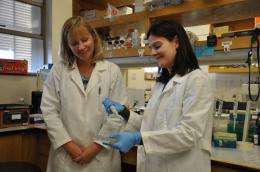
Iryna Ethell (left), an associate professor of biomedical sciences at UC Riverside, is seen here with Crystal Pontrello, a postdoctoral researcher in her lab. Credit: UCR Strategic Communication.
(Medical Xpress) -- Biomedical scientists at the University of California, Riverside have identified a new link between a protein called beta-arrestin and short-term memory that could open new doors for the therapeutic treatment of neurological disorders, particularly Alzheimers disease.
Beta-arrestin is expressed in various cells of the body, including cells of the hippocampus, the region of the brain that is involved in learning and the formation of short-term memories. Beta-arrestin, the absence of which impairs normal learning in mice, is one of many scaffolding proteins proteins that support the connections between neurons in the brain.
As our brain develops, new connections called synapses are formed between neurons. In the hippocampus, the formation of synapses is a continuous process. As we learn something new, new connections are formed and some old ones become stronger through a process known as long-term potentiation (LTP). But because brains have only a limited capacity, other old connections must disassemble through a process known as long-term depression (LTD) in order for new synapses to form.
The researchers report online last week in the Proceedings of the National Academy of Sciences that beta-arrestin plays an important role in the plasticity of synaptic connections and LTD by regulating the actin cytoskeleton, a dynamic filamentous network of proteins that forms the backbone of neurons and is involved in forming new and disassembling old synaptic connections.
In some pathological conditions such as Alzheimers disease, loss of the old synaptic connections far exceeds the formation of new ones, resulting in overall loss of synapses and short-term memory loss, said Iryna M. Ethell, an associate professor of biomedical sciences and the lead author of the research paper. Our work, done on mice, shows that if beta-arrestin is removed from neurons, this loss of synapses is prevented. But we also know that beta-arrestin is required for normal learning and memory; so a fine balance needs to be established. This balance could be easily achieved by pharmaceutical drugs in the future.
This is the first time researchers anywhere have linked beta-arrestin to Alzheimers and learning/memory.
Ethell explained that beta-arrestin can be visualized as energy supplied to a puppeteer (actin cytoskeleton) controlling the strings of the puppets (inter-neuronal connections). For normal learning to take place, the puppeteer needs to move the strings in a specific order. But in patients with Alzheimers, this supply of energy over-activates and the strings are pulled in a disorderly fashion that results in the strings being broken (loss of synapses) and the puppets collapsing. While the removal of beta-arrestin would prevent this collapse, a complete loss of beta-arrestin would mean no movement of the puppets at all (that is, no learning in the brain), which is equally undesirable.
A selective tuning of beta-arrestin activity is therefore necessary to partially reduce synapse disassembly, said Crystal G. Pontrello, the first author of the research paper and a postdoctoral researcher in Ethells lab. What you want, ideally, is the elimination of only some unused old synaptic connections so that there is room to make new connections.
Journal reference:
Proceedings of the National Academy of Sciences
Provided by University of California, Riverside
-
Scientists discover new mechanism that may be important for learning and memory
Jul 14, 2011 |
not rated yet |
0
-
Some antipsychotic drugs may be missing their mark
Jan 01, 2008 |
not rated yet |
0
-
Neuroscientists identify a master controller of memory
Dec 22, 2011 |
not rated yet |
0
-
Putting top brains to the test with Alzheimer's protein
Jan 31, 2011 |
not rated yet |
0
-
Scientists reveal molecular sculptor of memories
Sep 26, 2011 |
not rated yet |
0
-
Motion perception revisited: High Phi effect challenges established motion perception assumptions
Apr 23, 2013 |
3 / 5 (2) |
2
-
Anything you can do I can do better: Neuromolecular foundations of the superiority illusion (Update)
Apr 02, 2013 |
4.5 / 5 (11) |
5
-
The visual system as economist: Neural resource allocation in visual adaptation
Mar 30, 2013 |
5 / 5 (2) |
9
-
Separate lives: Neuronal and organismal lifespans decoupled
Mar 27, 2013 |
4.9 / 5 (8) |
0
-
Sizing things up: The evolutionary neurobiology of scale invariance
Feb 28, 2013 |
4.8 / 5 (10) |
14
-
Question of reflection and transmission of TEM wave in normal incidenc
4 hours ago
-
the rudyak-krasnolutski effective potencial
5 hours ago
-
Normal force for a lever model
7 hours ago
-
gravity is std. therefore can we rate a 'mass at height' by watts?
12 hours ago
-
Calculating on-axis elements of a solenoid
May 22, 2013
-
latitude & longitude & air pressure
May 22, 2013
- More from Physics Forums - Classical Physics
More news stories
Scientists discover cinnamon compounds' potential ability to prevent Alzheimer's
Cinnamon: Can the red-brown spice with the unmistakable fragrance and variety of uses offer an important benefit? The common baking spice might hold the key to delaying the onset of –– or warding off ...
Alzheimer's disease & dementia
5 hours ago |
5 / 5 (4) |
0
|
Drug reverses Alzheimer's disease deficits in mice, research confirms
An anti-cancer drug reverses memory deficits in an Alzheimer's disease mouse model, University of Pittsburgh Graduate School of Public Health researchers confirm in the journal Science.
Alzheimer's disease & dementia
7 hours ago |
not rated yet |
0
|
Multiple research teams unable to confirm high-profile Alzheimer's study
Teams of highly respected Alzheimer's researchers failed to replicate what appeared to be breakthrough results for the treatment of this brain disease when they were published last year in the journal Science.
Alzheimer's disease & dementia
7 hours ago |
5 / 5 (1) |
2
|
Major human drug trial underway for Alzheimer's
A potentially ground-breaking human drug trial is currently underway, which aims to discover whether blood pressure medication can slow or halt the progression of Alzheimer's Disease (AD). This is the latest ...
Alzheimer's disease & dementia
10 hours ago |
not rated yet |
0
Drugs found to both prevent and treat Alzheimer's disease in mice
Researchers at USC have found that a class of pharmaceuticals can both prevent and treat Alzheimer's Disease in mice.
Alzheimer's disease & dementia
May 21, 2013 |
5 / 5 (7) |
0
|
Controlling mood through the motions of mitochondria
(Medical Xpress)—Regulating the distribution of power in neurons is done by a system that makes the national electric grid look simple by comparison. Each neuron has several thousand mitochondria confined ...
Scientists discover molecule triggers sensation of itch
Scientists at the National Institutes of Health report they have discovered in mouse studies that a small molecule released in the spinal cord triggers a process that is later experienced in the brain as ...
Type 2 diabetes progresses faster in kids, study finds
(HealthDay)—Type 2 diabetes is more aggressive in children than adults, with signs of serious complications seen just a few years after diagnosis, new research finds.
Motion quotient: IQ predicted by ability to filter motion (w/ video)
A brief visual task can predict IQ, according to a new study. This surprisingly simple exercise measures the brain's unconscious ability to filter out visual movement. The study shows that individuals whose ...
Researchers find common childhood asthma unconnected to allergens or inflammation
Little is known about why asthma develops, how it constricts the airway or why response to treatments varies between patients. Now, a team of researchers at Weill Cornell Medical College, Columbia University Medical Center ...
Diabetes' genetic underpinnings can vary based on ethnic background, studies say
Ethnic background plays a surprisingly large role in how diabetes develops on a cellular level, according to two new studies led by researchers at the Stanford University School of Medicine.