Complex wiring of the nervous system may rely on a just a handful of genes and proteins
February 10, 2012 in Medical research
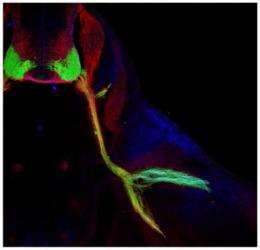
This image shows nerves (labeled in green) that control body movements emerging from the spinal cord of a mouse (upper left, in cross section) and connecting to muscles in the base of the leg. The Salk researchers discovered that a combination of genes direct nerves to split in the leg (lower right) to make the proper connections with their target muscles during early development. Credit: Image: Courtesy Dario Bonanomi, Salk Institute for Biological Studies
Researchers at the Salk Institute have discovered a startling feature of early brain development that helps to explain how complex neuron wiring patterns are programmed using just a handful of critical genes. The findings, published February 3 in Cell, may help scientists develop new therapies for neurological disorders, such as amyotrophic lateral sclerosis (ALS), and provide insight into certain cancers.
The Salk researchers discovered that only a few proteins on the leading edge of a motor neuron's axon - its outgoing electrical "wire" - and within the extracellular soup it travels through guide the nerve as it emerges from the spinal cord. These molecules can attract or repel the axon, depending on the long and winding path it must take to finally connect with its target muscle.
"The budding neuron has to detect the local environment it is growing through and decide where it is, and whether to grow straight, move to the left or right, or stop," says the study's senior investigator, Sam Pfaff, a professor in Salk's Gene Expression Laboratory and a Howard Hughes Medical Institute investigator.
"It does this by mixing and matching just a handful of protein products to create complexes that tell a growing neuron which way to go, in the same way that a car uses the GPS signals it receives to guide it through an unfamiliar city," he says.
The brain contains millions of times the number of neuron connections than the number of genes found in the DNA of brain cells. This is one of the first studies to try and understand how a growing neuron integrates many different pieces of information in order to navigate to its eventual target and make a functional connection.

This is Samuel Pfaff. Credit: Image: Courtesy of Salk Institute for Biological Studies
"We focused on motor neurons that control muscle movements, but the same kind of thing is going on throughout embryonic development of the entire nervous system, during which millions of axons make trillions of decisions as they move to their targets," he says. "It is the exquisite specificity with which they grow that underlies the basic architecture and proper function of the nervous system."These findings might eventually shed new light on a number of clinical disorders related to faulty nerve cell functioning, such as ALS, which is also known as Lou Gehrig's disease, says the first author on the paper, Dario Bonanomi, a post-doctoral researcher in Pfaff's laboratory.
"These are the motor neurons that die in diseases like Lou Gehrig's disease and that are linked to a genetic disorder in children known as spinal muscle atrophy," Bonanomi says.
"It is also a jumping off point to try and understand the basis for defects that might arise during fetal development of the nervous system," he added. "A better understanding of those signals might help to be able to regenerate and rewire circuits following diseases or injuries of the nervous system."
The researchers say the study also offers insights into cancer development, because a protein the researchers found to be crucial to the "push and pull" signaling system - Ret- is also linked to cancer. Mutations that activate Ret are linked to a number of different kinds of tumors.
The other protein receptors described in the study, known as Ephs, have also been implicated in cancer, Pfaff says.
"This study suggests that the way cells detect signals in their environment is likely a universal strategy," he says, "and we know that genes and proteins known to function primarily during embryonic development have been linked to cancer."
"Controlling neuronal growth requires very potent signaling molecules, and it makes sense they would be linked to disease," Pfaff says. "We hope our findings help further unravel these connections."
Provided by
Salk Institute
-
Unlocking the secret(ase) of building neural circuits
Jan 18, 2011 |
not rated yet |
0
-
Researchers uncover a new piece of the puzzle in the development of our nervous system
Jul 14, 2011 |
not rated yet |
0
-
Disease progression halted in rat model of Lou Gehrig's disease
Dec 12, 2011 |
not rated yet |
0
-
Preserving nerve cells in motor neuron disease
Sep 20, 2010 |
not rated yet |
0
-
Lou Gehrig's protein found throughout brain, suggesting effects beyond motor neurons
Jun 16, 2008 |
not rated yet |
0
-
Motion perception revisited: High Phi effect challenges established motion perception assumptions
Apr 23, 2013 |
3 / 5 (2) |
2
-
Anything you can do I can do better: Neuromolecular foundations of the superiority illusion (Update)
Apr 02, 2013 |
4.5 / 5 (11) |
5
-
The visual system as economist: Neural resource allocation in visual adaptation
Mar 30, 2013 |
5 / 5 (2) |
9
-
Separate lives: Neuronal and organismal lifespans decoupled
Mar 27, 2013 |
4.9 / 5 (8) |
0
-
Sizing things up: The evolutionary neurobiology of scale invariance
Feb 28, 2013 |
4.8 / 5 (10) |
14
-
Pressure-volume curve: Elastic Recoil Pressure don't make sense
May 18, 2013
-
If you became brain-dead, would you want them to pull the plug?
May 17, 2013
-
MRI bill question
May 15, 2013
-
Ratio of Hydrogen of Oxygen in Dessicated Animal Protein
May 13, 2013
-
Alcohol and acetaminophen
May 13, 2013
-
Marie Curie's leukemia
May 13, 2013
- More from Physics Forums - Medical Sciences
More news stories
Study suggests new source of kidneys for transplant
Nearly 20 percent of kidneys that are recovered from deceased donors in the U.S. are refused for transplant due to factors ranging from scarring in small blood vessels of the kidney's filtering units to the organ going too ...
Medical research
13 hours ago |
5 / 5 (2) |
0
|
Discovery of circadian clock in mice hair reveals period of time when damage from radiotherapy can be quickly repaired
Discovering that mouse hair has a circadian clock - a 24-hour cycle of growth followed by restorative repair - researchers suspect that hair loss in humans from toxic cancer radiotherapy and chemotherapy ...
Medical research
14 hours ago |
5 / 5 (2) |
1
|
Do salamanders hold the solution to regeneration?
Salamanders' immune systems are key to their remarkable ability to regrow limbs, and could also underpin their ability to regenerate spinal cords, brain tissue and even parts of their hearts, scientists have ...
Medical research
15 hours ago |
4.9 / 5 (7) |
2
|
New study finds blind people have the potential to use their 'inner bat' to locate objects
New research from the University of Southampton has shown that blind and visually impaired people have the potential to use echolocation, similar to that used by bats and dolphins, to determine the location of an object.
Medical research
17 hours ago |
not rated yet |
1
|
Germ-fighting vaccine system makes great strides in delivery
A novel vaccine study from South Dakota State University (SDSU) will headline the groundbreaking research that will be unveiled at the American Association of Pharmaceutical Scientists' (AAPS) National Biotechnology Conference ...
Medical research
18 hours ago |
not rated yet |
0
Holding drivers' attention
Each day, an average of nine people are killed in the United States and more than 1,000 injured by drivers doing something other than driving.
Genetic predictors of postpartum depression uncovered
Johns Hopkins researchers say they have discovered specific chemical alterations in two genes that, when present during pregnancy, reliably predict whether a woman will develop postpartum depression.
Nobel laureate plays down flu pandemic scaremongering
A Nobel prize-winning scientist Tuesday played down "shock-horror scenarios" that a new virus strain will emerge with the potential to kill millions of people.
Study puts Huntington's disease trials on TRACK
(Medical Xpress)—A three-year multinational study has tracked and detailed the progression of Huntington's disease (HD), predicting clinical decline in people carrying the HD gene more than 10 years before ...
Child maltreatment increases risk of adult obesity
Children who have suffered maltreatment are 36% more likely to be obese in adulthood compared to non-maltreated children, according to a new study by King's College London. The authors estimate that the prevention or effective ...
New immune system discovered
(Medical Xpress)—A research team, led by Jeremy Barr, a biology post-doctoral fellow, unveils a new immune system that protects humans and animals from infection.

Feb 11, 2012
Rank: not rated yet
http://www.physor...een.html
GPS as a universal strategy has never looked better.