When is a gene not a gene? New catalog helps identify gene variations associated with disease
February 16, 2012 in Genetics

When is a gene not a gene? New catalog helps identify gene variations associated with disease

Enlarge

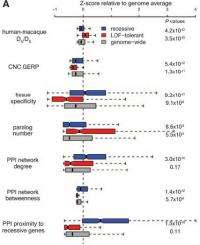
Distribution of recessive disease genes (blue) and LoF-tolerant genes (red) compared to all protein-coding genes (gray) [DOI:10.1126/science.1215040]

A high-quality reference catalogue of the genetic changes that result in the deactivation of human genes has been developed by a team of researchers. This catalogue of loss-of-function (LoF) variants is needed to find new disease-causing mutations and will help us to better understand the normal function of human genes. In addition, the researchers report that each of us is carrying around 20 genes that have been completely inactivated.

The team refined previous estimations of possible LoF variants by excluding more than half. They accomplished this by identifying errors and real variants that did not seem to affect gene function and eliminating them from the list. They also developed a method of determining whether or not a newly-identified variant could be a likely cause of disease.

Loss of function variants are that are predicted to severely disrupt the function of genes. They are known to cause severe human diseases such as and . Previous genome sequencing projects have suggested that hundreds of these variants are present in the DNA of even perfectly healthy individuals, but could not tell exactly how many.

"The key questions we focused on for this study were: how many of these LoF variants were real and how large a role might they play in human disease?" explains Dr Daniel MacArthur, first author from the Wellcome Trust Sanger Institute. "We looked at nearly 3000 putative LoF variants in the genomes of 185 people from Europe, East Asia and West Africa who were participants of the 1000 Genomes Project."

Working as part of the 1000 Genomes Project, the team developed a series of filters to identify common errors. The filters revealed that 56% of the 3000 LoFs were unlikely to seriously affect gene function. But of the true LoF variants, 100 are typically found in the of each European and 20 affect both copies of the gene, and are thus predicted to result in complete loss of gene function.

"We identified 253 genes that can be completely inactivated in one or more participant. This shows that at least 1% of human genes can be shut down without causing serious disease", explains Professor Mark Gerstein, co-author from Yale University. "We were able to use the differences between such "LoF-tolerant" genes and known human disease genes to develop a way of predicting whether or not a newly-discovered change in a gene is likely to be severely disease-causing."

The team found some of these LoFs are quite common and are unlikely to have a significant effect on health. For instance, some can affect the way in which we detect smells or how sensitive we are to sour taste. However, they found that the majority of the LoF variants are rare, with half of them being seen only once in the 185 people. This suggests that most of these variants can be quite harmful.

"Our research will be beneficial for current sequencing studies underway in disease patients," says Dr Chris Tyler-Smith, lead author from the Wellcome Trust Sanger Institute. "In addition, we provide a list of over 1000 loss-of-function variants, and in most cases little or nothing is known about how these genes work or what they do. By studying the people carrying them in detail, we should get new insights into the function of many poorly-known "

The team's long term goal is to study the potential effects all LoF variants have on humans. They will do this by looking at them in people with different diseases, as well as healthy people who have been measured for many different traits.

More information: McArthur et al 'A Systematic Survey of Loss-of-Function Variants in Human Protein-Coding Genes' Published in Science on 17 February 2012. dx.doi.org/10.1126… ence.1215040

Journal reference: Science search and more info website

Provided by Wellcome Trust Sanger Institute search and more info website

5 /5 (1 vote)  

Rank 5 /5 (1 vote)
Related Stories
Relevant PhysicsForums posts

More news stories

Researchers complete largest genetic sequencing study of human disease

Researchers from Queen Mary, University of London have led the largest sequencing study of human disease to date, investigating the genetic basis of six autoimmune diseases.

Genetics created 20 hours ago | popularity 4.5 / 5 (4) | comments 0 | with audio podcast

Researchers develop model for better testing, targeting of malignant peripheral nerve sheath tumors

University of Minnesota Medical School researchers from the Masonic Cancer Center, University of Minnesota, in partnership with the University's Brain Tumor Program, have developed a new mouse model of malignant peripheral ...

Genetics created May 20, 2013 | popularity 5 / 5 (1) | comments 0 | with audio podcast

Researchers identify new circadian clock component

Northwestern University scientists have shown a gene involved in neurodegenerative disease also plays a critical role in the proper function of the circadian clock.

Genetics created May 16, 2013 | popularity 3 / 5 (1) | comments 1 | with audio podcast

Returning genetic incidental findings without patient consent violates basic rights, experts say

Informed consent is the backbone of patient care. Genetic testing has long required patient consent and patients have had a "right not to know" the results. However, as 21st century medicine now begins to use the tools of ...

Genetics created May 16, 2013 | popularity 5 / 5 (1) | comments 3 | with audio podcast

Ethicists provide framework supporting new recommendations on reporting incidental findings in gene sequencing

In a paper published in Science Express, a group of experts led by bioethicists in the Center for Medical Ethics and Health Policy at Baylor College of Medicine provide a framework for the new American College of Medical Geneti ...

Genetics created May 16, 2013 | popularity not rated yet | comments 0


Cold plasma successful against brain cancer cells

For the first time, physicists from the Max Planck Institute for Extraterrestrial Physics (MPE), biologists and physicians demonstrated the synergistic effect of cold atmospheric plasma - a partly ionized ...

Study reveals active site of enzyme linked to stuttering

(Medical Xpress)—Scientists from the Joint Center for Structural Genomics (JCSG) at SLAC National Accelerator Laboratory have determined the 3-D structure of the chemically active part of an enzyme involved ...

Are kids who take music lessons different from other kids?

(Medical Xpress)—Research by U of T Mississauga psychology professor Glenn Schellenberg reveals that two key personality traits – openness-to-experience and conscientiousness—predict better than IQ ...

Key find for early bladder cancer treatment

Aggressive forms of bladder cancer involve the protein PODXL – a discovery that could hold the key to improved treatment, according to researchers at Lund University, Uppsala University and KTH in Sweden.

Common brain processes of anesthetic-induced unconsciousness identified

A study from the June issue of Anesthesiology found feedback from the front region of the brain is a crucial building block for consciousness and that its disruption is associated with unconsciousness when the anesthetics ketami ...

Parents can help preteens with abduction concerns

Parents naturally are concerned for their children's safety, particularly when there is news of a child abduction that happens close to home. Finding the balance between emotions and the "teachable moment" as parents talk ...