Rib fractures linked to circulatory disorder often seen in athletes
February 24, 2012 By Julia Evangelou Strait in Cardiology
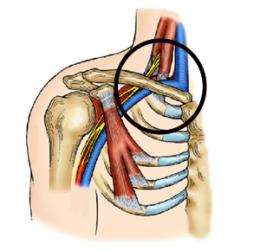
Venous thoracic outlet syndrome occurs when the vein, shown in blue, passing between the collarbone and first rib, is compressed and damaged, leading to blockage of the vein. Credit: ROBERT W. THOMPSON, MD
(Medical Xpress) -- Surgeons at Washington University School of Medicine in St. Louis have identified tiny fractures and other rib abnormalities in patients treated for a circulatory condition called venous thoracic outlet syndrome.
The findings come from a study of 37 patients who underwent surgery for the syndrome at Barnes-Jewish Hospital.
Also known as subclavian vein effort thrombosis or Paget-Schroetter syndrome, the disorder is often seen in elite athletes who rely on their upper extremities. The hallmark of the syndrome is blockage of the vein that carries blood from the arm to the heart. The vein passes over the first rib and under the collarbone, making it vulnerable to compression, especially under repetitive stress with the arm in an elevated position.
Most of our patients are young, healthy, physically active people, often athletes, says Robert W. Thompson, MD, professor of surgery and director of the Center for Thoracic Outlet Syndrome. And they have a sudden onset of a swollen, bluish arm, sometimes two or three times the normal size.
In these patients first ribs, located under the collarbone, the abnormalities Thompson and his colleagues reported include unusual calcification, degeneration of the rib and even small fractures that cannot be detected by X-ray studies. The study is available online in the Journal of Vascular Surgery.
If you have repetitive motion of the arm, you may get first-rib microfractures, Thompson says. There is often thickening around this rib in response to injury, almost like a callous has formed there. That may take up space and compress the vein. No one has reported this before in patients with thoracic outlet syndrome.
Once the symptoms are resolved with medication or other methods to break up the blood clot that forms in the compressed and damaged vein, doctors perform surgery to create more space for the vein to pass through and restore blood flow. Part of that surgery involves removal of the entire first rib, which provided Thompson and his colleagues with specimens to examine.
In the 37 patients who underwent surgery in one year at Barnes-Jewish Hospital to treat the syndrome, Thompson found that 16 of the patients had previously undetected fractures in the first rib (43 percent). And of those patients over age 30, 76 percent had rib fractures (16 of 21 patients).
A surprisingly high percentage of our patients had these microfractures, Thompson says. That area of the rib is often quite abnormal in those with venous thoracic outlet syndrome, and it might result from unusual stresses being placed on that rib.
Venous thoracic outlet syndrome is one of three types of thoracic outlet syndrome (TOS) that Thompson and his team treat. The most common is neurogenic TOS, which is caused by compression of the nerves under the collarbone. Venous TOS is the second most common type, followed by arterial TOS, which involves compression of the subclavian artery, often by a congenital extra first rib.
Thompson says that the relatively unique surgical method he uses to treat the venous condition makes Washington University one of the only places in the country where these rib observations could have been made.
Many times, these operations involve taking the rib out in pieces he says. Because we make incisions above and below the collarbone, we can actually remove the entire rib in one piece. Beyond being able to give the patient a nice souvenir, we have the whole rib to examine.
The nature of the surgery and the fact that the fractures are not visible with non-invasive imaging techniques, such as a CT scan, mean that they were not able to compare these ribs to those of individuals without venous thoracic outlet syndrome.
We dont have specimens from the general population, Thompson says. But we think these observations would surprise a lot of people. Even if another surgeon operates on patients with venous thoracic outlet syndrome, they likely dont do the same procedure, and they dont see the whole rib.
According to Thompson, treating this relatively uncommon condition in high volume with patient referrals from across the country has allowed Washington University surgeons to make new observations about what may be causing it.
More information: Sheng GG, Duwayri YM, Emery VB, Wittenberg AM, Moriarty CT, Thompson RW. Costochondral calcification, osteophytic degeneration, and occult first rib fractures in patients with venous thoracic outlet syndrome. Journal of Vascular Surgery. Online Feb. 10, 2012.
Provided by
Washington University School of Medicine in St. Louis
-
Study shows modified technique further reduces lung surgery pain
Jun 06, 2008 |
not rated yet |
0
-
Botox eases nerve pain in certain patients
Jun 10, 2010 |
not rated yet |
0
-
To have or not to have ribs (a vertebrate story)
Apr 27, 2010 |
not rated yet |
0
-
New test could help thousands of patients with high blood pressure
Dec 01, 2011 |
not rated yet |
0
-
Single-incision surgery repertoire expands to treat colorectal conditions
Oct 27, 2011 |
not rated yet |
0
-
Motion perception revisited: High Phi effect challenges established motion perception assumptions
Apr 23, 2013 |
3 / 5 (2) |
2
-
Anything you can do I can do better: Neuromolecular foundations of the superiority illusion (Update)
Apr 02, 2013 |
4.5 / 5 (11) |
5
-
The visual system as economist: Neural resource allocation in visual adaptation
Mar 30, 2013 |
5 / 5 (2) |
9
-
Separate lives: Neuronal and organismal lifespans decoupled
Mar 27, 2013 |
4.9 / 5 (8) |
0
-
Sizing things up: The evolutionary neurobiology of scale invariance
Feb 28, 2013 |
4.8 / 5 (10) |
14
-
Relating physics forces and entropy
2 hours ago
-
Force Between Two Concentric Solenoids
6 hours ago
-
Synchrotron, question about insertion devices and electron velocity
6 hours ago
-
Equating differentials => equating coefficients
8 hours ago
-
The idea behind a reverse shock
14 hours ago
-
Guass's Law for a charge distribution
14 hours ago
- More from Physics Forums - Classical Physics
More news stories
Heart failure accelerates male 'menopause'
Heart failure accelerates the aging process and brings on early andropausal syndrome (AS), according to research presented today at the Heart Failure Congress 2013. AS, also referred to as male 'menopause', was four times ...
Cardiology
19 hours ago |
5 / 5 (1) |
1
Death highest in heart failure patients admitted in January, on Friday, and overnight
Mortality and length of stay are highest in heart failure patients admitted in January, on Friday, and overnight, according to research presented today at the Heart Failure Congress 2013. The analysis of nearly 1 million ...
Cardiology
19 hours ago |
not rated yet |
0
First drug to improve heart failure mortality in over a decade
Coenzyme Q10 decreases all cause mortality by half, according to the results of a multicentre randomised double blind trial presented today at Heart Failure 2013 congress. It is the first drug to improve heart failure mortality ...
Cardiology
19 hours ago |
5 / 5 (5) |
5
Registry confirms TAVI efficacy and safety in Asian patients
Transcatheter aortic valve implantation (TAVI) is effective and safe in Asian patients, according to early experience based on first results from a multicentre Asian registry reported at EuroPCR 2013.
Cardiology
May 24, 2013 |
not rated yet |
0
Diagnostic coronary angiography: Functional flow reserve changes decisions in 25 percent of cases
Routinely measuring fractional flow reserve (FFR) using pressure wire assessment during coronary angiography for diagnosis of chest pain leads to significant changes in the management of one in four patients, according to ...
Cardiology
May 24, 2013 |
not rated yet |
0
Seniors more likely to crash when driving with pet, study finds
(HealthDay)—Animals make great companions for senior citizens, but elderly people who always drive with a pet in the car are far more likely to crash than those who never drive with a pet, researchers have ...
New immune system discovered
(Medical Xpress)—A research team, led by Jeremy Barr, a biology post-doctoral fellow, unveils a new immune system that protects humans and animals from infection.
Feds fight morning-after pill age ruling in NY
(AP)—Department of Justice lawyers have again asked a federal appeals court in New York to delay lifting age restrictions and prescription requirements on an emergency contraceptive popularly known as the morning-after ...
Brain can be trained in compassion, study shows
Until now, little was scientifically known about the human potential to cultivate compassion—the emotional state of caring for people who are suffering in a way that motivates altruistic behavior.
Do salamanders hold the solution to regeneration?
Salamanders' immune systems are key to their remarkable ability to regrow limbs, and could also underpin their ability to regenerate spinal cords, brain tissue and even parts of their hearts, scientists have ...
Hormone levels may provide key to understanding psychological disorders in women
Women at a particular stage in their monthly menstrual cycle may be more vulnerable to some of the psychological side-effects associated with stressful experiences, according to a study from UCL.