Youth football head impact study published
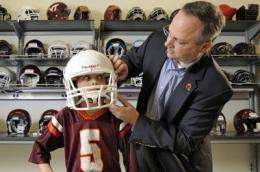
Wake Forest University School of Biomedical Engineering and Sciences (SBES) announces the first ever publication with data on head impacts from youth football players. The paper is published in the Annals of Biomedical Engineering and is available online for free download. The manuscript includes the details of over 700 head impacts measured on 7 and 8 year old youth football players.
Based on the importance of this initial publication, the School of Biomedical Engineering and Sciences is also announcing today a new study to instrument and map the head impact exposure of youth football players for all age groups from 6 years through 18 years. This program will consist of over 240 instrumented helmets on six different football teams in Virginia and North Carolina.
Called the Kinematics of Impact Data Set (KIDS), it is anticipated that this research program will greatly enhance the understanding of child brain biomechanics and will lead to improvements in youth practice and game techniques as well as the development of improved helmets specifically designed for children. The study is the first of its kind to look at the full age spectrum from age 6 to 18.
As part of the KIDS study, each team will receive new helmets and new sensors fitted inside the helmet. Each time a player impacts his head, data are recorded and wirelessly downloaded to a computer on the sideline. The technology is similar to what Virginia Tech has used since 2003 to instrument its collegiate football team. The research conducted with the Virginia Tech football team has led to a better understanding of head impacts in football and how they relate to concussions. Furthermore, this research has led to the development of the National Impact Database, containing the first safety rating system ever available for adult football helmets (STAR Evaluation System).
"In 2011 we collected the first data on one team of youth football players. This new study for 2012 allows for dramatically increased sample size and head exposure mapping for all age groups," said Stefan Duma, the Virginia Tech Professor of Biomedical Engineering and Department Head of the Virginia Tech – Wake Forest University School of Biomedical Engineering and Sciences (SBES) who directs this project. "Through our biomedical engineering partnership, we are able to capitalize on world class faculty and facilities at both Virginia Tech and Wake Forest University. A project of this size would not be possible without our long-term partnership."
Investigators at Virginia Tech will supervise the data collection for three teams in Virginia with the help of Steve Rowson and Ray Daniel of the biomedical school. Gunnar Brolinson and Mike Goforth of Virginia Tech Sports Medicine will also assist with the Virginia teams.
Investigators from Wake Forest School of Medicine will supervise the data collection for three teams in North Carolina. Dr. Alex Powers, a neurosurgeon, Dr. Joseph Maldjian and Dr. Christopher Whitlow, neuroradiologists, Dr. Daryl Rosenbaum, a sports medicine physician, and Joel Stitzel, a biomedical engineering professor, will assist with the North Carolina teams. They will implement medical imaging protocols combined with brain computer modeling research to better understand the biomechanics of impacts. "We are pleased to be involved with such an exciting project. The opportunity to work with this excellent group will ensure some light is shed on an issue that is extremely important," said Stitzel.
The KIDS project will utilize Simbex's Head Impact Telemetry System (HITS) technology in football helmets. This technology has been in use since 2003 at Virginia Tech. The KIDS study builds upon Virginia Tech's ongoing multi-year, multi-institution study of head impact exposure together with Simbex, Dartmouth College, and Brown University funded by the National Institutes of Health that has focused on college athletes and has resulted in more than 20 peer-reviewed publications to date.
It is anticipated that over 50,000 head impacts will be recorded through 2012 as part of this KIDS project. These data have implications that are not limited to improved youth football techniques and helmets, but also has applications towards improved head protection in other sports, as well as advancements in automobile safety designs.


