New research advances understanding of size perception
March 12, 2012 in Neuroscience
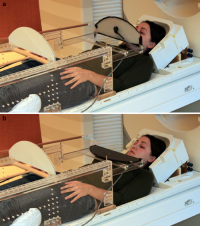
Apparatus used in the fMRI experiment. A) Induction of an afterimage by means of a bright light attached on the back of a foldable screen; B) The subject projected the afterimage upon a surface placed at different distances from the subject's eyes.
Neuroscientists from Western University have taken the all-important first step towards understanding the neural basis of size constancy or the ability to see an object as having the same size despite the fact that its image on the retina changes constantly with viewing distance.
The findings were revealed this week by Nature Neuroscience in a study titled, "Retinotopic activity in V1 reflects the perceived and not the retinal size of an afterimage."
"If we look at a car driving away from us, its image on our retina gets smaller and smaller -- yet we don't see the car as shrinking in size but rather as staying the same size. This is size constancy," explains Melvyn A. Goodale, Canada Research Chair in Visual Neuroscience and Director of Western's Brain and Mind Institute.
The test that Goodale and his colleagues Irene Sperandio and Philippe Chouinard employed was asking subjects to stare at a light long enough to create an 'afterimage' on the retina.
This video is not supported by your browser at this time.
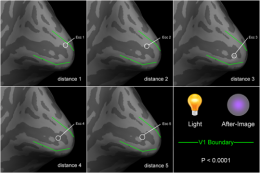
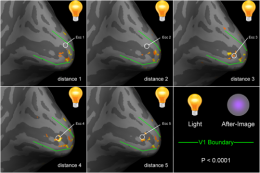
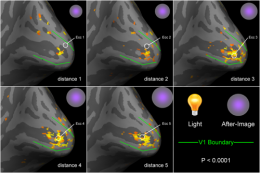
As the test subject projected' an afterimage onto surfaces at different viewing distances, his or her brain was scanned in Western's 3T fMRI (functional magnetic resonance imaging) scanner. As expected, people reported that the further the surface on which they saw the afterimage, the larger the afterimage appeared to be. Remarkably, the brain scans revealed that this difference in the perceived size of the afterimage was playing out very early in the visual pathway in a brain area that that is typically thought to reflect only what is happening on the retina.Frame_0. Primary visual cortex at rest (there is no activation).

Enlarge
Frame_1. Activity in primary visual cortex in response to the light.

Enlarge
Frame_2. Activity in primary visual cortex in response to the afterimage.
Take the test: 'Project' your own afterimage"We found that activation in the primary visual cortex (V1), which is an area located in the back of the brain that receives inputs from the eyes, was affected by the apparent size of the afterimage even though the information coming from the retina was always the same," says Goodale. "This suggests that V1 is a possible neural substrate for size-distance scaling."
Goodale says if the human brain didnt invoke size constancy; the world would appear to be a very strange place indeed, with objects expanding as we moved closer to them and shrinking as we moved away.
This video is not supported by your browser at this time.
"To maintain a stable visual world, we need to know how far away objects are from us so that our brain can make the appropriate adjustments to the size of the image coming from the retina," says Goodale. "Findings from this research are relevant not only for understanding how our brain represents the size of an object but also to understand medical conditions, such as Alice in Wonderland Syndrome, where patients experience visual distortions in which the world gets oddly smaller or bigger."Goodale suggests that the principles illuminated by this work can also be usefully applied to computer-based recognition devices and artificial visual systems that use brain implants.
Provided by
Northwestern University
-
What the brain sees after the eye stops looking
Nov 08, 2011 |
not rated yet |
0
-
'I can hear a building over there': Researchers study blind people's ability to echolocate
May 25, 2011 |
not rated yet |
0
-
New study shows those blinded by brain injury may still 'see'
Sep 02, 2009 |
not rated yet |
0
-
Neuroscientists reveal how the brain learns to recognize objects
Sep 22, 2010 |
not rated yet |
0
-
How the brain's architecture makes our view of the world unique
Dec 05, 2010 |
not rated yet |
0
-
Motion perception revisited: High Phi effect challenges established motion perception assumptions
Apr 23, 2013 |
3 / 5 (2) |
2
-
Anything you can do I can do better: Neuromolecular foundations of the superiority illusion (Update)
Apr 02, 2013 |
4.5 / 5 (11) |
5
-
The visual system as economist: Neural resource allocation in visual adaptation
Mar 30, 2013 |
5 / 5 (2) |
9
-
Separate lives: Neuronal and organismal lifespans decoupled
Mar 27, 2013 |
4.9 / 5 (8) |
0
-
Sizing things up: The evolutionary neurobiology of scale invariance
Feb 28, 2013 |
4.8 / 5 (10) |
14
-
Why is zone 1 in liver more prone to ischemic injury?
May 23, 2013
-
How can there be villous adenoma in colon, if there are no villi there
May 22, 2013
-
How can there be a term called "intestinal metaplasia" of stomach
May 21, 2013
-
Pressure-volume curve: Elastic Recoil Pressure don't make sense
May 18, 2013
-
If you became brain-dead, would you want them to pull the plug?
May 17, 2013
-
MRI bill question
May 15, 2013
- More from Physics Forums - Medical Sciences
More news stories
New neuron formation could increase capacity for new learning, at the expense of old memories
New research presented today shows that formation of new neurons in the hippocampus - a brain region known for its importance in learning and remembering - could cause forgetting of old memories by causing a reorganization ...
Neuroscience
18 hours ago |
4 / 5 (4) |
0
Help at hand for people with schizophrenia
How can healthy people who hear voices help schizophrenics? Finding the answer for this is at the centre of research conducted at the University of Bergen.
Neuroscience
18 hours ago |
4 / 5 (2) |
2
Japanese research organizations contribute to Human Brain Project
One of the major frontiers of modern science is a comprehensive understanding of the human brain and its functions to guide the development of new technologies in information and communication. In a major announcement for ...
Neuroscience
19 hours ago |
3.7 / 5 (3) |
0
Controlling mood through the motions of mitochondria
(Medical Xpress)—Regulating the distribution of power in neurons is done by a system that makes the national electric grid look simple by comparison. Each neuron has several thousand mitochondria confined ...
Neuroscience
May 23, 2013 |
4.9 / 5 (9) |
0
|
Brain uses internal 'average voice' prototype to identify who is talking
(Medical Xpress)—The human brain is able to identify individuals' voices by comparing them against an internal 'average voice' prototype, according to neuroscientists.
Neuroscience
May 23, 2013 |
3.7 / 5 (3) |
3
|
Engineered cytomegalovirus protects monkeys from HIV equivalent
(Medical Xpress)—A new study by researchers in the US has shown that an ancient virus can be modified to help in the fight against the simian immunodeficiency virus SIV, which is the equivalent in monkeys ...
Researchers identify first drug targets in childhood genetic tumor disorder
Two mutations central to the development of infantile myofibromatosis (IM)—a disorder characterized by multiple tumors involving the skin, bone, and soft tissue—may provide new therapeutic targets, according to researchers ...
Hormone levels may provide key to understanding psychological disorders in women
Women at a particular stage in their monthly menstrual cycle may be more vulnerable to some of the psychological side-effects associated with stressful experiences, according to a study from UCL.
Going live: Immune cell activation in multiple sclerosis
Biological processes are generally based on events at the molecular and cellular level. To understand what happens in the course of infections, diseases or normal bodily functions, scientists would need to ...
Alzheimer's disease, the soft target of the euthanasia debate
(Medical Xpress)—The way Alzheimer's disease is portrayed by advocacy groups and the media is having undue influence on the euthanasia debate, according to a Deakin University nursing ethics professor.
Depression raises diabetics' risk of severe low blood sugar episodes
(Medical Xpress)—Patients with diabetes who are depressed are much more likely to develop episodes of dangerously low blood sugars, or hypoglycemia, than are those who are not depressed, a new study has ...