Antimicrobial catheters could save NHS millions
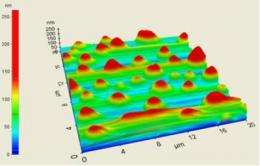
This is a non-contact atomic force microscopy showing the topography of a glass surface coated with a positively charged antimicrobial compound. Credit: The University of Manchester
A new catheter coating that reduces bacterial attachment to its surface is being developed by scientists who are reporting their work at the Society for General Microbiology's Spring Conference in Dublin this week. The antimicrobial coating could eventually be applied to other medical implants to reduce infection which would provide significant socioeconomic benefits to the NHS.
Urinary tract infections (UTIs) account for 25% of all hospital infections and cost the NHS around £125 million each year. The major predisposing factor for UTIs is the presence of a urinary catheter, upon which bacteria clump together in communities called biofilms. Bacteria in biofilms coat themselves in a sticky substance that provides a barrier to antibiotics, making infections difficult to clear. If the catheter is not regularly replaced, the infection may spread beyond the bladder, causing potentially life-threatening complications. Catheter replacement is costly, time consuming and causes distress to patients.
Researchers at The University of Manchester are trying to find a new antimicrobial catheter coating that will reduce the need for catheter replacement. They have been investigating a range of positively charged compounds which are known to have antimicrobial effects, explained Miss Nishal Govindji who is working on the project. "We have identified a solution containing a group of positively charged compounds which, in combination, are excellent at killing the bacteria such as Escherichia coli that attach to catheters. Observing the coating under the microscope, when applied on to a glass surface, has given us an idea of how it might work to prevent biofilms from forming on surfaces. This combination of compounds is completely new and the results are very promising it's really exciting work!"
Preventing biofilm formation will not only reduce NHS costs by prolonging the life of the catheter but also minimise possible patient complications. "If we can prevent bacteria from attaching to a catheter surface by just an extra 24 hours, it will save a lot of money for the NHS and most importantly, it will save a lot of stress to patients by reducing the risk of serious infection and minimizing discomfort," said Miss Govindji. "In the future, if this antimicrobial compound is successful at coating a surface to kill bacteria that would attach to urinary catheters, we are hopeful that we can extend its use to coat other types of catheters and medical devices such as artificial heart valves and other prosthetic devices," she said.
Provided by Society for General Microbiology
-
Potential new strategy to reduce catheter blockage
Apr 13, 2011 |
not rated yet |
0
-
'Crabby' compound that skewers bacteria could prevent medical implant infections
Sep 11, 2006 |
not rated yet |
0
-
Catheter chaos: Hospitals lag in preventing common infection
Jan 03, 2008 |
not rated yet |
0
-
Acne-treating antibiotic cuts catheter infections in dialysis patients
Aug 19, 2011 |
not rated yet |
0
-
Combination therapy rids common infection from implanted medical devices
Sep 08, 2011 |
not rated yet |
0
-
Motion perception revisited: High Phi effect challenges established motion perception assumptions
Apr 23, 2013 |
3 / 5 (2) |
2
-
Anything you can do I can do better: Neuromolecular foundations of the superiority illusion (Update)
Apr 02, 2013 |
4.5 / 5 (11) |
5
-
The visual system as economist: Neural resource allocation in visual adaptation
Mar 30, 2013 |
5 / 5 (2) |
9
-
Separate lives: Neuronal and organismal lifespans decoupled
Mar 27, 2013 |
4.9 / 5 (8) |
0
-
Sizing things up: The evolutionary neurobiology of scale invariance
Feb 28, 2013 |
4.8 / 5 (10) |
14
-
Classical and Quantum Mechanics via Lie algebras
Apr 15, 2011
- More from Physics Forums - Independent Research
More news stories
ACP issues recommendations for management of high blood glucose in hospitalized patients
High blood glucose is associated with poor outcomes in hospitalized patients, and use of intensive insulin therapy (IIT) to control hyperglycemia is a common practice in hospitals. But the recent evidence does not show a ...
Other
7 hours ago |
not rated yet |
0
Future doctors unaware of their obesity bias
Two out of five medical students have an unconscious bias against obese people, according to a new study by researchers at Wake Forest Baptist Medical Center. The study is published online ahead of print in the Journal of ...
Other
13 hours ago |
not rated yet |
0
Plastic realistic: Medical students to use plastinated human bodies for anatomy learning
Nanyang Technological University's (NTU) new medical school will be pioneering the use of plastinated bodies for medical education in Singapore.
Other
22 hours ago |
not rated yet |
0
Survey points out deficiencies in addictions training for medical residents
A 2012 survey of internal medicine residents at Massachusetts General Hospital (MGH) – one of the nation's leading teaching hospitals – found that more than half rated the training they had received in addiction and other ...
Other
May 22, 2013 |
5 / 5 (1) |
0
Early use of tracheostomy for mechanically ventilated patients not associated with improved survival
For critically ill patients receiving mechanical ventilation, early tracheostomy (within the first 4 days after admission) was not associated with an improvement in the risk of death within 30 days compared to patients who ...
Other
May 21, 2013 |
not rated yet |
0
WHO voices deep concern over spread of SARS-like virus
The World Health Organization voiced deep concern Thursday over the SARS-like virus that has killed 22 people in less than a year, saying it might potentially spread more widely between humans.
Study: No higher cancer rate at Conn. Pratt plant
(AP)—Researchers examining the incidence of brain cancer at jet engine manufacturer Pratt & Whitney in Connecticut say they have found no statistically significant elevations in the rate of cancer among workers.
Controlling mood through the motions of mitochondria
(Medical Xpress)—Regulating the distribution of power in neurons is done by a system that makes the national electric grid look simple by comparison. Each neuron has several thousand mitochondria confined ...
Obesity weighs down on top soda guzzler Mexico
Artemio Martinez balanced his corpulent frame on a stool in a Mexico City street taco stand, downing a sweet soda and eating a final pork-filled corn tortilla.
Hormone replacement therapy—clarity at last
The British Menopause Society and Women's Health Concern have today released updated guidelines on Hormone Replacement Therapy (HRT) to provide clarity around the role of HRT, the benefits and the risks. The new guidelines ...
Motion quotient: IQ predicted by ability to filter motion (w/ video)
A brief visual task can predict IQ, according to a new study. This surprisingly simple exercise measures the brain's unconscious ability to filter out visual movement. The study shows that individuals whose ...