Increased production of neurons in hypothalamus found in mice fed high fat diets
March 26, 2012
by Bob Yirka
in Neuroscience
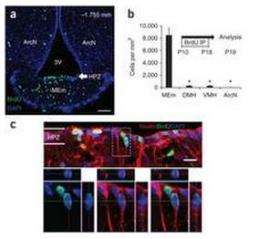
Hypothalamic proliferative zone. For more details, Nature Neuroscience (2012) doi:10.1038/nn.3079
(Medical Xpress) -- A research team made up of people from a wide variety of biological sciences has found that mice fed a diet high in fat tend to see an increase in the number of neurons created in the hypothalamus, a region of the brain associated with regulating energy use in the body. The team, as they describe in their paper published in Nature Neuroscience, write that the increase in neurons occurs in a part of the hypothalamus called the median eminence, which lies outside the blood-brain barrier.
Suspecting that something unusual goes on with the hypothalamus and the median eminence in particular, when mice eat more fat, the research team put a group of mice on a diet very high in it. In the lab, mice are usually fed a diet that is approximately thirty five percent fat, which keeps them from gaining weight. In this study, the fat content was raised to sixty percent, which of course caused the mice to get fat. But, the team found, it also caused the creation of new brain cells in the median eminence to increase, from one to five percent.
Next the researchers forced the mouse brains to stop creating new brain cells while continuing to feed the mice the high fat diet. And surprisingly, the mice weight gain slowed and the mice demonstrated more energy. Adding to the good news was the fact that the median eminence lies outside of the blood-brain area (a separation of blood and brain fluid that prevents many materials in blood from reaching brain cells) meaning that the possibility of developing a therapy based on this research to help humans lose weight might be possible.
The researchers are quick to point out however, that there is no evidence yet that increased neuron production occurs in people who eat extra amounts of fat, or even in any other animal. They also say they dont yet understand why new neuron growth occurs when mice are fed a high fat diet, but speculate that it may have something to do with detecting chemicals in the bloodstream and responding by sending signals to the rest of the hypothalamus.
More information: Tanycytes of the hypothalamic median eminence form a diet-responsive neurogenic niche, Nature Neuroscience (2012) doi:10.1038/nn.3079
Abstract
Adult hypothalamic neurogenesis has recently been reported, but the cell of origin and the function of these newborn neurons are unknown. Using genetic fate mapping, we found that median eminence tanycytes generate newborn neurons. Blocking this neurogenesis altered the weight and metabolic activity of adult mice. These findings reveal a previously unreported neurogenic niche in the mammalian hypothalamus with important implications for metabolism.
Journal reference:
Nature Neuroscience
© 2012 Medical Xpress
-
Voluntary exercise by animals prevents weight gain, despite high-fat diet
May 18, 2011 |
not rated yet |
0
-
Eating a high-fat diet may rapidly injure brain cells that control body weight
Jun 08, 2011 |
not rated yet |
0
-
Green tea helps mice keep off extra pounds
Oct 04, 2011 |
not rated yet |
0
-
Molasses extract decreases obesity caused by a high-fat diet
Jul 12, 2011 |
not rated yet |
0
-
Obese dieters' brain chemistry works against their weight-loss efforts
Jun 23, 2011 |
not rated yet |
0
-
Motion perception revisited: High Phi effect challenges established motion perception assumptions
Apr 23, 2013 |
3 / 5 (2) |
2
-
Anything you can do I can do better: Neuromolecular foundations of the superiority illusion (Update)
Apr 02, 2013 |
4.5 / 5 (11) |
5
-
The visual system as economist: Neural resource allocation in visual adaptation
Mar 30, 2013 |
5 / 5 (2) |
9
-
Separate lives: Neuronal and organismal lifespans decoupled
Mar 27, 2013 |
4.9 / 5 (8) |
0
-
Sizing things up: The evolutionary neurobiology of scale invariance
Feb 28, 2013 |
4.8 / 5 (10) |
14
-
Pressure-volume curve: Elastic Recoil Pressure don't make sense
May 18, 2013
-
If you became brain-dead, would you want them to pull the plug?
May 17, 2013
-
MRI bill question
May 15, 2013
-
Ratio of Hydrogen of Oxygen in Dessicated Animal Protein
May 13, 2013
-
Alcohol and acetaminophen
May 13, 2013
-
Marie Curie's leukemia
May 13, 2013
- More from Physics Forums - Medical Sciences
More news stories
For combat veterans suffering from post-traumatic stress disorder, 'fear circuitry' in the brain never rests
Chronic trauma can inflict lasting damage to brain regions associated with fear and anxiety. Previous imaging studies of people with post-traumatic stress disorder, or PTSD, have shown that these brain regions can over-or ...
Neuroscience
May 18, 2013 |
5 / 5 (1) |
0
|
Temporal processing in the olfactory system
The neural machinery underlying our olfactory sense continues to be an enigma for neuroscience. A recent review in Neuron seeks to expand traditional ideas about how neurons in the olfactory bulb might encode information about ...
Neuroscience
May 17, 2013 |
4 / 5 (1) |
0
|
Melon focus headband turns to Kickstarter for rollout plans
(Medical Xpress)—What if the quality of your work depends more on your focus on the piano keys or canvas or laptop than your musical or painting or computing skills? If target users can be convinced, they ...
Neuroscience
May 17, 2013 |
3.7 / 5 (3) |
0
|
Deep brain stimulation: A fix when the drugs don't work
Neurological disorders can have a devastating impact on the lives of sufferers and their families.
Neuroscience
May 17, 2013 |
5 / 5 (1) |
0
|
Brain makes call on which ear is used for cell phone
If you're a left-brain thinker, chances are you use your right hand to hold your cell phone up to your right ear, according to a newly published study from Henry Ford Hospital in Detroit.
Neuroscience
May 16, 2013 |
2 / 5 (2) |
0
|
Researchers identify a potential new risk for sleep apnea: Asthma
Researchers at the University of Wisconsin have identified a potential new risk factor for obstructive sleep apnea: asthma. Using data from the National Institutes of Health (Heart, Lung, and Blood Institute)-funded Wisconsin ...
Study finds that sleep apnea and Alzheimer's are linked
A new study looking at sleep-disordered breathing (SDB) and markers for Alzheimer's disease (AD) risk in cerebrospinal fluid (CSF) and neuroimaging adds to the growing body of research linking the two.
Computational tool translates complex data into simplified 2-dimensional images
In their quest to learn more about the variability of cells between and within tissues, biomedical scientists have devised tools capable of simultaneously measuring dozens of characteristics of individual ...
New theory on genesis of osteoarthritis comes with successful therapy in mice
Scientists at Johns Hopkins have turned their view of osteoarthritis (OA) inside out. Literally. Instead of seeing the painful degenerative disease as a problem primarily of the cartilage that cushions joints, ...
Ginger compounds may be effective in treating asthma symptoms
Gourmands and foodies everywhere have long recognized ginger as a great way to add a little peppery zing to both sweet and savory dishes; now, a study from researchers at Columbia University shows purified components of the ...
'Gap' for HIV vaccine efforts after latest setback
The hunt for an HIV vaccine has gobbled up $8 billion in the past decade, and the failure of the most recent efficacy trial has delivered yet another setback to 26 years of efforts.
Mar 26, 2012
Rank: not rated yet
Mar 26, 2012
Rank: not rated yet
--
Seriously though. They mention that the area in question is outside the blood-brain barrier. That means a pharmaceutical could theoretically slow neuron growth, but only outside the brain. Again, that's in theory.
Personally, it seems like a really dodgy idea to take a drug which inhibits neuron development in order to allow a person to eat lots of fat without gaining quite as much weight, but then again, I don't stand to profit from sales of junk-food or pharmaceuticals.