Just a few cell clones can make heart muscle
April 25, 2012 in Medical research

Just a few cell clones can make heart muscle

Enlarge

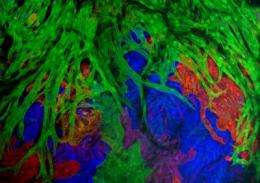
The growth of the zebrafish heart from embryo to adult is tracked using colored cardiac muscle clones, each containing many cellular progeny of a single cardiac muscle cell. Here, a large clone of green cardiac muscle cells (top) expands over the surface of many smaller clones in a growing heart. Credit: Vikas Gupta, Duke University Medical Center

Just a handful of cells in the embryo are all that's needed to form the outer layer of pumping heart muscle in an adult zebrafish.

Researchers at Duke University Medical Center used zebrafish embryos and careful employment of a new technique that allows for up to 90 color labels on different cells to track individual cells and cell lines as the heart formed.

The scientists were surprised by how few cells went into making a critical organ structure and they suspect that other organs may form in a similar fashion, said Kenneth Poss, Ph.D., professor in the Duke Department of Cell Biology and Howard Hughes Medical Institute.

The study appears online in Nature on April 25.

"The most surprising aspect of this work is that a very small number of cardiomyocytes () in the growing animal can give rise to the thousands of cardiomyocytes that form the wall of the cardiac ventricle," said Vikas Gupta, lead author, who is in the Duke Medical Scientist Training Program for M.D. and Ph.D. degrees.

Gupta found that about eight single cells contributed to forming the major type of in the wall of the zebrafish heart -- and just one or two cells could create anywhere from 30 to 70 percent of the entire ventricular surface.

"Clonal dominance like this is a property of some types of stem cells, and it's a new concept in how to form an organ during development," Poss said.

Another surprise was the way the patches of cloned cells formed muscle.

"It was completely unexpected," Gupta said. "I thought the wall would simply thicken in place, but instead there was a network of cells that enveloped the ventricle in a wave. It was as if a cell at your shoulder grew a thin layer of new cells down your arm surface."

Gupta said this opens an area for investigation to see whether or not a process like this repeats in the hearts of mammals, and perhaps in other .

Poss said the cell clones appear to have the ability to cover as much of the ventricular surface as possible before other cells start appearing and growing at the surface.

"Our suspicion is that the muscle cells that initiate large clones are not much different from other muscle cells – they just get to the surface of the heart first," Poss said.

They used the analogy of a sperm getting to the egg first, among all the millions of possible sperm cells.

Poss said the manner in which these muscle cells envelope the heart could lead to new therapies.

"Researchers may be able to channel this developmental process to help damaged hearts or failing hearts to grow muscle that will reinforce the ventricular walls," he said. "Someone who's had a heart attack would want this ability to generate new muscle to cover a scar naturally, and it's attractive to think that the help might come from a small number of within a population."

The color-label technique was originally developed by other biologists and was critical to allow the researchers to track heart cell populations.

"You can label individual cells very early in an embryo with a permanent color and those and their progeny will keep that color," Poss said. "You can learn what an individual cardiomyocyte did, and its neighbor, and that cell's neighbor and so on, until you've covered much of the whole of the developing zebrafish."

Poss said it makes sense that this growth process works by a gradual layering process, especially for the heart. "It's speculative, but for the heart to maintain circulation in a relatively slowly growing animal, a process like this to build the heart might be a way of gradually increasing its circulatory strength to keep up."

Provided by Duke University Medical Center search and more info website

not rated yet  

Rank not rated yet
Related Stories
Relevant PhysicsForums posts

More news stories

Discovery of novel medicine for treatment of chronic wounds

Every 20 seconds, a limb is lost as a consequence of diabetic foot ulcer that does not heal. To date, medical solutions that can change this situation are very limited. In his doctoral thesis Yue Shen from the Industrial ...

Medical research created 3 hours ago | popularity not rated yet | comments 0

Lymphatic fluid takes detour

When tumours metastasise, they can block lymphatic vessels, as researchers from ETH Zurich have discovered using a new method. The lymphatic fluid subsequently has to find a new path through the tissue. Such ...

Medical research created 3 hours ago | popularity not rated yet | comments 0 | with audio podcast

Computational tool translates complex data into simplified 2-dimensional images

In their quest to learn more about the variability of cells between and within tissues, biomedical scientists have devised tools capable of simultaneously measuring dozens of characteristics of individual ...

Medical research created 21 hours ago | popularity 5 / 5 (3) | comments 0 | with audio podcast

Now we know why old scizophrenia medicine works on antibiotics-resistant bacteria

In 2008 researchers from the University of Southern Denmark showed that the drug thioridazine, which has previously been used to treat schizophrenia, is also a powerful weapon against antibiotic-resistant bacteria such as ...

Medical research created May 17, 2013 | popularity 4 / 5 (4) | comments 0 | with audio podcast

SUMO wrestling cells reveal new protective mechanism target for stroke

Scientists investigating the interaction of a group of proteins in the brain responsible for protecting nerve cells from damage have identified a new target that could increase cell survival.

Medical research created May 17, 2013 | popularity 5 / 5 (1) | comments 0


Anabolic steroids may affect future mental health

There is a link between use of anabolic-androgenic steroids and reduced mental health later in life. This is the main conclusion of a new study on elite male strength athletes that researchers from the University of Gothenburg ...

Neurons that can multitask greatly enhance the brain's computational power, study finds

Over the past few decades, neuroscientists have made much progress in mapping the brain by deciphering the functions of individual neurons that perform very specific tasks, such as recognizing the location ...

Half time warm-ups boost athletic performance

High-intensity, short duration warm up activities at half time intervals boost athletic performance, a study of soccer players has found.

Team finds mechanism linking key inflammatory marker to cancer

In a new study described in the journal Oncogene, researchers reveal how a key player in cell growth, immunity and the inflammatory response can be transformed into a primary contributor to tumor growth.

Youth bullying because of perceived sexual orientation widespread and damaging

(Medical Xpress)—Bullying because of perceived sexual orientation is prevalent among school-aged youths, according to a study led by Donald Patrick, professor of health services at the UW School of Public ...

Immune protein could stop diabetes in its tracks

Melbourne researchers have identified an immune protein that has the potential to stop or reverse the development of type 1 diabetes in its early stages, before insulin-producing cells have been destroyed.