From feast to famine: A metabolic switch that may help diabetes treatment
April 25, 2012 in Medical research

From feast to famine: A metabolic switch that may help diabetes treatment

Enlarge

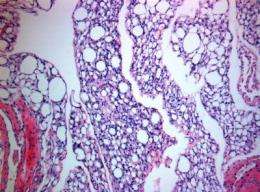
The Salk researchers discovered that mice lacking a protein known as fibroblast growth factor 1 were unable to store and use fat normally. When these mice were switched from a high-fat diet to a normal diet, they developed uneven lumps of fat (seen in white in the above image) in their body tissues, suggesting that their fat metabolism mechanisms had gone awry. Credit: Image: Courtesy of Jae Myoung Suh, research associate, Gene Expression Laboratory

Humans are built to hunger for fat, packing it on during times of feast and burning it during periods of famine. But when deluged by foods rich in fat and sugar, the modern waistline often far exceeds the need to store energy for lean times, and the result has been an epidemic of diabetes, heart disease and other obesity-related problems.

Now, scientists at the Salk Institute for Biological Studies have identified the of metabolism, a protein known as fibroblast growth factor 1 (FGF1), which may open new avenues in the treatment of diabetes.

In a paper published April 22 in Nature, the Evans lab reports that FGF1 activity is triggered by a high-fat diet and that mice lacking the protein swiftly develop diabetes. This suggests that FGF1 is crucial to maintaining the body's sensitivity to insulin and normal levels of sugar in the blood.

"Because humans are good at storing fat during times of plenty, we are also excellent at surviving times of famine," says Ronald M. Evans, a professor in Salk's Gene Expression Laboratory and lead author of the paper. "The fat tissues of our body are like batteries, providing us with a steady source of energy when food is scarce. FGF1 governs the expansion and contraction of fat and thus controls the ebb and flow of energy throughout our body."

have soared in the United States in recent decades, with more than one third of U.S. adults and 17 percent of children and adolescents now considered obese, according to the .

From feast to famine: A metabolic switch that may help diabetes treatment
Enlarge

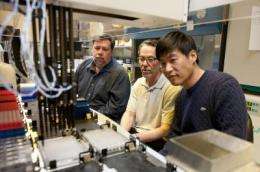
This is Ron Evans, Professor Gene Expression Laboratory, Michael Downes, Senior Staff Scientist and Jae Myoung Suh, Postdoctoral Research Associate. Credit: Images: Courtesy of the Salk Institute for Biological Studies

As the number of overweight people has grown, so too has the incidence of , with nearly 26 million Americans estimated to have obesity-related . With annual costs exceeding well over $200 billion, obesity is a chronic disease that is consuming a huge portion of our health care dollars.

Although exercise and are known to be effective at preventing and treating diabetes, the obesity epidemic continues to grow and new drugs to treat the problem are desperately needed. Against this backdrop, the Evans' lab discovery is an important breakthrough ---- and a surprise.

"The discovery of FGF1 was unexpected ---- and intriguing ---- because it was believed to do nothing," says Jae Myoung Suh, a postdoctoral researcher in Evans' laboratory and co-first author on the paper. "If you deplete FGF1 from the body, nothing happens when the mice are fed a steady low fat diet. But when given a high-fat, "Western-style" diet the mice develop an aggressive form of diabetes and experience a system-wide breakdown of their metabolic health."

"These abnormalities cause abdominal or stomach fat to become inflamed," says Michael Downes, a senior staff scientist in Salk's Gene Expression Laboratory and co-lead author on the paper. "This is important because inflamed visceral fat has been linked to heightened risk for diabetes and other obesity-related diseases, such as heart disease and stroke."

The scientists also found that FGF1 is regulated by the antidiabetic drug Actos, which is used to increase the body's sensitivity to insulin. But Actos and related drugs, though helpful, have side effects that limit their use.

Thus, Evans and his colleagues plan to explore whether FGF1 might point to a new way to control by avoiding the drawbacks of Actos and providing a more natural means of increasing insulin sensitivity.

Provided by Salk Institute search and more info website

4 /5 (4 votes)  

Rank 4 /5 (4 votes)
Relevant PhysicsForums posts

More news stories

Now we know why old scizophrenia medicine works on antibiotics-resistant bacteria

In 2008 researchers from the University of Southern Denmark showed that the drug thioridazine, which has previously been used to treat schizophrenia, is also a powerful weapon against antibiotic-resistant bacteria such as ...

Medical research created May 17, 2013 | popularity 3.7 / 5 (3) | comments 0 | with audio podcast

SUMO wrestling cells reveal new protective mechanism target for stroke

Scientists investigating the interaction of a group of proteins in the brain responsible for protecting nerve cells from damage have identified a new target that could increase cell survival.

Medical research created May 17, 2013 | popularity 5 / 5 (1) | comments 0

How serotonin receptors can shape drug effects, from LSD to migraine medication

New findings by researchers carrying out experiments at the U.S. Department of Energy Office of Science's Advanced Photon Source (APS) help explain why some drugs that interact with two kinds of human serotonin ...

Medical research created May 17, 2013 | popularity not rated yet | comments 0 | with audio podcast

Preventing blood poisoning

Peptide molecules derived from the body's natural immune system can help boost the body's defence against life-threatening blood poisoning, joint University research has uncovered.

Medical research created May 17, 2013 | popularity 4 / 5 (1) | comments 0 | with audio podcast

New mechanism to prevent type 2 diabetes in obese individuals

A new Montréal study conducted by Dr. May Faraj, associate research professor at the Université de Montréal and invited scientist at the IRCM, along with her research team and medical collaborators, shows ...

Medical research created May 17, 2013 | popularity not rated yet | comments 0 | with audio podcast


New research identifies risks, interventions for children's GI health

An increasing number of U.S. children are experiencing gastrointestinal issues that require interventions to resolve, according to research presented at Digestive Disease Week (DDW).

US psychiatry gets makeover in new manual

The latest makeover to a massive psychiatric tome honored by some, reviled by others and even called the "Bible" of mental disorders is being released Saturday with a host of new changes.

New case of SARS-like virus in Saudi: ministry

A new case of the deadly coronavirus has been detected in Saudi Arabia where 15 people have already died after contracting it, the health ministry announced on Saturday on its Internet website.

AIDS science at 30: 'Cure' now part of lexicon

Big names in medicine are set to give an upbeat assessment of the war on AIDS on Tuesday, 30 years after French researchers identified the virus that causes the disease.

For combat veterans suffering from post-traumatic stress disorder, 'fear circuitry' in the brain never rests

Chronic trauma can inflict lasting damage to brain regions associated with fear and anxiety. Previous imaging studies of people with post-traumatic stress disorder, or PTSD, have shown that these brain regions can over-or ...

New colonoscope provides ground-breaking view of colon

A ground-breaking advance in colonoscopy technology signals the future of colorectal care, according to research presented today at Digestive Disease Week(DDW). Additional research focuses on optimizing the minimal withdrawal ...