April 26, 2012 feature
Seeing is as seeing does: Spatially-structured retinal input in early development of cortical maps
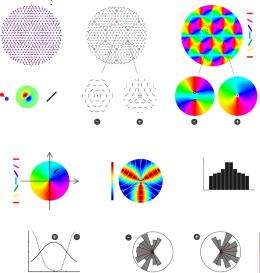
(Medical Xpress) -- Remarkably, cortical maps show that neurons in the primary visual cortex have specific preferences for the location and orientation of a given visual field stimulus – but how these maps develop and what function they play in visual processing remains a mystery. Evidence suggests that the retinotopic map is established by molecular gradients, but little is known about how orientation maps are wired. One hypothesis: at their inception, these orientation maps are seeded by the spatial interference of ON- and OFF-center retinal receptive field mosaics. Recently, scientists in the Departments of Neurobiology and Psychology at the University of California, Los Angeles have shown that this proposed mechanism predicts a link between the layout of orientation preferences around singularities of different signs and the cardinal axes of the retinotopic map, and have confirmed this prediction in the tree shrew primary visual cortex. The researchers say their findings support the idea that spatially structured retinal input may provide a blueprint of sorts for the early development of cortical maps and receptive fields – and that the same may hold true for other senses as well.
Professor of Neurobiology and Psychology Dario L. Ringach articulates the primary elements of showing that the hypothesis that orientation maps are initially seeded by the spatial interference of ON- and OFF-center retinal receptive field mosaics corresponds to a mechanism that predicts a link between the layout of orientation preferences around singularities of different signs and the cardinal axes of the retinotopic map. “The cerebral cortex of higher mammals contains diverse maps,” he tells Medical Xpress, “where information about sensory input or motor planning is laid out systematically across the surface of a given cortical area. Some scientists have postulated that these computational maps are key to cortical function. However, we still do not know exactly what role cortical maps play in normal sensory and motor processes.” Their importance, he stresses, is that understanding how cortical maps are wired during development, and what types of pathology may arise from their faulty wiring, are fundamental questions of brain function.
Ringach also notes that neurons in primary visual cortex are selective to the orientation of a stimulus in visual space, and their preference changes systematically across the cortical surface in a periodic fashion. “We know these maps are present at the earliest stages of life,” he continues, “and do not require normal sensory experience to develop – but how do they wire themselves? We’ve postulated that the initial structure of these maps is biased by the spatial organization of the periphery.” In the visual system this is represented by the signals the retina within the eye conveys to the brain.
The researchers’ model postulates that at each location in the visual field, the input from the retina constraints the range of orientation preferences that the cortex can implement at that location. “We show that, given what is known about the organization of retinal signals, that such constraints would be quasi-periodic, thereby potentially providing the blueprint for an orientation map in the cortex.” One prediction of this theory is that groups of neurons preferring the same orientation should be arranged on an approximate hexagonal lattice on the cortical surface – a prediction the researchers confirmed in a previous study1.
“Another map in primary visual cortex that overlaps with the orientation map is that of visual space the so-called retinotopic map,” Ringach adds. “Neurons are organized in a systematic fashion according to the preference for the location of a visual stimulus in visual space.” A second prediction of the theory is that of a predicted link between the spatial layouts of the two maps. “In other words,” he explains, “the two maps are not independent of each other and related in a very specific way predicted by the theory.” This prediction was also confirmed in the current PNAS study. “This second paper thus offers a new, successful test of our theory,” Ringach states.
The ultimate test of the theory involves a comparison between the organization of the orientation map and the spatial organization of the retinal signals across individuals. “Our model predicts there should be a correlation between them, meaning that given the retinal organization one should be able to predict the organization of the orientation map. This is the next logical step that may conclusively prove or disprove our hypothesis. If proven correct, our work stands to answer a long-lasting and fundamental question of visual neuroscience. Moreover,” he tells Medical Xpress, “the idea is so simple and appealing that it can potentially offer an explanation to the origin of other sensory and motor maps in the brain. We hope some of our colleagues working in other modalities will be drawn to investigate such a possibility.”
When asked about the possibility of transitioning such research to computer models, Ringach replies: “When it comes to understanding brain wiring, function and the complex computations it performs, my opinion is that we are generations away from achieving this feat. We can only simulate what we already understand – and we’re far from developing a full understanding of the development and function of the brain. For the foreseeable future,” he concludes, “such studies will require the responsible use of non-human animals in medical research.”
More information: Link between orientation and retinotopic maps in primary visual cortex, PNAS, Published online before print April 16, 2012, doi: 10.1073/pnas.1118926109
1Related: Retinal origin of orientation maps in visual cortex, Nature Neuroscience 14, 919–925 (2011), Published online 29 May 2011, doi:10.1038/nn.2824
Copyright 2012 Medical Xpress
All rights reserved. This material may not be published, broadcast, rewritten or redistributed in whole or part without the express written permission of PhysOrg.com.


