Waking embryos before they are born
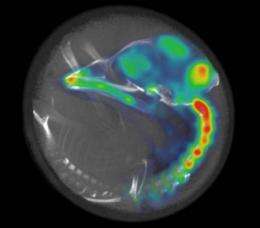
This image shows an X-ray computed-tomography image of the chicken embryo skeleton inside an egg, which shows the developmental stage, together with a positron emission tomography image showing nervous system activity in the brain. Balaban et al., publishing in Current Biology, report the activity in chicken embryo brains is inversely related to behavioral activity, with different sleep-like states emerging for the first time. Playing meaningful sounds selectively induced patterns of embryonic brain activity similar to awake, post-hatching animals. Image 3D rendering by Carmen García-Villalba. Credit: Balaban et al. Current Biology
Under some conditions, the brains of embryonic chicks appear to be awake well before those chicks are ready to hatch out of their eggs. That's according to an imaging study published online on May 3 in Current Biology, a Cell Press publication, in which researchers woke chick embryos inside their eggs by playing loud, meaningful sounds to them. Playing meaningless sounds to the embryos wasn't enough to rouse their brains.
The findings may have implications not only for developing chicks and other animals, but also for prematurely born infants, the researchers say. Pediatricians have worried about the effects of stimulating brains that are still under construction, especially as modern medicine continues to push back the gestational age at which preemies can reliably survive.
"This work showed that embryo brains can function in a waking-like manner earlier than previously thoughtwell before birth," said Evan Balaban of McGill University. "Like adult brains, embryo brains also have neural circuitry that monitors the environment to selectively wake the brain up during important events."
That waking-like brain activity appears in a latent but inducible state during the final 20 percent of embryonic life, the researchers found. At that point, sleep-like brain activity patterns also emerge.
Before that major dividing line in developmentfor the first 80 percent of embryonic life "embryos are in a state that is neither like sleep nor waking," Balaban said. He suggests it may be useful to compare that state to what happens when people are comatose or under the influence of anesthesia.
This entire line of work was made possible by a new generation of molecular brain imagers developed by Balaban's coauthors Juan-José Vaquero and Manuel Desco at the Universidad Carlos III in Madrid. Those state-of-the art machines can detect very small amounts of tracer molecules and pinpoint them to a tiny region of the brain (about 0.7 mm, or less than 3/100ths of an inch).
The researchers say they were surprised to capture waking-like activity before birth. And there were other surprises, too. The embryo brains they observed showed considerable variation in activity, for one.
Before the emergence of sleep and waking patterns of brain activity, the chick embryos in their study exhibited lots of spontaneous movement, even as their higher-brain regions remained inactive. Once the chicks reached that 80 percent mark in development, higher-brain regions began crackling with activity. At the same time, those physical movements ceased as the embryos entered a sleep-like state.
"The last 30 percent of fetal brain development is a more interesting time than we previously thought, because it's when complex whole-brain functions that depend on coordination of widely separated brain areas first emerge," Balaban said. "Embryos begin to cycle through a variety of brain states and are even capable of showing waking-like brain activity."
That might explain instances of complex fetal and early neonatal learning. "It also raises questions about the longer-term developmental consequences that such brain activity may have, if it is induced before intrinsic brain wiring is sufficiently completed," Balaban said, "for example, in babies born very prematurely. We are excited by the possibility that the techniques developed here can now be used to provide answers to these questions."
More information: doi:10.1016/j.cub.2012.03.030
Provided by
Cell Press
-
Brain imaging study: A step toward true 'dream reading'
Oct 27, 2011 |
not rated yet |
0
-
Brain regions can take short naps during wakefulness, leading to errors
Apr 27, 2011 |
not rated yet |
0
-
Timing is key in the proper wiring of the brain: study
Dec 19, 2011 |
not rated yet |
0
-
Brain waves control the impact of noise on sleep
Sep 06, 2011 |
not rated yet |
0
-
Brain's energy restored during sleep, suggests animal study
Jun 29, 2010 |
not rated yet |
0
-
Motion perception revisited: High Phi effect challenges established motion perception assumptions
Apr 23, 2013 |
3 / 5 (2) |
2
-
Anything you can do I can do better: Neuromolecular foundations of the superiority illusion (Update)
Apr 02, 2013 |
4.5 / 5 (11) |
5
-
The visual system as economist: Neural resource allocation in visual adaptation
Mar 30, 2013 |
5 / 5 (2) |
9
-
Separate lives: Neuronal and organismal lifespans decoupled
Mar 27, 2013 |
4.9 / 5 (8) |
0
-
Sizing things up: The evolutionary neurobiology of scale invariance
Feb 28, 2013 |
4.8 / 5 (10) |
14
-
Why is zone 1 in liver more prone to ischemic injury?
May 23, 2013
-
How can there be villous adenoma in colon, if there are no villi there
May 22, 2013
-
How can there be a term called "intestinal metaplasia" of stomach
May 21, 2013
-
Pressure-volume curve: Elastic Recoil Pressure don't make sense
May 18, 2013
-
If you became brain-dead, would you want them to pull the plug?
May 17, 2013
-
MRI bill question
May 15, 2013
- More from Physics Forums - Medical Sciences
More news stories
New neuron formation could increase capacity for new learning, at the expense of old memories
New research presented today shows that formation of new neurons in the hippocampus - a brain region known for its importance in learning and remembering - could cause forgetting of old memories by causing a reorganization ...
Neuroscience
May 24, 2013 |
4 / 5 (4) |
0
Help at hand for people with schizophrenia
How can healthy people who hear voices help schizophrenics? Finding the answer for this is at the centre of research conducted at the University of Bergen.
Neuroscience
May 24, 2013 |
4 / 5 (2) |
2
Japanese research organizations contribute to Human Brain Project
One of the major frontiers of modern science is a comprehensive understanding of the human brain and its functions to guide the development of new technologies in information and communication. In a major announcement for ...
Neuroscience
May 24, 2013 |
3.7 / 5 (3) |
0
Controlling mood through the motions of mitochondria
(Medical Xpress)—Regulating the distribution of power in neurons is done by a system that makes the national electric grid look simple by comparison. Each neuron has several thousand mitochondria confined ...
Neuroscience
May 23, 2013 |
4.9 / 5 (10) |
0
|
Brain uses internal 'average voice' prototype to identify who is talking
(Medical Xpress)—The human brain is able to identify individuals' voices by comparing them against an internal 'average voice' prototype, according to neuroscientists.
Neuroscience
May 23, 2013 |
3.7 / 5 (3) |
3
|
First drug to improve heart failure mortality in over a decade
Coenzyme Q10 decreases all cause mortality by half, according to the results of a multicentre randomised double blind trial presented today at Heart Failure 2013 congress. It is the first drug to improve heart failure mortality ...
Heart failure accelerates male 'menopause'
Heart failure accelerates the aging process and brings on early andropausal syndrome (AS), according to research presented today at the Heart Failure Congress 2013. AS, also referred to as male 'menopause', was four times ...
Seniors more likely to crash when driving with pet, study finds
(HealthDay)—Animals make great companions for senior citizens, but elderly people who always drive with a pet in the car are far more likely to crash than those who never drive with a pet, researchers have ...
New immune system discovered
(Medical Xpress)—A research team, led by Jeremy Barr, a biology post-doctoral fellow, unveils a new immune system that protects humans and animals from infection.
Death highest in heart failure patients admitted in January, on Friday, and overnight
Mortality and length of stay are highest in heart failure patients admitted in January, on Friday, and overnight, according to research presented today at the Heart Failure Congress 2013. The analysis of nearly 1 million ...
Feds fight morning-after pill age ruling in NY
(AP)—Department of Justice lawyers have again asked a federal appeals court in New York to delay lifting age restrictions and prescription requirements on an emergency contraceptive popularly known as the morning-after ...