Intravenous kidney cell transplant experiments raise hope for future human kidney failure treatments
May 31, 2012 in Other

Intravenous kidney cell transplant experiments raise hope for future human kidney failure treatments

Enlarge

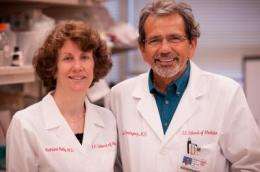
Katherine J. Kelly, M.D., is associate professor of medicine and Jesus Dominguez, M.D., is professor of medicine at the Indiana University School of Medicine. Credit: Indiana University School of Medicine

Indiana University School of Medicine scientists have successfully transplanted primary kidney cells intravenously to treat renal failure in rats, pointing the way to a possible future alternative to kidney transplants and expensive dialysis treatments in humans.

The researchers, Katherine J. Kelly, M.D., associate professor of medicine, and Jesus Dominguez, M.D., professor of medicine, genetically modified the cells in the laboratory to produce a – called SAA – that plays an important role in renal cell growth, embryonic kidney development and kidney regeneration after an injury. Modified cells found their way to the appropriate locations of the damaged kidneys, resulting in regeneration of tissue and improved function in the kidney.

The researchers' work has been accepted for publication in the American Journal of Physiology – Renal Physiology, which published an advance online version of the paper on May 16.

The authors point out there is a significant and expanding need for better kidney treatments because growing numbers of people are facing progressive due to rising incidence of diabetes, hypertension and the aging of the population.

According to the National Institute of Diabetes and Digestive and Kidney Diseases of the National Institutes of Health, more than 20 million Americans have chronic kidney disease, and more than half a million people are being treated for end stage renal disease. For those patients the options are limited to dialysis or kidney transplants. Nearly 99,000 people are now on the waiting list for a kidney transplant, according to the Organ Procurement and Transplantation Network, and more than 12 people die each day while on a waiting list.

"Obviously there is a need for, and an opportunity for, regenerative medicine in kidney failure as well as other organs," said Dr. Dominguez. There have been efforts to use stem cells to regenerate kidney tissue, but the benefits have not been long lasting, he noted.

In the IU researchers' experiments, however, some of the reprogrammed adult kidney donor cells made their way back to the damaged rat kidneys and engrafted themselves into key locations for renal function, resulting in improved kidney function and limiting physical damage. In some cases the modified cells came from other donor rats. In other experiments, one of the rats damaged kidneys was removed and the treated cells were grown in the laboratory and then returned to the same rat.

"Ultimately, you can imagine taking a part of someone's , expanding those cells with appropriate growth factors in a tissue culture dish, and then giving the back," said Dr. Kelly.

The researchers cautioned, however, that much work remains to be done before tests could begin in humans.

Provided by Indiana University School of Medicine search and more info website

not rated yet  

Rank not rated yet
Relevant PhysicsForums posts

More news stories

Wireless ultrasound transducers help physicians

Siemens has presented the world's first ultrasound system with wireless transducers. The system's transducers, which can be easily operated with one hand, transmit ultrasound images via radio waves to the ...

Other created 2 hours ago | popularity not rated yet | comments 0

Flesh-eating disease victim gets prosthetic hands

(AP)—A woman who lost both hands, her left leg and right foot after contracting a flesh-eating disease has been fitted with prosthetic hands.

Other created May 18, 2013 | popularity not rated yet | comments 0

Illinois Senate approves medical marijuana bill

(AP)—Medical marijuana use in Illinois is now in Gov. Pat Quinn's hands after the state Senate approved legislation.

Other created May 17, 2013 | popularity 5 / 5 (1) | comments 0

Nigerian court jails two over killer teething drug

A Nigerian court on Friday sentenced two officials from a pharmaceutical company to seven years in prison over the sale of an adulterated teething drug which killed 84 babies in 2008.

Other created May 17, 2013 | popularity not rated yet | comments 0

Many patients would switch doc to cut health care costs

(HealthDay)—Many Americans feel that keeping out-of-pocket health care costs is more important than staying with the same primary care physician.

Other created May 17, 2013 | popularity not rated yet | comments 0


Neurons that can multitask greatly enhance the brain's computational power, study finds

Over the past few decades, neuroscientists have made much progress in mapping the brain by deciphering the functions of individual neurons that perform very specific tasks, such as recognizing the location ...

Team finds mechanism linking key inflammatory marker to cancer

In a new study described in the journal Oncogene, researchers reveal how a key player in cell growth, immunity and the inflammatory response can be transformed into a primary contributor to tumor growth.

New study identifies risk factors for depression among COPD patients

Patients suffering from chronic obstructive pulmonary disease (COPD) typically suffer from depression more frequently than those without COPD, resulting in higher levels of disability and illness and increasing the overall ...

Half time warm-ups boost athletic performance

High-intensity, short duration warm up activities at half time intervals boost athletic performance, a study of soccer players has found.

Youth bullying because of perceived sexual orientation widespread and damaging

(Medical Xpress)—Bullying because of perceived sexual orientation is prevalent among school-aged youths, according to a study led by Donald Patrick, professor of health services at the UW School of Public ...

Inflammatory bowel disease raises risk of melanoma

Patients with inflammatory bowel disease (IBD) are at higher risk of melanoma, a form of skin cancer, report researchers at Mayo Clinic. Researchers found that IBD is associated with a 37 percent greater risk for the disease. ...