Tiny tots in the dentist's chair among changes in pediatric dentistry
May 18, 2012 By Serena Gordon, HealthDay Reporter in Dentistry
Options for kids now include sealants and early removal of wisdom teeth.
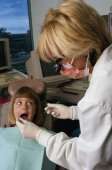
(HealthDay) -- If you've been to the dentist with your children recently, you may have noticed that things have changed since you were a kid.
Many dental offices are more kid-friendly these days, offering books and toys to pass the time in the waiting room and maybe even TV or videos to watch while they're getting dental work.
But, there have also been changes in the actual practice of children's dentistry. You probably never got dental sealants as a child, or had topical fluoride treatments. If you had your wisdom teeth removed, more than likely it was because they were causing a problem, but today those teeth may come out sooner to reduce the risk for complications.
Here's a sampling of what's new in pediatric dentistry:
Dental Sealants
Many teeth have rough surfaces that are hard to clean. When applied to these surfaces, a dental sealant makes the pitted and grooved area of a tooth smooth and easy to clean.
"Back teeth have a biting surface and crevices that are hard to clean," said Dr. Larry Kronenberg, a pediatric dentist affiliated with Northern Westchester Hospital in Mount Kisco, N.Y. "Depending on the depth of the crevice, bacteria and food can get lodged in the tooth and cause cavities."
"If your child has shallow crevices, sealants probably aren't indicated," he said. "But if you've ever given your child a pretzel and later saw that the food was still stuck on the teeth, your child could benefit from sealants."
Sealants are easy to apply. The dentist brushes them onto the teeth, and the sealant bonds with the tooth's enamel, according to the American Dental Association (ADA). Sometimes a curing light is used to help the sealants dry faster.
Fluoride Treatments
"Ingested fluoride works on teeth that haven't yet come into the mouth, those that haven't erupted yet, but it has no effect on the teeth already in the mouth," Kronenberg said. "A fluoride treatment using a gel or varnish incorporates the fluoride into the surface outer layer of the tooth. It has to be repeated because it gets worn off."
Fluoride is applied using a cotton swab or brush, or it's placed in a tray that the child bites down on and then holds in the mouth for several minutes. Once a fluoride treatment is done, there should be no eating or drinking for 30 minutes to allow the fluoride to soak into the teeth, according to the ADA.
Kronenberg explained that the difference between the fluoride contained in toothpaste and fluoride treatments is the concentration. The fluoride in toothpaste is much less concentrated, he noted.
Wisdom Teeth
Should they stay or should they go? That's the question kids and parents face.
Kronenberg said that most dentists start to look at a kid's wisdom teeth at about age 16 or 17 to see if there's room for the teeth to come in properly, without causing problems. If a tooth looks like it won't come in properly, some dentists now suggest removing these teeth sooner rather than later to make the removal easier. The less chance the tooth has to develop, the shallower the roots will be, explained Kronenberg.
But not everyone is practicing early removal.
"There's no cut-and-dried protocol saying that all wisdom teeth have to be extracted," said Dr. Joshua Verona from the division of dental medicine at Beth Israel Medical Center in New York City. "If they don't affect function or appearance, we just leave them in. We only extract wisdom teeth when they're symptomatic."
Parents should discuss with their family dentist the risks and benefits associated with leaving wisdom teeth in or taking them out.
Reducing Anxiety
Kronenberg said that pediatric dentists are seeing patients at a younger and younger age. Some recommend that well-dental visits, much like well-child visits at the pediatrician, start at age 1 so that dentists can discuss the importance of diet and oral hygiene with the parents. But more importantly, he said, early visits "help start a relationship between the child and the dentist at an early age, and generally if you've built a positive relationship, children are more willing to accept necessary treatments in the future."
More information: The Nemours Foundation KidsHealth website has more on good oral hygiene.
A companion article recounts changes in pediatric dentistry from one generation to the next.
Copyright © 2012 HealthDay. All rights reserved.
-
Studies advise on fluoridated toothpaste use in children
Jan 20, 2010 |
not rated yet |
0
-
Most people brush their teeth in the wrong way
May 15, 2012 |
not rated yet |
0
-
New 'massage method' quadruples protection against tooth decay
Mar 26, 2012 |
not rated yet |
0
-
Early oral health care is important to a child's development
Feb 04, 2011 |
not rated yet |
0
-
Programs may prevent tooth decay in tots
Jun 15, 2011 |
not rated yet |
0
-
Motion perception revisited: High Phi effect challenges established motion perception assumptions
Apr 23, 2013 |
3 / 5 (2) |
2
-
Anything you can do I can do better: Neuromolecular foundations of the superiority illusion (Update)
Apr 02, 2013 |
4.5 / 5 (11) |
5
-
The visual system as economist: Neural resource allocation in visual adaptation
Mar 30, 2013 |
5 / 5 (2) |
9
-
Separate lives: Neuronal and organismal lifespans decoupled
Mar 27, 2013 |
4.9 / 5 (8) |
0
-
Sizing things up: The evolutionary neurobiology of scale invariance
Feb 28, 2013 |
4.8 / 5 (10) |
14
-
Assumptions of Griffith's fracture theory
9 hours ago
-
Current leading voltage or vice versa concept
10 hours ago
-
Angular Frequency of AC voltage
14 hours ago
-
Modeling Rigid Body - Unsure about Euler angles and angular velocity
14 hours ago
-
Function for a bullet's path
15 hours ago
-
Elementary questions relating to Newton's laws of motion
17 hours ago
- More from Physics Forums - Classical Physics
More news stories
Primary care docs should play role in kids' dental health, experts say
(HealthDay)—When it comes to the care of your children's teeth, dentists aren't the only experts who can help.
Dentistry
3 hours ago |
not rated yet |
0
Guidelines issued to prevent infection with dental work
(HealthDay)—Practitioners might consider discontinuing prophylactic antibiotics for patients with prosthetic implants undergoing dental procedures, and these patients should be encouraged to maintain appropriate ...
Dentistry
May 14, 2013 |
not rated yet |
0
First analysis of dental therapists finds increase in access for children, low-income adults
A new report assessing the economic viability of services provided by practicing midlevel dental providers in the U.S. shows that they are expanding preventive dental care to people who need it most: children and those who ...
Dentistry
May 14, 2013 |
not rated yet |
0
Excessive soda can mimic illicit drug use effects on teeth
(HealthDay)—Manifestation of dental erosion caused by illicit drug use or excessive soda consumption needs to be distinguished from dental caries, according to case studies published in the March/April ...
Dentistry
May 13, 2013 |
5 / 5 (1) |
0
Common habits that harm your teeth
Are you wrecking your teeth without even knowing it? For instance, chewing on ice or opening stuff with your teeth may be convenient but using your teeth as tools can cause them to crack or chip.
Dentistry
May 03, 2013 |
3 / 5 (1) |
1
If you can remember it, you can remember it wrong
(Medical Xpress)—Native peoples in regions where cameras are uncommon sometimes react with caution when their picture is taken. The fear that something must have been stolen from them to create the photo ...
Study shows where scene context happens in our brain
In a remote fishing community in Venezuela, a lone fisherman sits on a cliff overlooking the southern Caribbean Sea. This man –– the lookout –– is responsible for directing his comrades on the water, ...
Monoclonal antibody appears effective and safe in asthma Phase IIa trial
A novel approach to obstructing the runaway inflammatory response implicated in some types of asthma has shown promise in a Phase IIa clinical trial, according to U. S. researchers.
New rice contamination reported in China
Authorities are investigating rice mills in southern China following tests that found almost half of the staple grain in one of the country's largest cities was contaminated with a toxic metal.
Delayed transfer to the ICU increases risk of death in hospital patients
Delayed transfer to the intensive care unit (ICU) in hospitalized patients significantly increases the risk of dying in the hospital, according to a new study from researchers in Chicago.
New immune system discovered
(Medical Xpress)—A research team, led by Jeremy Barr, a biology post-doctoral fellow, unveils a new immune system that protects humans and animals from infection.
May 18, 2012
Rank: not rated yet