Detecting tumour cells individually
May 16, 2012 By Peter Rüegg in Cancer
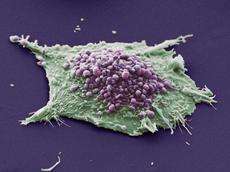
A tumour consists of more different genetic variants of cancer cells (in the picture, a lung-cancer cell) than originally believed. Credit: Wellcome Images / Flickr
(Medical Xpress) -- Swiss researchers have devised a method to detect mutations in tumor cells that are only present in a proportion of the cancers cells. The analysis reveals that cells of individual tumours are more variable than first thought and differ from patient to patient.
Sometimes, a tumor only develops very slowly. It begins with a few cells that mutate. Then these cells mutate. And mutate again. The mutants are more successful than their predecessors, outcompeting them as they multiply. Consequently, new variants of cells keep emerging, each fitter than their predecessors: the tumor goes through an evolution that gives rise to a genetically heterogeneous cancer.
This makes it difficult to treat a tumour with medication as there might be cells that do not respond to the drug used. Researchers from ETH Zurich and the Swiss Institute of Bioinformatics thus teamed up with colleagues from the University of Zurich to develop a new method for determining the genetic variants of tumor cells reliably. Using this method, the researchers are able to detect mutations that only appear in one in every 10,000 cells.
Test on renal cancer tissue successful
This method will be important for use in clinics, for instance, when therapy-resistant cell types need to be detected to adapt the treatment accordingly, says lead author Moritz Gerstung from ETH Zurichs Department of Biosystems Science and Engineering. The study has just been published in Nature Communications.
The new approach also enables to measure the frequency of certain variants within the tumour-cell population, which sheds light on how tumours grow and how quickly they change genetically inside the patient.
In a comparison of two particular regions of two genes from healthy renal cells and renal cancer cells, the researchers found twenty-four gene variants. Some variants were only present in two in every 10,000 cells examined; others, however, in over a third.
Statistics compensate for read errors
For their method, the researchers genetically analyzed countless tumor cells from renal cancer tissue using a modern sequencing technique called deep sequencing. As a result, millions of DNA fragments from single genes were sequenced simultaneously. These DNA fragments are isolated from the entire population of tumor cells and shed light on the genetic composition of the tumor. These genes were sequenced over 100,000 times, which corresponds to equally as many individually sequenced cells.
In reading the genetic code, however, errors can occur. So as not to mistake these errors for actual mutations, the researchers sequenced healthy tissue in parallel to be able to determine the error rate at any point on the DNA. In order to distinguish actual mutations from sequencing errors at a particular point, they developed a special statistical algorithm. This was a critical step for us as even the tiniest of inaccuracies can cause a large number of errors because the algorithm analyses several million DNA fragments, says Dr. Gerstung.
Personalized cancer medicine the aim
The researchers began by testing their new method on control samples with a known cell composition to make sure that it worked and did not display any false forecasts. Then they analysed four tumor samples and found numerous mutations or subtypes cells. Their existence supports the theory that tumours change constantly in accordance with a Darwinian evolutionary process, says Dr. Gerstung.
The new method helps personalise cancer therapy further. In future, tumors may not be treated as a unit. If one knows which cell types a tumor contains, the therapy can be adapted individually to a specific combination of drugs. When and whether the method will be used routinely in clinics remains to be seen. Further research is required to determine how tumor cell populations respond to different treatments. However, the method is already at a stage where it can be also used for other cancer types, says the ETH-Zurich researcher.
More information: Gerstung M, Beisel C, Rechsteiner M, Wild P, Schraml P, Moch H & Beerenwinkel N. Reliable detection of subclonal single-nucleotide variants in tumour cell populations. Nature Communications, published online on 2 May 2012. doi: 10.1038/ncomms1814
Journal reference:
Nature Communications
Provided by
ETH Zurich
-
Cancer cells more likely to genetically mutate
Feb 19, 2007 |
not rated yet |
0
-
New analytical method enhances the possibility of selecting optimal cancer treatment
Nov 14, 2011 |
not rated yet |
0
-
An ABSOLUTEly new view of the cancer genome
May 04, 2012 |
not rated yet |
0
-
Sensitive detection method analyzes circulating tumor cells in patients with lung cancer
Jan 09, 2012 |
not rated yet |
0
-
Scientists discover how cancers generate muscle-like contractions to spread around the body
Aug 16, 2011 |
not rated yet |
0
-
Motion perception revisited: High Phi effect challenges established motion perception assumptions
Apr 23, 2013 |
3 / 5 (2) |
2
-
Anything you can do I can do better: Neuromolecular foundations of the superiority illusion (Update)
Apr 02, 2013 |
4.5 / 5 (11) |
5
-
The visual system as economist: Neural resource allocation in visual adaptation
Mar 30, 2013 |
5 / 5 (2) |
9
-
Separate lives: Neuronal and organismal lifespans decoupled
Mar 27, 2013 |
4.9 / 5 (8) |
0
-
Sizing things up: The evolutionary neurobiology of scale invariance
Feb 28, 2013 |
4.8 / 5 (10) |
14
-
Pressure-volume curve: Elastic Recoil Pressure don't make sense
May 18, 2013
-
If you became brain-dead, would you want them to pull the plug?
May 17, 2013
-
MRI bill question
May 15, 2013
-
Ratio of Hydrogen of Oxygen in Dessicated Animal Protein
May 13, 2013
-
Alcohol and acetaminophen
May 13, 2013
-
Marie Curie's leukemia
May 13, 2013
- More from Physics Forums - Medical Sciences
More news stories
Team finds mechanism linking key inflammatory marker to cancer
In a new study described in the journal Oncogene, researchers reveal how a key player in cell growth, immunity and the inflammatory response can be transformed into a primary contributor to tumor growth.
Cancer
3 hours ago |
not rated yet |
0
|
Study of young Israelis emphasizes need for avoidance of sun exposure for the very young
A new study conducted using extensive medical records of over one million Israeli adolescents before military service shows clearly how exposure to the Israeli sun of young, light-skinned children increases substantially ...
Cancer
5 hours ago |
not rated yet |
0
Genetic diversity within tumors predicts outcome in head and neck cancer
A new measure of the heterogeneity – the variety of genetic mutations – of cells within a tumor appears to predict treatment outcomes of patients with the most common type of head and neck cancer. In the May 20 issue ...
Cancer
9 hours ago |
not rated yet |
0
Molecular marker from pancreatic 'juices' helps identify pancreatic cancer
Researchers at Mayo Clinic have developed a promising method to distinguish between pancreatic cancer and chronic pancreatitis—two disorders that are difficult to tell apart. A molecular marker obtained from pancreatic ...
Cancer
9 hours ago |
not rated yet |
0
New smartphone application improves colonoscopy preparation
The use of a smartphone application significantly improves patients' preparation for a colonoscopy, according to new research presented today at Digestive Disease Week (DDW). The preparation process, which begins days in ...
Cancer
May 19, 2013 |
not rated yet |
0
First long-term study reveals link between childhood ADHD and obesity
A new study conducted by researchers at the Child Study Center at NYU Langone Medical Center found men diagnosed as children with attention-deficit/hyperactivity disorder (ADHD) were twice as likely to be obese in a 33-year ...
New study finds blind people have the potential to use their 'inner bat' to locate objects
New research from the University of Southampton has shown that blind and visually impaired people have the potential to use echolocation, similar to that used by bats and dolphins, to determine the location of an object.
Germ-fighting vaccine system makes great strides in delivery
A novel vaccine study from South Dakota State University (SDSU) will headline the groundbreaking research that will be unveiled at the American Association of Pharmaceutical Scientists' (AAPS) National Biotechnology Conference ...
Diabetes drug tested in Parkinson's disease patients
Parkinson's disease (PD) is a degenerative neurological disorder marked by a progressive loss of motor control. Despite intensive research, there are currently no approved therapies that have been demonstrated to alter the ...
Women with severe injuries are less likely than men to be treated in a trauma center
Women are less likely than men to receive care in a trauma center after severe injury, according to a new study of almost 100,000 Canadian patients.
Neurons that can multitask greatly enhance the brain's computational power, study finds
Over the past few decades, neuroscientists have made much progress in mapping the brain by deciphering the functions of individual neurons that perform very specific tasks, such as recognizing the location ...