Cell contents may be key to controlling toxicity of Huntington's disease protein
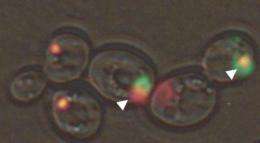
This is an image showing sequestration of the prion form of translation release factor Sup35 (red) by polyglutamines in an aggresome (green). A new study found that aggresome formation in yeast cells containing Sup35 did not reduce the toxicity of huntingtin proteins with a polyglutamine tract. The study suggests a potentially new approach for identifying possible therapeutic targets for treating Huntington’s disease. Credit: Georgia Tech/Yury Chernoff
New research into the cell-damaging effects of Huntington's disease suggests a potentially new approach for identifying possible therapeutic targets for treating the nerve-destroying disorder.
Huntington's disease causes the progressive breakdown of nerve cells in the brain and affects an individual's movement, cognition and mental state. Genetically, the disease is associated with a mutation in the Huntingtin gene that causes the huntingtin protein to be produced with an extended region containing the amino acid glutamine.
The mechanisms that control the severity and onset of the disease are poorly understood, as individuals with the same amount of expansion in their huntingtin proteins experience differences in toxicity and onset of the disease.
A new study led by Georgia Institute of Technology researchers suggests that the toxic effects of the huntingtin protein on cells may not be driven exclusively by the length of the protein's expansion, but also by which other proteins are present in the cell.
The researchers placed human huntingtin protein with an expanded region, called a polyglutamine tract, into yeast cells and found toxicity differences that were based on the other protein aggregates -- called prions -- present in the cells.
"This study clarifies genetic and epigenetic mechanisms that modulate polyglutamine's toxicity on cells and establishes a new approach for identifying potential therapeutic targets through characterization of pre-existing proteins in the cell," said Yury Chernoff, a professor in the School of Biology at Georgia Tech. "While this study was conducted in yeast, it is possible that there are differences in aggregated proteins present in human cells as well, which are causing variation in huntingtin toxicity among individuals."
The results of the study were published in the April 2012 issue of the journal PLoS Genetics. This work was supported by the National Institutes of Health and the Hereditary Disease Foundation.
Also contributing to this research were former Georgia Tech graduate student He Gong and postdoctoral fellow Nina Romanova, University of North Carolina at Chapel Hill School of Medicine research assistant professor Piotr Mieczkowski, and Boston University School of Medicine professor Michael Sherman.
Expanded huntingtin forms clumps in human cells that are typically transported and stored in an internal compartment called an aggresome until they can be removed from the body. While the compartment is thought to protect the contents of the cell from the toxic contents inside the aggresome, the current study shows that huntingtin molecules inside an aggresome can still be toxic to the cell.
In the study, aggresome formation in the cells containing the prion form of the Rnq1 protein reduced the toxicity of the huntingtin protein in Saccharomyces cerevisiae yeast cells, whereas the huntingtin protein's toxicity remained in the presence of the prion form of translation release factor Sup35.
"It remains uncertain whether the toxicity was primarily driven by sequestration of Sup35 into the aggresome or by its sequestration into the smaller huntingtin protein aggregates that remained in the cytoplasm," explained Chernoff, who is also director of the Center for Nanobiology of the Macromolecular Assembly Disorders (NanoMAD). "While Sup35 was detected in the aggresome, we don't know if the functional fraction of Sup35 was sequestered there."
In a follow-on experiment, the researchers increased the level of another release factor, Sup45, in the presence of Sup35 and found that this combination counteracted the toxicity.
"While the Rnq1 and Sup35 prions did not cause significant toxicity on their own, the results show that prion composition in the cell drove toxicity," noted Chernoff. "Prions modulated which proteins were sequestered by the aggresome, as proteins associated with the pre-existing prions were more likely to be sequestered, such as Sup45 because of its association with Sup35."
It remains unknown if polyglutamines can sequester the human versions of the Sup35 and Sup45 release factors, but this study shows the possibility that organisms may differ by the protein composition in their cells, and this in turn may influence their susceptibility to polyglutamine disorders such as Huntington's disease.
Journal reference:
PLoS Genetics
Provided by
Georgia Institute of Technology
-
Study finds two gene classes linked to new prion formation
May 26, 2011 |
not rated yet |
0
-
Cellular stress can induce yeast to promote prion formation
Jul 23, 2011 |
not rated yet |
0
-
Researchers describe molecular 'two-step' leading to protein clumps of Huntington's disease
Mar 08, 2009 |
not rated yet |
0
-
Researchers discover zip codes for protein
Jan 29, 2007 |
not rated yet |
0
-
Huntington's disease discovery provides new hope for treatment
Jul 28, 2010 |
not rated yet |
0
-
Motion perception revisited: High Phi effect challenges established motion perception assumptions
Apr 23, 2013 |
3 / 5 (2) |
2
-
Anything you can do I can do better: Neuromolecular foundations of the superiority illusion (Update)
Apr 02, 2013 |
4.5 / 5 (11) |
5
-
The visual system as economist: Neural resource allocation in visual adaptation
Mar 30, 2013 |
5 / 5 (2) |
9
-
Separate lives: Neuronal and organismal lifespans decoupled
Mar 27, 2013 |
4.9 / 5 (8) |
0
-
Sizing things up: The evolutionary neurobiology of scale invariance
Feb 28, 2013 |
4.8 / 5 (10) |
14
-
Classical and Quantum Mechanics via Lie algebras
Apr 15, 2011
- More from Physics Forums - Independent Research
More news stories
Researchers identify new circadian clock component
Northwestern University scientists have shown a gene involved in neurodegenerative disease also plays a critical role in the proper function of the circadian clock.
Genetics
May 16, 2013 |
not rated yet |
0
|
Returning genetic incidental findings without patient consent violates basic rights, experts say
Informed consent is the backbone of patient care. Genetic testing has long required patient consent and patients have had a "right not to know" the results. However, as 21st century medicine now begins to use the tools of ...
Genetics
May 16, 2013 |
5 / 5 (1) |
3
|
Ethicists provide framework supporting new recommendations on reporting incidental findings in gene sequencing
In a paper published in Science Express, a group of experts led by bioethicists in the Center for Medical Ethics and Health Policy at Baylor College of Medicine provide a framework for the new American College of Medical Geneti ...
Genetics
May 16, 2013 |
not rated yet |
0
Experts urge caution over use of new genetic sequencing techniques
The use of genome-wide analysis (GWA), where the entirety of an individual's DNA is examined to look for the genomic mutations or variants which can cause health problems is a massively useful technology for diagnosing disease. ...
Genetics
May 16, 2013 |
not rated yet |
0
Collecting DNA for human rights: How to help while safeguarding privacy
DNA databases might help identify victims of crime and human trafficking, but how do we safeguard the personal privacy of innocent victims and family members? A new report online May 15 in the Cell Press journal Trends in ...
Genetics
May 15, 2013 |
not rated yet |
0
AIDS science at 30: 'Cure' now part of lexicon
Big names in medicine are set to give an upbeat assessment of the war on AIDS on Tuesday, 30 years after French researchers identified the virus that causes the disease.
For combat veterans suffering from post-traumatic stress disorder, 'fear circuitry' in the brain never rests
Chronic trauma can inflict lasting damage to brain regions associated with fear and anxiety. Previous imaging studies of people with post-traumatic stress disorder, or PTSD, have shown that these brain regions can over-or ...
Melon focus headband turns to Kickstarter for rollout plans
(Medical Xpress)—What if the quality of your work depends more on your focus on the piano keys or canvas or laptop than your musical or painting or computing skills? If target users can be convinced, they ...
Temporal processing in the olfactory system
The neural machinery underlying our olfactory sense continues to be an enigma for neuroscience. A recent review in Neuron seeks to expand traditional ideas about how neurons in the olfactory bulb might encode information about ...
Now we know why old scizophrenia medicine works on antibiotics-resistant bacteria
In 2008 researchers from the University of Southern Denmark showed that the drug thioridazine, which has previously been used to treat schizophrenia, is also a powerful weapon against antibiotic-resistant bacteria such as ...
College women exceed NIAAA drinking guidelines more frequently than college men
In order to avoid harms associated with alcohol consumption, in 2009 the National Institute on Alcohol Abuse and Alcoholism issued guidelines that define low-risk drinking. These guidelines differ for men and women: no more ...