Study explains fast tumor migration
June 12, 2012 in Cancer

Tumor cells move faster through tight spaces

Enlarge

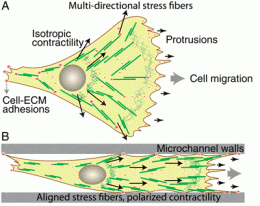
This image shows the traction polarization along the direction of migration for a cell in a confined space, explaining increased migration speed.

(Phys.org) -- Bioengineering Professor Sanjay Kumar’s lab at the UC Berkeley today released major new research showing that tumor cells are able to migrate faster through confined spaces in the body.

The findings are published in the Proceedings of the National Academy of Sciences, co-authored by Kumar and postdoctoral researcher Amit Pathak.

Scientists know that the invasion of tumors through tissue is regulated both by mechanical properties of the tissue, such as its stiffness, and tissue microstructure properties, such as pore size. However, past attempts to study and understand these mechanisms in detail have been complicated by the fact that it is extremely difficult to change one property without changing the other.

Through newly-developed techniques, the Kumar Lab has shown for the first time that the two parameters regulate motility in very different ways and, rather surprisingly, confinement of actually enables them to move more rapidly and directionally than they do in wide open spaces.

The researchers have developed a microfabricated platform that enables the creation of 3D channels of independently-defined size and stiffness. This structure allowed them to see that narrow channels enable cells to develop traction against the scaffold in a more focused way.

“Since there is only one way to go,” explained Kumar, “the cell doesn’t waste its ‘energy’ exploring other avenues.”

This may be a physiologically important mechanism, as malignant brain tumors tend to infiltrate most rapidly along tissue interfaces and confined spaces, such as blood vessels and nerve tracts.

More information: www.pnas.org/conte… ull.pdf+html

Journal reference: Proceedings of the National Academy of Sciences search and more info website

Provided by University of California - Berkeley search and more info website

not rated yet  

Rank not rated yet
Tags

Related Stories
Relevant PhysicsForums posts

More news stories

Research identifies a way to make cancer cells more responsive to chemotherapy

Breast cancer characterized as "triple negative" carries a poor prognosis, with limited treatment options. In some cases, chemotherapy doesn't kill the cancer cells the way it's supposed to. New research from Western University ...

Cancer created 7 hours ago | popularity 5 / 5 (2) | comments 0

Mayo Clinic genomic analysis lends insight to prostate cancer

Mayo Clinic researchers have used next generation genomic analysis to determine that some of the more aggressive prostate cancer tumors have similar genetic origins, which may help in predicting cancer progression. The findings ...

Cancer created 7 hours ago | popularity not rated yet | comments 0

When oxygen is short, EGFR prevents maturation of cancer-fighting miRNAs

Even while being dragged to its destruction inside a cell, a cancer-promoting growth factor receptor fires away, sending signals that thwart the development of tumor-suppressing microRNAs (miRNAs) before it's dissolved, researchers ...

Cancer created 8 hours ago | popularity not rated yet | comments 0 | with audio podcast

Improved chemo regimen for childhood leukemia may offer high survival, no added heart toxicity

Treating pediatric leukemia patients with a liposomal formulation of anthracycline-based chemotherapy at a more intense-than-standard dose during initial treatment may result in high survival rates without causing any added ...

Cancer created 12 hours ago | popularity not rated yet | comments 0

Protein preps cells to survive stress of cancer growth and chemotherapy

Scientists have uncovered a survival mechanism that occurs in breast cells that have just turned premalignant-cells on the cusp between normalcy and cancers-which may lead to new methods of stopping tumors.

Cancer created 12 hours ago | popularity not rated yet | comments 0 | with audio podcast


ACP issues recommendations for management of high blood glucose in hospitalized patients

High blood glucose is associated with poor outcomes in hospitalized patients, and use of intensive insulin therapy (IIT) to control hyperglycemia is a common practice in hospitals. But the recent evidence does not show a ...

Controlling mood through the motions of mitochondria

(Medical Xpress)—Regulating the distribution of power in neurons is done by a system that makes the national electric grid look simple by comparison. Each neuron has several thousand mitochondria confined ...

Motion quotient: IQ predicted by ability to filter motion (w/ video)

A brief visual task can predict IQ, according to a new study. This surprisingly simple exercise measures the brain's unconscious ability to filter out visual movement. The study shows that individuals whose ...

Multiple research teams unable to confirm high-profile Alzheimer's study

Teams of highly respected Alzheimer's researchers failed to replicate what appeared to be breakthrough results for the treatment of this brain disease when they were published last year in the journal Science.

Scientists discover molecule triggers sensation of itch

Scientists at the National Institutes of Health report they have discovered in mouse studies that a small molecule released in the spinal cord triggers a process that is later experienced in the brain as ...

Researchers find common childhood asthma unconnected to allergens or inflammation

Little is known about why asthma develops, how it constricts the airway or why response to treatments varies between patients. Now, a team of researchers at Weill Cornell Medical College, Columbia University Medical Center ...