With mind-reading speller, free-for-all conversations that are silent and still
June 28, 2012 in Neuroscience

With mind-reading speller, free-for-all conversations that are silent and still

Enlarge

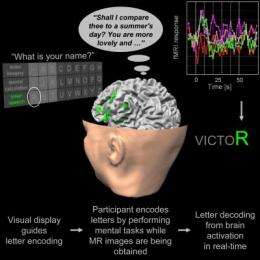
Researchers have come up with a device that may enable people who are completely unable to speak or move at all to nevertheless manage unscripted back-and-forth conversation. The key to such silent and still communication is the first real-time, brain-scanning speller, according to the report published online on June 28 in Current Biology.

Researchers have come up with a device that may enable people who are completely unable to speak or move at all to nevertheless manage unscripted back-and-forth conversation. The key to such silent and still communication is the first real-time, brain-scanning speller, according to the report published online on June 28 in Current Biology.

The new technology builds on groundbreaking earlier uses of fMRI brain scans to assess consciousness in people described as being in an unconscious, vegetative state and to enable them to answer yes and no questions. fMRI (or ) is typically used for clinical and research purposes to track by measuring blood flow.

"The work of Adrian Owen and colleagues led me to wonder whether it might even become possible to use fMRI, , and appropriate experimental designs to freely encode thoughts, letter-by-letter, and therewith enable back-and-forth communication in the absence of ," said Bettina Sorger of Maastricht University in The Netherlands.

This video is not supported by your browser at this time.

This video shows mental task-related brain activation patterns. Video (c) Current Biology

The new evidence shows that the answer to that thought question is yes. Sorger's team came up with a letter-encoding technique that requires almost no pre-training. Participants in their study voluntarily selected letters on a screen, which guided the letter encoding; for each specific character, participants were asked to perform a particular mental task for a set period of time. That produced 27 distinct corresponding to each letter of the alphabet and the equivalent of a space bar, which could be automatically decoded in real-time using newly developed data analysis methods.

In each communication experiment, participants held a mini-conversation consisting of two open questions and answers. Everyone the researchers tested was able to successfully produce answers within a single one-hour session.

The results substantially extend earlier uses of fMRI, which allowed individuals to answer the equivalent of multiple-choice questions having four or fewer possible answers, by enabling free-letter spelling. That could make all the difference for people who are completely paralyzed and unable to benefit from other means of alternative communication, Sorger says.

Ultimately, she says their goal is to transfer the fMRI technology they've developed to a more portable and affordable method for measuring blood flow, such as functional near-infrared spectroscopy (fNIRS).

More information: Current Biology, July 24, 2012 print issue print issue. DOI:10.1016/j.cub.2012.05.022

Journal reference: Current Biology search and more info website

Provided by Cell Press search and more info website

5 /5 (4 votes)  

Rank 5 /5 (4 votes)
Relevant PhysicsForums posts

More news stories

Leading researchers report on the elusive search for biomarkers in Huntington's disease

While Huntington's disease (HD) is currently incurable, the HD research community anticipates that new disease-modifying therapies in development may slow or minimize disease progression. The success of HD research depends ...

Neuroscience created 9 hours ago | popularity not rated yet | comments 0

Study shows premature birth interrupts vital brain development processes leading to reduced cognitive abilities

Researchers from King's College London have for the first time used a novel form of MRI to identify crucial developmental processes in the brain that are vulnerable to the effects of premature birth. This new study, published ...

Neuroscience created 12 hours ago | popularity 5 / 5 (1) | comments 0 | with audio podcast

Researchers find far-reaching, microvascular damage in uninjured side of brain after stroke

While the effects of acute stroke have been widely studied, brain damage during the subacute phase of stroke has been a neglected area of research. Now, a new study by the University of South Florida reports that within a ...

Neuroscience created 14 hours ago | popularity not rated yet | comments 0 | with audio podcast

Neurons that can multitask greatly enhance the brain's computational power, study finds

Over the past few decades, neuroscientists have made much progress in mapping the brain by deciphering the functions of individual neurons that perform very specific tasks, such as recognizing the location ...

Neuroscience created 17 hours ago | popularity 4.9 / 5 (10) | comments 1 | with audio podcast

For combat veterans suffering from post-traumatic stress disorder, 'fear circuitry' in the brain never rests

Chronic trauma can inflict lasting damage to brain regions associated with fear and anxiety. Previous imaging studies of people with post-traumatic stress disorder, or PTSD, have shown that these brain regions can over-or ...

Neuroscience created May 18, 2013 | popularity 5 / 5 (1) | comments 0 | with audio podcast


Early-life traffic-related air pollution exposure linked to hyperactivity

Early-life exposure to traffic-related air pollution was significantly associated with higher hyperactivity scores at age 7, according to new research from the University of Cincinnati (UC) and Cincinnati Children's Hospital ...

New immune system discovered

(Medical Xpress)—A research team, led by Jeremy Barr, a biology post-doctoral fellow, unveils a new immune system that protects humans and animals from infection.

The compound in the Mediterranean diet that makes cancer cells 'mortal'

New research suggests that a compound abundant in the Mediterranean diet takes away cancer cells' "superpower" to escape death. By altering a very specific step in gene regulation, this compound essentially re-educates cancer ...

Resistance to last-line antibiotic makes bacteria resistant to immune system

Bacteria resistant to the antibiotic colistin are also commonly resistant to antimicrobial substances made by the human body, according to a study in mBio, the online open-access journal of the American Society for Microb ...

Do salamanders hold the solution to regeneration?

Salamanders' immune systems are key to their remarkable ability to regrow limbs, and could also underpin their ability to regenerate spinal cords, brain tissue and even parts of their hearts, scientists have ...

Scientists identify molecular trigger for Alzheimer's disease

Researchers have pinpointed a catalytic trigger for the onset of Alzheimer's disease – when the fundamental structure of a protein molecule changes to cause a chain reaction that leads to the death of neurons ...