Skin cell transplant may offer new hope to vitiligo patients
June 22, 2012 By Jenifer Goodwin, HealthDay Reporter in Diseases, Conditions, Syndromes
In small study, some people had about 45 percent return of skin color.
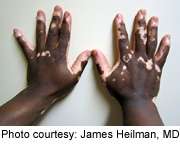
(HealthDay) -- Skin cell transplants can restore pigment to the skin of some patients with the disorder known as vitiligo, new research finds.
Vitiligo is a skin condition in which melanocytes, or the cells in skin that produce pigment, are destroyed. The result is the skin loses color, often in patches. Vitiligo affects about one in every 200 people in the United States.
In the study, researchers from Henry Ford Hospital in Detroit removed a postage stamp-sized sample of skin from the upper thighs of 23 patients. Participants ranged in age from 18 to 60 and included whites, blacks, Asians and Hispanics.
Researchers then isolated melanocytes and keratinocytes, another type of skin cell, into a liquid solution.
Next, researchers used a device called a dermabrader to scrape off the white patches of skin, and sprayed the liquid containing the skin cells onto the skin, allowing it to disperse over the entire white patch. The area was then covered in dressings for about a week.
Gradually, the transplant, including the melanocytes, took hold and began to grow. Over the course of one to six months, color gradually returned to the white patches.
On average, the skin regained about 45 percent of its original color, although some patients saw better results than others.
The technique worked best in people who have what's known as "focal" or "segmental" vitiligo, in which color is lost only on one portion or side of the face or body, while the other is normally pigmented. On average, they had about 68 percent of their natural color return.
The treatment didn't work as well in people with "symmetrical" vitiligo, or pigment loss on both sides of the body or face, said senior study author Dr. Iltefat Hamzavi, a senior staff physician in Henry Ford's department of dermatology.
Researchers believe the immune system is more active in those patients, and continues to destroy color-producing cells, including the transplanted ones.
"This is a step forward but it's not a solution for everybody," Hamzavi said.
There were few complications. No patients developed an infection, and only one patient developed mild scarring, he said.
The study was published in a recent issue of the Journal of the American Academy of Dermatology.
Although this is among the first published studies on using skin cell transplants to treat vitiligo in the United States, a similar technique has been used in India and Saudi Arabia, Hamzavi said.
Vitiligo can occur at any age, but it often strikes when people are in their teens and 20s, Hamzavi said. It can be an especially difficult time for people to deal with the cosmetic issues of the disease, he added.
Among the patients who had the procedure done, one admitted he would wear bandages on his face in public to avoid stares; others avoided socializing, Hamzavi said. After their pigment was restored, the patients no longer practiced these behaviors, he said.
It's unknown how long the color remains intact. Researchers followed patients until about six months and none had lost color, while initial reports from Saudi Arabia and India have also not described color loss over time, Hamzavi said.
The researchers are continuing to offer the procedure at their hospital, and Hamzavi said they handle several cases per month.
Dr. Michele Green, a dermatologist at Lenox Hill Hospital in New York City, said the technique would be welcomed by many patients and dermatologists. Currently, there isn't much in the way of treatments for vitiligo, Green noted.
"It's amazing, if it's really as good as they say it is," Green said. "There are some laser [procedures] that are mildly effective, but short of that there is no treatment for vitiligo. And it's cosmetically extremely disfiguring for these patients. It's really big news."
But, Green cautioned, more research needs to be done. Only 23 patients were treated this way, and not all were helped, she said.
In addition, more needs to be learned about who has the best chances of success with the treatment, including whether it works better on new-onset vitiligo or if it works as well if people have had the disease for many years.
"It's a great preliminary study and very promising, but more investigation needs to be done," Green said.
More information: The U.S. National Institute of Arthritis and Musculoskeletal and Skin Diseases has more on vitiligo.
Journal reference:
Journal of the American Academy of Dermatology
Copyright © 2012 HealthDay. All rights reserved.
-
Henry Ford Hospital first in United States to offer MKTP surgery as treatment option for vitiligo
Oct 25, 2011 |
not rated yet |
0
-
Skin transplant offers new hope for vitiligo patients
May 30, 2012 |
not rated yet |
0
-
Skin transplant offers new hope to vitiligo patients
Mar 09, 2010 |
not rated yet |
0
-
Eye color may indicate risk for serious skin conditions
May 06, 2012 |
not rated yet |
0
-
Romanian community provides insight into genetic factors associated with vitiligo
Mar 17, 2008 |
not rated yet |
0
-
Motion perception revisited: High Phi effect challenges established motion perception assumptions
Apr 23, 2013 |
3 / 5 (2) |
2
-
Anything you can do I can do better: Neuromolecular foundations of the superiority illusion (Update)
Apr 02, 2013 |
4.5 / 5 (11) |
5
-
The visual system as economist: Neural resource allocation in visual adaptation
Mar 30, 2013 |
5 / 5 (2) |
9
-
Separate lives: Neuronal and organismal lifespans decoupled
Mar 27, 2013 |
4.9 / 5 (8) |
0
-
Sizing things up: The evolutionary neurobiology of scale invariance
Feb 28, 2013 |
4.8 / 5 (10) |
14
-
Classical and Quantum Mechanics via Lie algebras
Apr 15, 2011
- More from Physics Forums - Independent Research
More news stories
Ginger compounds may be effective in treating asthma symptoms
Gourmands and foodies everywhere have long recognized ginger as a great way to add a little peppery zing to both sweet and savory dishes; now, a study from researchers at Columbia University shows purified components of the ...
Diseases, Conditions, Syndromes
5 hours ago |
not rated yet |
0
New research identifies practice changes to improve value and quality of GI procedures
There are significant cost and risk factors associated with two procedures commonly used to diagnose or treat gastrointestinal problems, according to research presented at Digestive Disease Week (DDW).
Diseases, Conditions, Syndromes
17 hours ago |
not rated yet |
0
Consuming coffee linked to lower risk of detrimental liver disease, study finds
Regular consumption of coffee is associated with a reduced risk of primary sclerosing cholangitis (PSC), an autoimmune liver disease, Mayo Clinic research shows. The findings were being presented at the Digestive Disease ...
Diseases, Conditions, Syndromes
17 hours ago |
not rated yet |
0
|
New case of SARS-like virus in Saudi: ministry
A new case of the deadly coronavirus has been detected in Saudi Arabia where 15 people have already died after contracting it, the health ministry announced on Saturday on its Internet website.
Diseases, Conditions, Syndromes
May 18, 2013 |
not rated yet |
0
Little evidence for prediction rules for low back pain
(HealthDay)—Few randomized clinical trials have been done to assess clinical prediction rules for patients with lower back pain, and the trials that have been done are of low quality and do not provide ...
Diseases, Conditions, Syndromes
May 17, 2013 |
not rated yet |
0
|
Researchers identify a potential new risk for sleep apnea: Asthma
Researchers at the University of Wisconsin have identified a potential new risk factor for obstructive sleep apnea: asthma. Using data from the National Institutes of Health (Heart, Lung, and Blood Institute)-funded Wisconsin ...
Study finds that sleep apnea and Alzheimer's are linked
A new study looking at sleep-disordered breathing (SDB) and markers for Alzheimer's disease (AD) risk in cerebrospinal fluid (CSF) and neuroimaging adds to the growing body of research linking the two.
Computational tool translates complex data into simplified 2-dimensional images
In their quest to learn more about the variability of cells between and within tissues, biomedical scientists have devised tools capable of simultaneously measuring dozens of characteristics of individual ...
New theory on genesis of osteoarthritis comes with successful therapy in mice
Scientists at Johns Hopkins have turned their view of osteoarthritis (OA) inside out. Literally. Instead of seeing the painful degenerative disease as a problem primarily of the cartilage that cushions joints, ...
'Gap' for HIV vaccine efforts after latest setback
The hunt for an HIV vaccine has gobbled up $8 billion in the past decade, and the failure of the most recent efficacy trial has delivered yet another setback to 26 years of efforts.
Alzheimer's leaves bilingual victims stranded in Canada
The devastating effect of Alzheimer's disease on bilingual people has been thrown into focus in Canada, where the sudden loss of a second language can leave sufferers feeling like strangers in their own country.