Novel anti-malarial drug target identified
July 19, 2012 in Medical research

Novel anti-malarial drug target identified

Enlarge

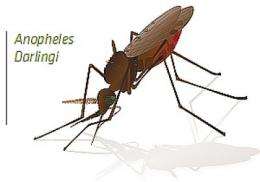
This is an illustration of Anopheles darlingi. Credit: UC San Diego School of Medicine

An international team of scientists, led by researchers from the Department of Pediatrics at the University of California, San Diego School of Medicine, have identified the first reported inhibitors of a key enzyme involved in survival of the parasite responsible for malaria. Their findings, which may provide the basis for anti-malarial drug development, are currently published in the online version of the Journal of Medicinal Chemistry.

Tropical malaria is responsible for more than 1.2 million deaths annually. Severe forms of the disease are mainly caused by the parasite Plasmodium falciparum, transmitted to humans by female . has not been possible due to the lack of vaccines and the parasite's ability to develop resistance to most drugs.

The researchers conducted high-throughput screening of nearly 350,000 compounds in the National Institutes of Health's Molecular Libraries Small Molecule Repository (MLSMR) to identify compounds that inhibit an enzyme which plays an important role in parasite development: Plasmodium falciparum glucose-6-phosphate dehydrogenase (PfG6PD) is essential for proliferating and propagating P. falciparum.

"The enzyme G6PD catalyzes an initial step in a process that protects the from oxidative stress in , creating an environment in which the parasite survives," said senior author Lars Bode, PhD, assistant professor in the UCSD Department of Pediatrics, Division of and the Division of Gastroenterology, and Nutrition. People with a natural deficiency in this enzyme are protected from malaria and its deadly symptoms, an observation that triggered the reported research.

The parasitic form of the enzyme (PfG6PD) is what contributes the majority of G6PD activity in infected red blood cells. Because the parasite lives in the blood of a malaria-infected person, the scientists aimed at identifying compounds that inhibit the parasitic form but not the human form of the enzyme. "We didn't want to interfere with the human form of the enzyme and risk potential side effects," Bode explained.

Scientific testing had previously been limited by a lack of recombinant PfG6PD. Team members in the lab of Katja Becker, PhD, at the Interdisciplinary Research Center at Justus-Liebig-University in Giessen, Germany produced the first complete and functional recombinant PfG6PD, and researchers led by Anthony Pinkerton, PhD, at Sanford-Burnham Medical Research Institute used it to identify the lead compound resulting from their efforts, ML276.

ML276 represents the first reported selective PfG6PD inhibitor, which stops the growth of malaria parasites in cultured red blood cells – even those parasites that developed resistance to currently available drugs. "ML276 is a very promising basis for future drug design of new anti-malarial therapeutics," said Bode.

Journal reference: Journal of Medicinal Chemistry search and more info website

Provided by University of California - San Diego search and more info website

4 /5 (2 votes)  

Rank 4 /5 (2 votes)
Relevant PhysicsForums posts

More news stories

Study reveals new mechanism for estrogen suppression of liver lipid synthesis

By discovering the new mechanism by which estrogen suppresses lipid synthesis in the liver, UC Irvine endocrinologists have revealed a potential new approach toward treating certain liver diseases.

Medical research created May 23, 2013 | popularity 5 / 5 (1) | comments 0 | with audio podcast

MRI-based measurement helps predict vascular disease in the brain

Aortic arch pulse wave velocity, a measure of arterial stiffness, is a strong independent predictor of disease of the vessels that supply blood to the brain, according to a new study published in the June issue the journal ...

Medical research created May 23, 2013 | popularity not rated yet | comments 0

Antibiotics: A new understanding of sulfonamide nervous system side effects

Since the discovery of Prontosil in 1932, sulfonamide antibiotics have been used to combat a wide spectrum of bacterial infections, from acne to chlamydia and pneumonia. However, their side effects can include serious neurological ...

Medical research created May 23, 2013 | popularity 3 / 5 (1) | comments 0 | with audio podcast

Scientists discover molecule triggers sensation of itch

Scientists at the National Institutes of Health report they have discovered in mouse studies that a small molecule released in the spinal cord triggers a process that is later experienced in the brain as ...

Medical research created May 23, 2013 | popularity 5 / 5 (3) | comments 0 | with audio podcast

Discarded immune cells induce the relocation of stem cells

Spanish researchers have discovered that the daily clearance of neutrophils from the body stimulates the release of hematopoietic stem cells from the bone marrow into the bloodstream, according to a report published today ...

Medical research created May 23, 2013 | popularity 5 / 5 (2) | comments 0


First drug to improve heart failure mortality in over a decade

Coenzyme Q10 decreases all cause mortality by half, according to the results of a multicentre randomised double blind trial presented today at Heart Failure 2013 congress. It is the first drug to improve heart failure mortality ...

Seniors more likely to crash when driving with pet, study finds

(HealthDay)—Animals make great companions for senior citizens, but elderly people who always drive with a pet in the car are far more likely to crash than those who never drive with a pet, researchers have ...

Heart failure accelerates male 'menopause'

Heart failure accelerates the aging process and brings on early andropausal syndrome (AS), according to research presented today at the Heart Failure Congress 2013. AS, also referred to as male 'menopause', was four times ...

Death highest in heart failure patients admitted in January, on Friday, and overnight

Mortality and length of stay are highest in heart failure patients admitted in January, on Friday, and overnight, according to research presented today at the Heart Failure Congress 2013. The analysis of nearly 1 million ...

Feds fight morning-after pill age ruling in NY

(AP)—Department of Justice lawyers have again asked a federal appeals court in New York to delay lifting age restrictions and prescription requirements on an emergency contraceptive popularly known as the morning-after ...

New immune system discovered

(Medical Xpress)—A research team, led by Jeremy Barr, a biology post-doctoral fellow, unveils a new immune system that protects humans and animals from infection.