By decoding brain activity, scientists read monkeys' inner thoughts
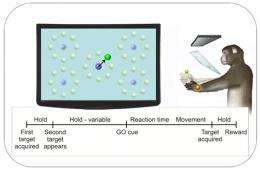
In the classic center-out reaching task, a monkey reaches from a central location to targets on a circle surrounding the starting position. This task does not allow the neural encoding for hand position to be separated from the neural encoding for hand velocity. If the starting position varies, however, as in the task shown here, hand position and initial hand velocity can be disambiguated. Credit: Moran/Pearce
Anyone who has looked at the jagged recording of the electrical activity of a single neuron in the brain must have wondered how any useful information could be extracted from such a frazzled signal.
But over the past 30 years, researchers have discovered that clear information can be obtained by decoding the activity of large populations of neurons.
Now, scientists at Washington University in St. Louis, who were decoding brain activity while monkeys reached around an obstacle to touch a target, have come up with two remarkable results.
Their first result was one they had designed their experiment to achieve: they demonstrated that multiple parameters can be embedded in the firing rate of a single neuron and that certain types of parameters are encoded only if they are needed to solve the task at hand.
Their second result, however, was a complete surprise. They discovered that the population vectors could reveal different planning strategies, allowing the scientists, in effect, to read the monkeys' minds.
By chance, the two monkeys chosen for the study had completely different cognitive styles. One, the scientists said, was a hyperactive type, who kept jumping the gun, and the other was a smooth operator, who waited for the entire setup to be revealed before planning his next move. The difference is clearly visible in their decoded brain activity.
The study was published in the July 19th advance online edition of the journal Science.
This video is not supported by your browser at this time.
The difference between the cognitive styles of two monkeys is clearly visible in the neural population vectors for hand movement direction. The instant the target (green) appears, monkey H plans to move directly to it (his direction decoding vector lengthens in the direction of the target). When the obstacle then appears, the vector shrinks and rotates to a direction that will allow him to avoid the obstacle and then lengthens again. In contrast, monkey G doesn’t react to the appearance of the target. Knowing that his path to the target may be blocked by the obstacle he waits until the task has been fully specified before planning his move. Credit: Moran/Pearce
All in the taskThe standard task for studying voluntary motor control is the "center-out task," in which a monkey or other subject must move its hand from a central location to targets placed on a circle surrounding the starting position.
To plan the movement, says Daniel Moran, PhD, associate professor of biomedical engineering in the School of Engineering & Applied Science and of neurobiology in the School of Medicine at Washington University in St. Louis, the monkey needs three pieces of information: current hand and target position and the velocity vector that the hand will follow.
In other words, the monkey needs to know where his hand is, what direction it is headed and where he eventually wants ot to go.
A variation of the center-out task with multiple starting positions allows the neural coding for position to be separated from the neural coding for velocity.
By themselves, however, the straight-path, unimpeded reaches in this task don't let the neural coding for velocity to be distinguished from the neural coding for target position, because these two parameters are always correlated. The initial velocity of the hand and the target are always in the same direction.
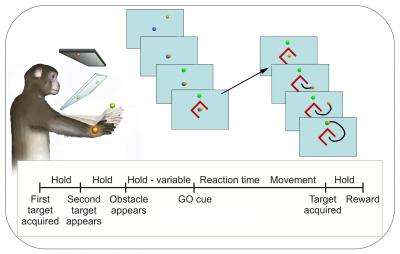
The obstacle-avoidance task is a variation on the center-out reaching task in which an obstacle sometimes prevents the monkey from moving directly to the target. The monkey must first place a cursor (yellow) on the central target (purple). This was the starting position. After the first hold, a second target appeared (green). After the second hold an obstacle appeared (red box). After the third hold, the center target disappeared, indicating a "go" for the monkey, which then moved the cursor out and around the obstacle to the target. Credit: Moran/Pearce
To solve this problem and isolate target position from movement direction, doctoral student Thomas Pearce designed a novel obstacle-avoidance task to be done in addition to the center-out task.Crucially, in one-third of the obstacle-avoidance trials, either no obstacle appeared or the obstacle didn't block the monkey's path. In either case, the monkey could move directly to the target once he got the "go" cue.
The population vector corresponding to target position showed up during the third hold of the novel task, but only if there was an obstacle. If an obstacle appeared and the monkey had to move its hand in a curved trajectory to reach the target, the population vector lengthened and pointed at the target. If no obstacle appeared and the monkey could move directly to the target, the population vector was insignificant.
In other words, the monkeys were encoding the position of the target only when it did not lie along a direct path from the starting position and they had to keep its position "in mind" as they initially moved in the "wrong" direction.
"It's all," Moran says, "in the design of the task."
And then some magic happens
Pearce's initial approach to analyzing the data from the experiment was the standard one of combining the data from the two monkeys to get a cleaner picture.
"It wasn't working," Pearce says, "and I was frustrated because I couldn't figure out why the data looked so inconsistent. So I separated the data by monkey, and then I could see, wow, they're very different. They're approaching this task differently and that's kind of cool."
The difference between the monkey's' styles showed up during the second hold. At this point in the task, the target was visible, but the obstacle had not yet appeared.
The hyperactive monkey, called monkey H, couldn't wait. His population vector during that hold showed that he was poised for a direct reach to the target. When the obstacle was then revealed, the population vector shortened and rotated to the direction he would need to move to avoid the obstacle.
The smooth operator, monkey G, in the meantime, idled through the second hold, waiting patiently for the obstacle to appear. Only when it was revealed did he begin to plan the direction he would move to avoid the obstacle.
Because he didn't have to correct course, monkey G's strategy was faster, so what advantage was it to monkey H to jump the gun? In the minority of trials where no obstacle appeared, monkey H approached the target more accurately than monkey G. Maybe monkey H is just cognitively adapted to a Whac-A-Mole world. And monkey G, when caught without a plan, was at a disadvantage.
Working with the monkeys, the scientists had been aware that they had very different personalities, but they had no idea this difference would show up in their neural recordings.
"That's what makes this really interesting," Moran says.
More information: "Strategy-Dependent Encoding of Planned Arm Movements in the Dorsal Premotor Cortex," by T.M. Pearce; D.W. Moran, Science, 2012.
Journal reference:
Science
Provided by
Washington University in St. Louis
-
Monkeys found to wonder what might have been
May 14, 2009 |
not rated yet |
0
-
Scientists discover neurons that 'mirror' the attention of others
May 18, 2009 |
not rated yet |
0
-
Brits rescue 88 research monkeys
Jan 30, 2008 |
not rated yet |
0
-
S. Korean scientists to try monkey cloning
Dec 20, 2006 |
not rated yet |
0
-
Monkey economy works
Jul 13, 2009 |
not rated yet |
0
-
Motion perception revisited: High Phi effect challenges established motion perception assumptions
Apr 23, 2013 |
3 / 5 (2) |
2
-
Anything you can do I can do better: Neuromolecular foundations of the superiority illusion (Update)
Apr 02, 2013 |
4.5 / 5 (11) |
5
-
The visual system as economist: Neural resource allocation in visual adaptation
Mar 30, 2013 |
5 / 5 (2) |
9
-
Separate lives: Neuronal and organismal lifespans decoupled
Mar 27, 2013 |
4.9 / 5 (8) |
0
-
Sizing things up: The evolutionary neurobiology of scale invariance
Feb 28, 2013 |
4.8 / 5 (10) |
14
-
Pressure-volume curve: Elastic Recoil Pressure don't make sense
May 18, 2013
-
If you became brain-dead, would you want them to pull the plug?
May 17, 2013
-
MRI bill question
May 15, 2013
-
Ratio of Hydrogen of Oxygen in Dessicated Animal Protein
May 13, 2013
-
Alcohol and acetaminophen
May 13, 2013
-
Marie Curie's leukemia
May 13, 2013
- More from Physics Forums - Medical Sciences
More news stories
For combat veterans suffering from post-traumatic stress disorder, 'fear circuitry' in the brain never rests
Chronic trauma can inflict lasting damage to brain regions associated with fear and anxiety. Previous imaging studies of people with post-traumatic stress disorder, or PTSD, have shown that these brain regions can over-or ...
Neuroscience
May 18, 2013 |
5 / 5 (1) |
0
|
Temporal processing in the olfactory system
The neural machinery underlying our olfactory sense continues to be an enigma for neuroscience. A recent review in Neuron seeks to expand traditional ideas about how neurons in the olfactory bulb might encode information about ...
Neuroscience
May 17, 2013 |
4 / 5 (1) |
0
|
Melon focus headband turns to Kickstarter for rollout plans
(Medical Xpress)—What if the quality of your work depends more on your focus on the piano keys or canvas or laptop than your musical or painting or computing skills? If target users can be convinced, they ...
Neuroscience
May 17, 2013 |
3.7 / 5 (3) |
0
|
Deep brain stimulation: A fix when the drugs don't work
Neurological disorders can have a devastating impact on the lives of sufferers and their families.
Neuroscience
May 17, 2013 |
5 / 5 (1) |
0
|
Brain makes call on which ear is used for cell phone
If you're a left-brain thinker, chances are you use your right hand to hold your cell phone up to your right ear, according to a newly published study from Henry Ford Hospital in Detroit.
Neuroscience
May 16, 2013 |
2 / 5 (2) |
0
|
Computational tool translates complex data into simplified 2-dimensional images
In their quest to learn more about the variability of cells between and within tissues, biomedical scientists have devised tools capable of simultaneously measuring dozens of characteristics of individual ...
New theory on genesis of osteoarthritis comes with successful therapy in mice
Scientists at Johns Hopkins have turned their view of osteoarthritis (OA) inside out. Literally. Instead of seeing the painful degenerative disease as a problem primarily of the cartilage that cushions joints, ...
'Gap' for HIV vaccine efforts after latest setback
The hunt for an HIV vaccine has gobbled up $8 billion in the past decade, and the failure of the most recent efficacy trial has delivered yet another setback to 26 years of efforts.
Alzheimer's leaves bilingual victims stranded in Canada
The devastating effect of Alzheimer's disease on bilingual people has been thrown into focus in Canada, where the sudden loss of a second language can leave sufferers feeling like strangers in their own country.
Consuming coffee linked to lower risk of detrimental liver disease, study finds
Regular consumption of coffee is associated with a reduced risk of primary sclerosing cholangitis (PSC), an autoimmune liver disease, Mayo Clinic research shows. The findings were being presented at the Digestive Disease ...
Ketamine shows significant therapeutic benefit in people with treatment-resistant depression
Patients with treatment-resistant major depression saw dramatic improvement in their illness after treatment with ketamine, an anesthetic, according to the largest ketamine clinical trial to-date led by researchers from the ...