GMO in sport: Genetically Modified Olympians?
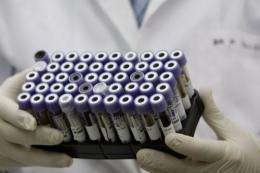
As athletes get ready to smash Olympic records in London, scientists are in a high-stakes race of their own to develop a test that will unmask anyone altering their genes in a desperate quest for gold.
Observers said science will not prevail in time for the games that start on July 27.
While no-one is sure whether "gene doping" is actually happening yet, the theoretical possibility of people fiddling with their DNA to boost power and endurance is one that scares sport officials.
"Today, no, it cannot be tested. If a genetically modified athlete wins the 100m sprint at the London 2012 Games, we won't know -- at least not immediately," bioethicist Andy Miah told AFP.
"In some years, a test may show that gene doping took place and (we) will have to confront the possibility of retracting medals."
In theory, gene doping could see athletes injecting lab-fabricated DNA into their bodies through a carrier, like a virus, to stimulate the production of muscle-growing hormones or red blood cells that shuttle oxygen to the muscles.
A virus works by forcing its own DNA into human cells, which then replicate the DNA containing biological instructions.
"You could take a full-fledged, developed athlete and you could fiddle around with their genes to make them stronger and better," said Don Catlin, a medical doctor who helped set up the first drug testing lab in the United States.
But is it happening?
"Not that I know of, but then again, nobody will call me up and tell me. We are concerned about it because it is a theoretical possibility. We know people will try it and probably are trying it," said Catlin.
In 2006, the sporting world was forced to sit up and take notice when a German athletics coach was accused of seeking to obtain an experimental gene therapy called Repoxygen ahead of the Winter Olympics.
Considered a possible treatment for anaemia, Repoxygen contained a synthetic virus that carries a gene for erythropoietin (EPO) -- a hormone that tells the body to make more red blood cells.

EPO is a favourite doping agent of cyclists and runners.
The World Anti-Doping Agency (WADA) added gene doping to its list of prohibited substances and methods in 2003, and has spent millions of dollars on developing a test.
"We've engaged the gene therapy specialists in the world and we've been working with them since 2002," WADA director general David Howman told AFP, adding there was "no evidence" of athletes using gene manipulation.
Yet.
"Nobody has examples of this, but it doesn't mean it isn't happening," said Miah, who has published several papers on Olympic doping. "That is the problem with doping generally. It isn't very well known what athletes are doing."
Observers like Miah, Catlin and sport genomics expert Alun Williams say there will be no accurate gene doping test in place for the Olympics, a topic WADA would not be drawn on.
A growth-booster gene injected directly into the muscle would be near impossible to trace in the blood or urine, said Williams of the Manchester Metropolitan University.
"If you were to take a muscle biopsy from an athlete, you'd have a much better chance of (finding it), but that is a much more invasive procedure ... and you'd have to do it in every muscle" -- a technique that is unlikely to ever be approved.

Using existing techniques, the odds of finding foreign DNA in an athlete are "probably similar to finding a needle in a haystack", said Williams, but added it should be possible "within a few years".
Under the new rules, an Olympic athlete's blood and urine samples can be kept for up to eight years, meaning it can be retrospectively tested for gene doping once an accurate test is in place.
More than 6,000 blood and urine samples are to be taken at the London Olympics.
The experts warn that gene therapy, even in tests for treating diseases like cancer, Alzheimer's and diabetes, is still in its infancy and risky.
"In several studies, patients have experienced serious adverse effects and several have died," Theodore Friedman, director of the University of California's gene therapy programme and head of WADA's gene doping panel, told AFP.
Added Catlin: "One crude way to learn about it is if athletes started to drop dead."
But while gene doping may still be in the starting blocks, this is unlikely to stop determined cheaters.
"The technique works in clinical settings. It is not perfect, it is not without risk... but athletes will try lots of things that are risky," said Williams.
"Even if there is a very high risk, if there is a chance to improve their performance, some will take that risk."
As cheaters run out of drugs that the authorities don't have a method to detect, gene doping is the next frontier.
"It is make or break for the world of sport," said Miah.
"If they find a way to catch gene doping, it will most likely solve the doping problem forever. If they don't, then it is unlikely ever to be solved."
(c) 2012 AFP


