Researchers study knee stress at tissue, cellular levels
July 24, 2012 in Medical research
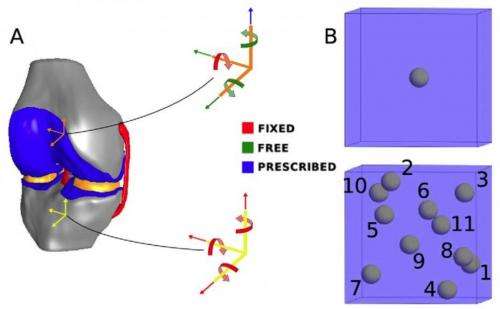
A macro-scale model of the knee (left) was created by a research team at the Cleveland Clinic to study compressive loading of the joint. At the micro scale, the single-cell model (top, right) has been used in previous studies, while Ahmet Erdemir's 11-cell model better represents the effects of loading on the individual cells. Credit: Erdemir/Cleveland Clinic
A Cleveland Clinic research team is developing virtual models of human knee joints to better understand how tissues and their individual cells react to heavy loads virtual models that someday can be used to understand damage mechanisms caused by the aging process or by debilitating diseases, such as osteoarthritis.
Led by Ahmet Erdemir, Ph.D., the team is leveraging the powerful computing systems of the Ohio Supercomputer Center to develop state-of-the-art computational representations of the human body to understand how movement patterns and loads on the joints deform the surrounding tissues and cells. Erdemir is the director of the Computational Biomodeling Core (CoBi) and a faculty member in the Department of Biomedical Engineering at the Lerner Research Institute (LRI) in Cleveland, Ohio.
"The aging process and debilitating diseases affect many aspects of the mechanical function of the human body: from the way we move to how our muscles, joints, tissues, and cells accommodate the loading exerted on the body during daily activities," Erdemir explained. "Computational modeling techniques provide an avenue to obtain additional insights about mechanics at various spatial scales."
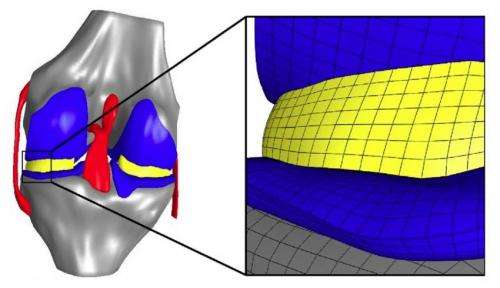
The Cleveland Clinic's Ahmet Erdemir, Ph.D., created this finite element model of the knee joint with representation of the cartilage, menisci and the associated bone structures. An enlarged model region (right) illustrates the mesh resolution of the simulation. Credit: Erdemir/Cleveland Clinic
Many macro-scale studies have looked at how the various components of a knee joint cartilage, menisci, ligaments and bone respond to weight and other external loads. However, Erdemir and colleague Scott C. Sibole wanted to better understand how those large mechanical forces correspond to the related deformation of individual cartilage cells or chondrocytes within the knee. Previous micro-scale studies of cartilage have not commonly been based on data from body-level scales, in particular, by the musculoskeletal mechanics of the knee joint.In addition, calculated deformations typically have been for a single cell at the center of a 100-cubic-micrometer block of simulated tissue; Erdemir used an anatomically based representation that calculated deformations for 11 cells distributed within the same volume.
"In both micro-scale approaches, the cartilage cells experienced amplified deformations compared to those at the macro-scale, predicted by simulating the compression of tissues in the knee joint under the weight of the body," Erdemir found. "In the 11-cell case, all cells experienced less deformation than the single cell case, and also exhibited a larger variance in deformation compared to other cells residing in the same block."
Erdemir's method proved to be highly scalable because of micro-scale model independence that allowed exploitation of distributed memory computing architecture. As a result, Sibole, a research engineer at LRI, was able to leverage the computational muscle of OSC's IBM 1350 Glenn Cluster. At the time, the 9,500 nodes of the Glenn Cluster provided 75 teraflops of computing power, tech-speak for 75 trillion calculations per second. Recently, the Glenn Cluster was partially decommissioned when engineers deployed the center's more powerful HP-Intel Xeon Oakley Cluster.
"Both of OSC's two most recent flagship computing systems were specifically designed to support biomedical applications, such as those employed by Dr. Erdemir and Mr. Sibole," said Ashok Krishnamurthy, OSC interim co-executive director. "Researchers working at Ohio's various respected medical centers are conducting an ever-increasing load of computational studies and analyses, and they now represent a significant share of our user community."
More information: An article authored by Erdemir and Sibole, "Chondrocyte Deformations as a Function of Tibiofemoral Joint Loading Predicted by a Generalized High-Throughput Pipeline of Multi-Scale Simulations," was recently published in PLoS ONE. dx.doi.org/10.1371… pone.0037538
Journal reference:
PLoS ONE
Provided by
Ohio Supercomputer Center
-
Green 'Oakley Cluster' to double OSC computing power
Mar 19, 2012 |
not rated yet |
0
-
OSC's Oakley Cluster delivers on performance efficiency
May 30, 2012 |
not rated yet |
0
-
Embryonic stem cells used to grow cartilage
Sep 06, 2007 |
not rated yet |
0
-
Research team finds compound that can spur cartilage growth
Apr 06, 2012 |
not rated yet |
0
-
Arthritic knees, but not hips, have robust repair response
Feb 10, 2012 |
not rated yet |
0
-
Motion perception revisited: High Phi effect challenges established motion perception assumptions
Apr 23, 2013 |
3 / 5 (2) |
2
-
Anything you can do I can do better: Neuromolecular foundations of the superiority illusion (Update)
Apr 02, 2013 |
4.5 / 5 (11) |
5
-
The visual system as economist: Neural resource allocation in visual adaptation
Mar 30, 2013 |
5 / 5 (2) |
9
-
Separate lives: Neuronal and organismal lifespans decoupled
Mar 27, 2013 |
4.9 / 5 (8) |
0
-
Sizing things up: The evolutionary neurobiology of scale invariance
Feb 28, 2013 |
4.8 / 5 (10) |
14
-
Pressure-volume curve: Elastic Recoil Pressure don't make sense
May 18, 2013
-
If you became brain-dead, would you want them to pull the plug?
May 17, 2013
-
MRI bill question
May 15, 2013
-
Ratio of Hydrogen of Oxygen in Dessicated Animal Protein
May 13, 2013
-
Alcohol and acetaminophen
May 13, 2013
-
Marie Curie's leukemia
May 13, 2013
- More from Physics Forums - Medical Sciences
More news stories
Computational tool translates complex data into simplified 2-dimensional images
In their quest to learn more about the variability of cells between and within tissues, biomedical scientists have devised tools capable of simultaneously measuring dozens of characteristics of individual ...
Medical research
2 hours ago |
5 / 5 (1) |
0
|
Now we know why old scizophrenia medicine works on antibiotics-resistant bacteria
In 2008 researchers from the University of Southern Denmark showed that the drug thioridazine, which has previously been used to treat schizophrenia, is also a powerful weapon against antibiotic-resistant bacteria such as ...
Medical research
May 17, 2013 |
3.7 / 5 (3) |
0
|
SUMO wrestling cells reveal new protective mechanism target for stroke
Scientists investigating the interaction of a group of proteins in the brain responsible for protecting nerve cells from damage have identified a new target that could increase cell survival.
Medical research
May 17, 2013 |
5 / 5 (1) |
0
How serotonin receptors can shape drug effects, from LSD to migraine medication
New findings by researchers carrying out experiments at the U.S. Department of Energy Office of Science's Advanced Photon Source (APS) help explain why some drugs that interact with two kinds of human serotonin ...
Medical research
May 17, 2013 |
4 / 5 (1) |
0
|
Preventing blood poisoning
Peptide molecules derived from the body's natural immune system can help boost the body's defence against life-threatening blood poisoning, joint University research has uncovered.
Medical research
May 17, 2013 |
4 / 5 (1) |
0
|
Researchers identify a potential new risk for sleep apnea: Asthma
Researchers at the University of Wisconsin have identified a potential new risk factor for obstructive sleep apnea: asthma. Using data from the National Institutes of Health (Heart, Lung, and Blood Institute)-funded Wisconsin ...
Study finds that sleep apnea and Alzheimer's are linked
A new study looking at sleep-disordered breathing (SDB) and markers for Alzheimer's disease (AD) risk in cerebrospinal fluid (CSF) and neuroimaging adds to the growing body of research linking the two.
New theory on genesis of osteoarthritis comes with successful therapy in mice
Scientists at Johns Hopkins have turned their view of osteoarthritis (OA) inside out. Literally. Instead of seeing the painful degenerative disease as a problem primarily of the cartilage that cushions joints, ...
Ginger compounds may be effective in treating asthma symptoms
Gourmands and foodies everywhere have long recognized ginger as a great way to add a little peppery zing to both sweet and savory dishes; now, a study from researchers at Columbia University shows purified components of the ...
'Gap' for HIV vaccine efforts after latest setback
The hunt for an HIV vaccine has gobbled up $8 billion in the past decade, and the failure of the most recent efficacy trial has delivered yet another setback to 26 years of efforts.
Alzheimer's leaves bilingual victims stranded in Canada
The devastating effect of Alzheimer's disease on bilingual people has been thrown into focus in Canada, where the sudden loss of a second language can leave sufferers feeling like strangers in their own country.
