People ignorant of cancers caused by smoking
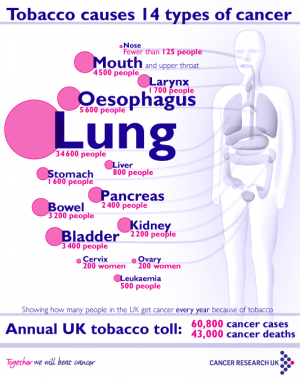
(Medical Xpress) -- Cancer Research UK today reveals the shocking level of ignorance about smoking and cancer among the UK public in a comprehensive new survey of more than 4000 people.
When asked to select cancers linked to smoking, more than 80 per cent of people did not know there was a link between smoking and eight different cancers.
At least two thirds of the 4,099 people surveyed knew smoking caused cancers of the lung, mouth (oral) and throat (larynx and oesophagus). But less than 20 per cent knew tobacco was linked to leukaemia and cancers of the liver, pancreas, bowel (colorectum), kidney, bladder, cervix, and ovary.
And less than 40 per cent knew that stomach cancer is linked to smoking.
Cigarette smoke contains a toxic cocktail of more than 70 cancer-causing chemicals. When a cigarette is smoked, these chemicals can enter the bloodstream and travel around the body, increasing the risk of cancer in more than a dozen different locations.
Professor Robert West, Cancer Research UKs quit smoking expert, said: Nearly everyone knows that smoking causes lung cancer. And smokers may often gamble with their chance of developing the disease. The addiction can lead people to reason that they might avoid lung cancer. But the odds arent good. And these alarming results show what could be a fatal level of ignorance about the toxic hit list from tobacco. There are only two options to eliminate illness caused by smoking: help smokers to quit and stop young people from starting to smoke.
The figures are released on the eve of Englands five year anniversary of pubs, bars and all public spaces going smoke free Sunday, 1st July. Seen as a success by the health community and enjoying massive public support, the UK government is now consulting on whether to remove the brightly coloured, slickly designed tobacco packaging.
Current packaging would be replaced with packs of standard size, shape and colouring, all designed to make cigarettes less appealing to children and give health warnings more impact.
Smoking is by far the most important preventable risk factor for cancer in the UK, responsible for nearly a fifth of all new cancer cases - around 60 000 in the UK in 2010.
Smoking causes more than a quarter (28 per cent) of all deaths from cancer in the UK around 43,000 deaths in 2009 and has killed an estimated 6.5 million people in the UK over the last 50 years.
Jean King, Cancer Research UKs director of tobacco control, said: The list of cancers linked to smoking is truly shocking. Its a long list of body parts that are affected, reflecting just how deadly tobacco is. One of the major problems with smoking is the strength of the addiction. Once a smoker is hooked it can be extremely difficult and take years to quit. The longer a person smokes, the greater the risk of illness.
Around half of all long-term smokers will die from cancer or other smoking-related illnesses. And a quarter of smokers die in middle age - between 35 and 69.
Around 20 per cent of the UK population smoke. Eight out of ten smokers start smoking by the time they turn 19 and around 157,000 11-15 year olds started smoking in the UK in 2010.
Jean King continued: The key to reducing the number of lives blighted by tobacco is to prevent young people from starting smoking in the first place. Reducing the appeal of cigarettes is vital to this goal. Plain packaging of tobacco is the vital next step. Replacing the slickly designed, brightly coloured cigarette packaging with packs of standard size, shape and colour will give millions of children one less reason to start smoking. With the government consulting on the future of tobacco packaging, we urge everyone to show their support for this measure and sign our petition at www.theanswerisplain.org.
Provided by
Cancer Research UK
-
Plain packaging removes cigarettes' appeal
Sep 09, 2011 |
not rated yet |
0
-
Lung cancer cases keep going up in UK women
Apr 13, 2012 |
not rated yet |
0
-
Tobacco displays increase the odds of teens becoming smokers
Sep 13, 2011 |
not rated yet |
0
-
Drop in UK teenage smokers
Aug 18, 2010 |
not rated yet |
0
-
Stopping smoking is hard despite success of smoke-free legislation
Apr 20, 2012 |
not rated yet |
0
-
Motion perception revisited: High Phi effect challenges established motion perception assumptions
Apr 23, 2013 |
3 / 5 (2) |
2
-
Anything you can do I can do better: Neuromolecular foundations of the superiority illusion (Update)
Apr 02, 2013 |
4.5 / 5 (11) |
5
-
The visual system as economist: Neural resource allocation in visual adaptation
Mar 30, 2013 |
5 / 5 (2) |
9
-
Separate lives: Neuronal and organismal lifespans decoupled
Mar 27, 2013 |
4.9 / 5 (8) |
0
-
Sizing things up: The evolutionary neurobiology of scale invariance
Feb 28, 2013 |
4.8 / 5 (10) |
14
-
How can there be a term called "intestinal metaplasia" of stomach
15 hours ago
-
Pressure-volume curve: Elastic Recoil Pressure don't make sense
May 18, 2013
-
If you became brain-dead, would you want them to pull the plug?
May 17, 2013
-
MRI bill question
May 15, 2013
-
Ratio of Hydrogen of Oxygen in Dessicated Animal Protein
May 13, 2013
-
Alcohol and acetaminophen
May 13, 2013
- More from Physics Forums - Medical Sciences
More news stories
Small cancer risk following CT scans in childhood and adolescence confirmed
The gap between life expectancy in patients with a mental illness and the general population has widened since 1985 and efforts to reduce this gap should focus on improving physical health, suggest researchers in a paper ...
Cancer
3 hours ago |
not rated yet |
0
Changing cancer's environment to halt its spread
By studying the roles two proteins, thrombospondin-1 and prosaposin, play in discouraging cancer metastasis, a trans-Atlantic research team has identified a five-amino acid fragment of prosaposin that significantly reduces ...
Cancer
4 hours ago |
not rated yet |
0
Novel RNA-based classification system for colorectal cancer
A novel transcriptome-based classification of colon cancer that improves the current disease stratification based on clinicopathological variables and common DNA markers is presented in a study published in PLOS Medicine this w ...
Cancer
5 hours ago |
not rated yet |
0
Low radiation scans help identify cancer in earliest stages
A study of veterans at high risk for developing lung cancer shows that low-dose computed tomography (LDCT) can be highly effective in helping clinicians spot tiny lung nodules which, in a small number of patients, may indicate ...
Cancer
6 hours ago |
not rated yet |
0
Poliovirus vaccine trial shows early promise for recurrent glioblastoma
An attack on glioblastoma brain tumor cells that uses a modified poliovirus is showing encouraging results in an early study to establish the proper dose level, researchers at Duke Cancer Institute report.
Cancer
8 hours ago |
not rated yet |
0
If you can remember it, you can remember it wrong
(Medical Xpress)—Native peoples in regions where cameras are uncommon sometimes react with caution when their picture is taken. The fear that something must have been stolen from them to create the photo ...
B vitamins could delay dementia
(Medical Xpress)—Despite spending billions of dollars on research and development, drug companies have been unable to come up with effective treatments for dementia and Alzheimer's Disease (AD). Now, A. ...
New sleeping pill poised to hit US markets
An experimental sleeping pill from US drug company Merck is effective at helping people fall and stay asleep, according to reviewers at the US Food and Drug Administration, which could soon approve the new drug.
Reducing caloric intake delays nerve cell loss
Activating an enzyme known to play a role in the anti-aging benefits of calorie restriction delays the loss of brain cells and preserves cognitive function in mice, according to a study published in the May ...
Insight into the dazzling impact of insulin in cells
Australian scientists have charted the path of insulin action in cells in precise detail like never before. This provides a comprehensive blueprint for understanding what goes wrong in diabetes.
Antidepressant reduces stress-induced heart condition
A drug commonly used to treat depression and anxiety may improve a stress-related heart condition in people with stable coronary heart disease, according to researchers at Duke Medicine.